
Quick Summary

- B2B last-mile delivery is crucial for logistics, accounting for 41-53% of total costs, requiring strategic planning and visibility.
- Challenges include multi-stop routing, bulk shipment handling, and strict time-window compliance, impacting efficiency and costs.
- Optimizing B2B last-mile delivery involves dynamic route management, automated dispatch, and real-time tracking to enhance performance.
- Platforms like TrackoMile streamline operations, ensuring timely deliveries, reducing costs, and improving accountability in B2B last-mile delivery.
B2B last-mile delivery requires careful planning and clear visibility. This guide covers strategy, challenges, and optimization methods to boost delivery performance and control costs.
Last-mile delivery is where logistics costs rise the fastest. For most supply chains, it takes up to 41-53% of the total logistics cost. The reason is simple. This is the stage with the most variables. Riders, routes, delivery locations, time windows, and on-ground execution. Small mistakes here quickly turn into large cost overruns.
B2B last mile delivery is harder to manage than B2C. Deliveries are tied to fixed clients, strict SLAs, bulk orders, and documentation requirements. Unlike B2C, a single missed delivery does not just affect one order. It disrupts the whole chain.
Plus, B2B logistics expectations are rising. Businesses now expect predictable delivery timelines. Clear delivery status and accurate proof of delivery. Managing all this manually fails when businesses scale.
This guide explains how B2B last-mile delivery works, where teams lose control as operations grow, and how to fix it.
What is B2B Last-Mile Delivery?
B2B last mile delivery is the last stage of the supply chain process. Goods are transported from a distribution center or any given warehouse to the business customer.
B2B deliveries are different from B2C. Orders are usually larger. Delivery schedules are fixed. Mistakes can affect many orders. A single missed delivery can disrupt a client’s operations. It can halt production or cause billing problems.
Many people are involved in B2B last mile delivery services. Logistics managers plan routes and schedules. Riders execute deliveries. Customers look for timely deliveries with proof of receipt. Coordinating all these roles is key to smooth operations.
Here’s a quick comparison table of B2B and B2C last-mile delivery.
|
Aspect |
B2B Last-Mile Delivery |
B2C Last-Mile Delivery |
| Order Size | Usually bulk shipments | Mostly single packages |
| Delivery Schedule | Fixed, pre-planned | Flexible, often chosen by customer |
| Service-Level Agreements (SLAs) |
Strict and formal | Less formal, focused on speed |
| Documentation | Required (invoices, proofs, compliance) |
Rarely required |
| Delivery Accuracy | Critical errors affect operations | Important, but errors affect only one customer |
| Impact of Delay | Disrupts business operations | Customer satisfaction |
| Stakeholders Involved | Logistics managers, supply chain teams, operations, riders, client teams |
Delivery personnel, sometimes customer support |
How B2B Last-Mile Delivery Works
Last-mile delivery works in 6 key steps. Order intake, route planning, fleet allocation, dispatch, proof of delivery, and billing.
Let’s take a closer look.
- Orders are captured digitally or manually. Every detail is checked, quantity, delivery address, delivery window, and client instructions.
- Routes are generated using dynamic engines. They consider traffic, delivery windows, vehicle capacity, and client priority.
- Vehicles are assigned based on route requirements and order type. To avoid delays and save fuel costs.
- Riders receive assignments with routes, stops, and client instructions. Managers track them in real time to track their progress.
- POD is captured digitally-signatures, photos, or barcodes. This keeps deliveries accurate and accountable.
- Completed deliveries feed directly into billing. Orders, payments, and PODs are reconciled automatically.
Key Challenges in B2B Last-Mile Delivery
The key challenges in B2B last-mile delivery affect routes. fleet management, timing, and overall service quality. Continue reading to see their operational impact.
1. Multi-Stop Routing Complexity
Multi-stop routes make daily execution fragile. A single delay disrupts ETAs. Driver utilization. Fuel efficiency. Customer coordination across the route.
2. Bulk Shipment Handling
Bulk shipments reduce flexibility on the ground. Any mismatch impacts loading time, route execution, and cost efficiency for the entire day.
3. Time-Window Compliance
Strict delivery window leaves no room for recovery. Missing a slot can result in reattempts or SLA penalties. This affects both service reliability and cost.
4. Fleet Visibility Issues
Limited tracking makes it difficult to monitor routes, fuel used, and idle time. So, this leads to missed ETAs, delivery delays, and increased operating expenses.
5. Failed Deliveries & Reattempt Costs
Failed deliveries lead to reattempts. This increases trips, fuel consumption, and pressure on daily schedules.
6. Manual Documentation
Paper-based PODs often get missed, delayed, or lost. This slows billing, creates disputes, increases follow-ups, and delays cash collection.
7. Lack of Real-Time Tracking
Route deviations, delayed POD updates, and unclear order status make it hard to track deliveries in real time.
8. Fuel Cost Optimization
Detours, idle time, and inefficient routes drive fuel costs higher. This increases overall delivery expenses.
Key Metrics & KPIs in B2B Last Mile
In B2B logistics, KPIs reflect how deliveries actually move on the ground, not how they look on paper. Here’s how
- Deliveries reach customers within the committed time window. Even when routes change or volumes spike.
- Each delivery’s cost is visible after fuel usage, driver time, vehicle usage, and reattempts are accounted for.
- Most orders are successfully delivered at the first attempt without repeat visits or customer follow-up.
- Planned routes match actual driver movement.
- Riders complete more deliveries per shift. No rushing, no waiting at docks, no constant calls to managers.
- Proof of delivery is recorded on site. Signatures, photos, or geo stamps are logged instantly.
- Vehicles carry goods based on their capacity and follow the best routes to save time and fuel.
Core Features of B2B Last Mile Delivery Operations
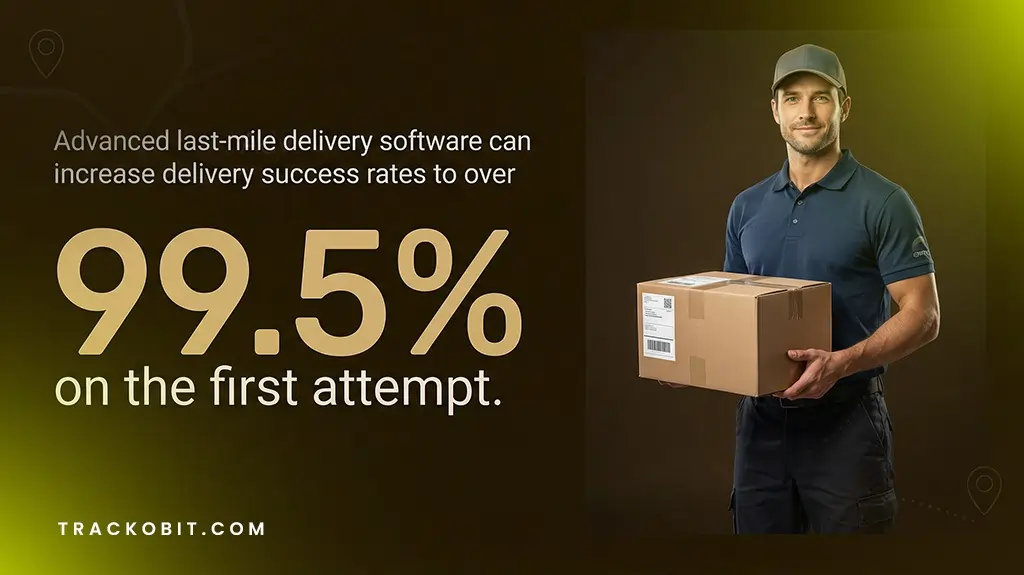
First-Time Success
Managing B2B last-mile delivery at scale requires more than tracking vehicles. Platforms like TrackoMile combine routing, tracking, and delivery proof into one operational workflow.
Here are the core features of b2b last mile delivery services operations must have:
1. Route Optimization Software
Route optimization helps businesses calculate the most efficient route for deliveries. TrackoMile’s route optimization software uses dynamic routing engines built on 50+ parameters. These include delivery windows, vehicle capacity, stop priority, traffic conditions, and SLA commitments.
Many operations see up to a 28% improvement in vehicle capacity utilization. Plus, a 10–15% drop in overall transportation costs.
2. Real-time Tracking
Real-time tracking gives operations the live visibility into vehicles, routes, and delivery progress. It helps teams know what is happening on the road without calling riders.
Platforms like TrackoMile help monitor route deviations, order status, and geofencing alerts. Teams can act immediately on exceptions. This reduces manual check-ins and helps enforce SLA compliance while keeping operations transparent.
3. E-POD Systems
POD is very crucial to ensure accountability in the supply chain. It offers delivery confirmation digitally at the customer’s location. Riders ask for OTPs, take photos, or scan barcodes to prove the order was delivered correctly.
This reduces manual paperwork, prevents billing disputes, and ensures SLA compliance.
4. Delivery Management Software
In B2B logistics, managing orders, routes, and riders manually slows down daily operations. TrackoMile centralizes everything in one place. Automated dispatch assigns the right driver to the right orders instantly. Riders get instructions and updates on the rider app. Proof of delivery and ETAs are recorded digitally,
Deliveries stay on schedule, even as volumes grow.
5. Automated Dispatch
In last mile delivery B2B, assigning orders manually slows operations and increases errors. Platforms like TrackoMile use real-time data on routes and vehicle capacity to assign trips automatically.
This reduces delivery delays by up to 28%. Managers get 99.9% accurate data to act on immediately.
6. Geo-Fencing
Managing delivery zones and client sites can be tricky. Riders accidentally skip stops or enter the wrong area. TrackoMile helps managers set virtual boundaries for vehicles and deliveries. Alerts are triggered if a vehicle enters or leaves a zone unexpectedly.
This helps enforce client-specific rules. Ensures pickups and drop-offs happen in the right locations.
7. Analytics Dashboards
The B2B last-mile logistics team often struggles to see what’s happening across its fleet. TrackoMile’s analytics dashboards consolidate all delivery, driver, and route data in real time. Managers can track performance metrics and monitor fleet utilization.
This reduces fuel costs, improves productivity, and prevents operational issues.
Benefits of Optimized B2B Last-Mile Delivery
Advanced B2B last-mile solutions help businesses in several ways:
- Reduced Operational Costs: Plan routes better and assign trips automatically. Fewer extra trips and less overtime lower your total operating spend.
- Improved SLA Compliance: Offers on-time deliveries to clients. Late drops and penalty costs go down. ETAs become reliable.
- Better Distributor Satisfaction: Accurate deliveries with digital proof reduce complaints and build trust. This brings recurring business.
- Reduced Fuel Usage: Shorter, optimized routes and less idle time save fuel and reduce vehicle wear.
- Improved Transparency: Track riders and deliveries in real time. Managers can spot problems fast and act before costs rise.
- Scalable Growth: Handle more deliveries without adding staff or vehicles. Costs stay predictable even as volumes grow.
Industries That Need B2B Last-Mile Solutions
Businesses across sectors rely on B2B last-mile logistics for accurate, on-time, and cost-effective. Top B2B last-mile delivery companies help industries run operations smoothly and grow faster.
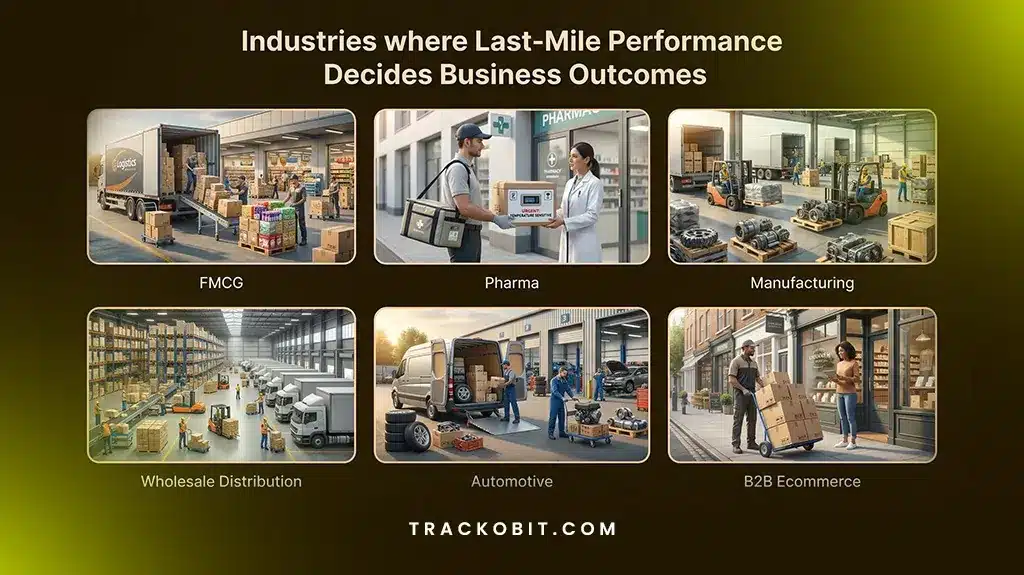
Sectors That Deliver
1. FMCG
Distributors deliver multiple SKUs to hundreds of stores daily. Manual planning causes missed deliveries and wasted fuel.
- Prioritize high-demand stores.
- Optimize routes to cut backtracking.
- Track deliveries in real time.
2. Pharma
Medicines must arrive on time and stay within temperature limits. Delays or spoilage risk compliance.
- Assign shipments to the right vehicles.
- Plan routes for time-critical deliveries.
- Monitor deliveries live.
3. Manufacturing
Factories need raw materials on time. Late shipments halt production and increase costs.
- Schedule deliveries to match production.
- Optimize routes for faster transit.
- Track shipments in real time.
4. Wholesale Distribution
Bulk shipments to multiple warehouses often get delayed or misrouted. Manual planning wastes fuel and driver time.
- Assign the right vehicle for each order.
- Optimize routes to reduce empty runs.
- Track deliveries live to fix delays fast.
5. Automotive
Dealers and service centers need parts delivered in sequence. Wrong or late deliveries stop service and hurt uptime.
- Sequence deliveries for the correct order.
- Plan routes to meet tight schedules.
- Monitor shipments in real time.
6. B2B eCommerce
Bulk business orders are large and varied. Manual handling causes errors, missed ETAs, and customer complaints.
- Consolidate orders and assign the right vehicle.
- Optimize routes for multiple deliveries per trip.
- Track each delivery to catch problems early.
How to Optimize B2B Last-Mile Delivery
Optimizing last mile delivery B2B operations is critical for cost control, on-time deliveries, and customer satisfaction.
Read on to understand how B2B last mile delivery services can be optimized:
- Dynamic route management plan deliveries based on traffic, delivery windows, and vehicle capacity. This cuts fuel costs and improves ETAs.
- Automatically assign orders to the most suitable riders and vehicles, and update trips in real time to account for delays, traffic, or urgent requests.
- Monitor speed, idle time, and route adherence. This helps reduce fuel wastage and prevent delays.
- Capture delivery confirmations digitally using OTPs, photos, or barcode scans. Reduces manual errors and billing disputes.
- Track on-time delivery rates, route efficiency, and driver productivity.
Platforms like TrackoMile combine these features into one solution. From route optimization and automated dispatch to digital POD and analytics. It helps teams effectively manage B2B last-mile delivery, cut costs, and enhance reliability.
Why Choose TrackoMile for B2B Last-Mile Delivery?
TrackoMile brings smart route optimization and real-time fleet visibility into a single platform. This offers instant insights about the delivery, riders, and routes to the manager. So, operations run smoothly and efficiently. Digital proof of delivery ensures every drop is accounted for. Analytics dashboards show performance clearly. Decisions become faster and data-driven.
For last mile delivery B2B, this means predictable deliveries, lower operational costs, and a scalable workflow that grows with your business.
Conclusion
B2B last-mile delivery is the most complex stage of the supply chain. When your fleet grows, keeping track of routes and riders manually just doesn’t work anymore.
Platforms like TrackoMile bring all key capabilities into one solution. It offers smart route optimization, smart dispatch, real-time fleet tracking, digital proof of delivery, and analytics dashboards. This reduces fuel and labor costs. Plus , it ensures accountability and scale operations predictably.

FAQs
-
How is B2B last-mile delivery different from B2C?
B2B last-mile delivery caters to bulk and scheduled orders for businesses. It requires strict SLAs. In case of a delay, it impacts several orders, whereas for B2C, one missed delivery affects just a single customer.
-
How does route optimization improve B2B delivery?
Route optimization plans the fastest, most efficient paths. It reduces fuel use, driver hours, and delays. Ensure on-time and accurate deliveries. Optimized routes lower costs and improve operational efficiency.
-
What is the average cost per delivery in B2B logistics?
Average B2B delivery costs depend on shipment size, distance, and complexity. Last-mile deliveries can make up 41–53% of total logistics spend. Optimized routing and automated dispatch reduce costs per delivery.
-
What is proof of delivery in B2B logistics?
Proof of delivery is a confirmation that the order has reached the customer safely. It is captured digitally through signatures, photos, OTPs, or even barcodes. It provides a sense of responsibility, avoids disputes, and gives quite reliable delivery records.
-
How much does B2B last-mile delivery cost?
The delivery cost depends on distance, order size, and delivery complexity. Fuel, labor, and route efficiency affect total expenses. Technology like TrackoMile can optimize routes, so businesses can reduce costs.

Parul is a content writer with 2+ years of experience in B2B and SaaS domains. She creates clear, actionable content for TrackoBit and TrackoMile, focusing on fleet management, last-mile delivery, and... Read More


Related Blog
Building Resilient Delivery Operations with TrackoMile in 2026 and Beyond
Logistics businesses build resilient delivery networks with TrackoMile. But how exactly? With real-time route optimization, automated scheduling, and end-to-end fleet…
How to Scale Quick Commerce Beyond 10 Minutes with TrackoMile
TrackoMile transforms chaotic last-mile logistics into a predictable, automated, and high-margin retail powerhouse. See how it works in quick commerce.
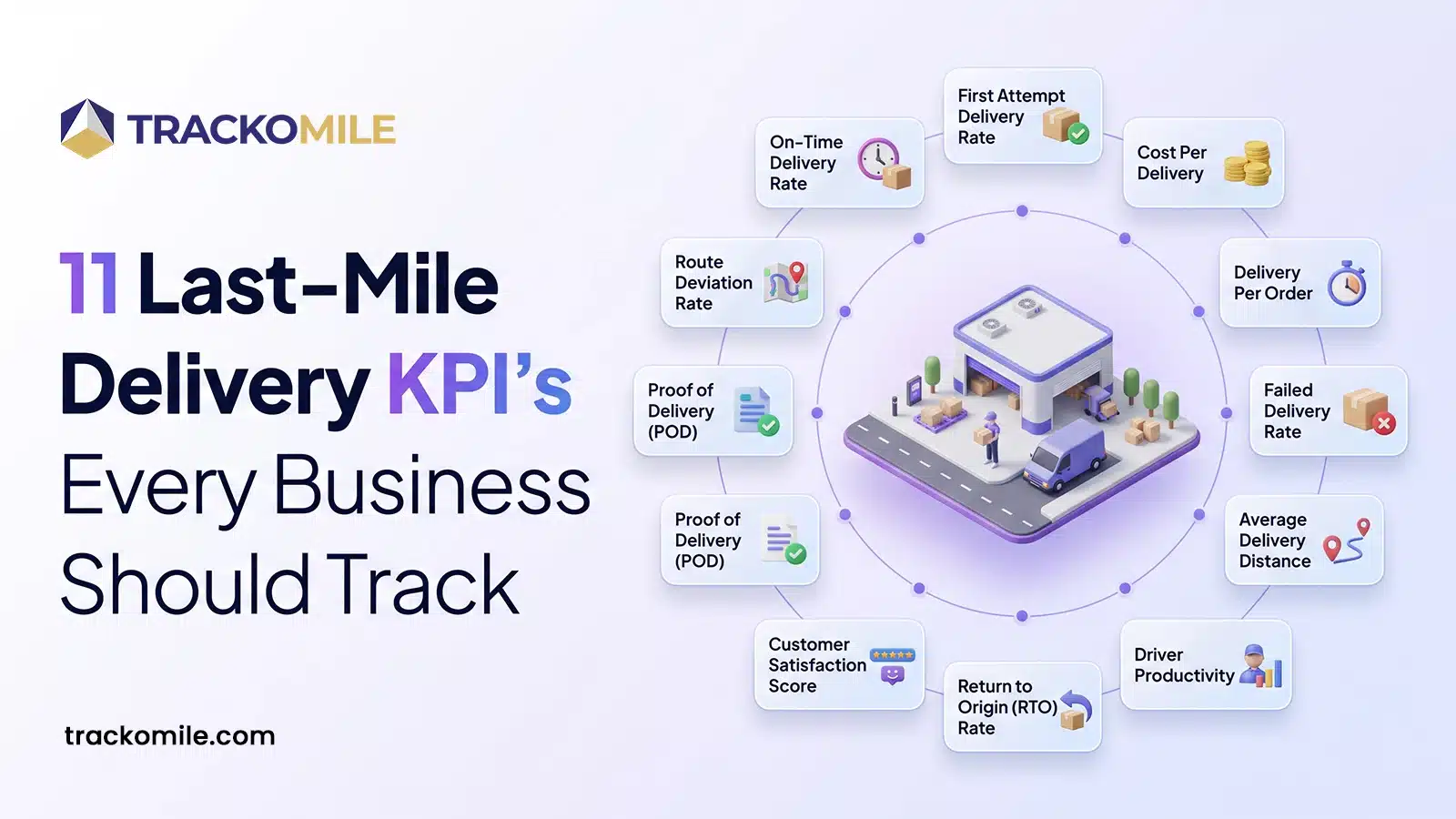
Last Mile Delivery KPIs & Metrics: 11 Essential Metrics to Track
To improve last mile operations, it’s important to track 11 essential last mile delivery KPIs like on-time delivery rate, cost…
Last-Mile Technology: 6 Technologies Transforming Delivery Operations
Learn how last-mile technology combines routing, dispatch, tracking, ePOD, and analytics. Improve your businesses’ delivery speed, visibility, efficiency, and customer…


Your inbox awaits a welcome email. Stay tuned for the latest blog updates & expert insights.
"While you're here, dive into some more reads or grab quick bites from our social platforms!"Stay Updated on tech, telematics and mobility. Don't miss out on the latest in the industry.