
Quick Summary

- Proof of Delivery (POD) confirms successful shipment delivery using digital methods like OTPs and e-signatures, enhancing transparency and reducing disputes.
- Digital POD systems improve operational efficiency by providing real-time tracking, automated workflows, and geo-tagged evidence, which lowers costs and enhances customer trust.
- Implementing POD reduces delivery disputes and fake claims, streamlining billing cycles and ensuring accurate invoicing for logistics operations.
- As logistics evolve, adopting digital POD solutions becomes essential for scalability, accountability, and maintaining high customer satisfaction in last-mile delivery.
In modern logistics, proof of delivery (POD) confirms that a shipment has been delivered using OTP, photos, or e-signatures. This boosts transparency and lowers disputes.
In last-mile logistics, delivery is not complete until it is proven. This is where proof of delivery (POD) comes in. It confirms that the shipment has been successfully delivered. Here, three critical factors are validated – ‘when’, ‘where’, and, to ‘whom’. This is backed by verifiable evidence. For modern logistics, POD is no longer a signed piece of paper. It has evolved into electronic proof of delivery, which is a digital control layer. It strengthens billing cycle, SLA adherence, and most importantly, customer experience. Without it, disputes increase and customer trust is put at risk.
Industry benchmarks show that businesses cut 14% last mile delivery expenses. Also, 28% customer complaints reduce with POD. As they grow, POD solutions can scale to accommodate high delivery volumes. There is rarely an increase in operational workload. The result? Higher accountability, greater transparency, and error-free invoicing.
As delivery networks scale, ePOD is a necessity across logistics and distribution. Keep reading to know why it can no longer be treated as an afterthought.
Why Proof of Delivery Matters in Logistics & Distribution?
A delivery receipt acknowledges handover. But a POD offers a structured digital system that provides evidence. In high-velocity environments, digital PODs are more than a compliance step. It is a risk mitigation layer built into every delivery.
Reduced Delivery Disputes
POD provides time-stamped and location-verified proof. This helps resolve disputes and internal escalations fairly and quickly. For D2C and 3PL operations, this translates into fewer escalations. It also supports lower costs and faster delivery closure.
No Fake or Failed Deliveries
ePOD prevents fake deliveries by replacing manual confirmations. It uses real-time evidence of failed attempts. Digital proof of delivery validates every delivery. This ensures accountability at the rider’s level. The result is tighter control and cleaner operational data.
Faster Billing and Invoicing
POD ensures verified deliverables. This enables quicker invoicing and fewer disputes. The cash flow improves. For 3PLs managing multiple clients, this translates into smoother reconciliations. The revenue cycles thus become predictable.
Improved Customer Trust
POD acts as a key trust factor while eliminating customer frustration. They have real-time access to tracking and delivery information. It builds confidence and lowers anxiety. Long-term brand loyalty is strengthened, especially in quick commerce.
Proof of Delivery (POD) – Traditional Vs Digital
As delivery volumes scale, customer expectations tighten. A POD is the difference between unlocking efficiency and slowing operations down. So, let us see how traditional and digital POD works for D2C, quick commerce, and 3PL enterprises.
| Factors | Paper-Based POD | Digital Proof of Delivery (ePOD) |
| Delivery Confirmation | Physical signatures on paper. | E-signature, photos, and OTPs captured on apps. |
| Data Availability | Delayed manual entries. | Real-time syncs to central dashboards. |
| Risks of Tampering | High ( misplaced documents) |
Low (secure, tamper-proof records) |
| Dispute Resolution | Slow and reactive. | Evidence-backed and fast. |
| Billing and Invoicing | Delayed due to lag in verification. | Instantly, after delivery. |
| Scalability | Difficulty at high volumes. | Built specifically for high-volume operations. |
| Audit Readiness | Manual and time-taking. | Auditable with timestamps and geo-tags. |
| Operational Efficiency | Process-heavy and error-prone. | Automated and streamlined. |
Bottom Line: Paper-based PODs struggle to keep up with modern logistics complexity. Digital PODs are designed for scale and speed. So, it becomes the preferred choice for enterprises focused on accuracy and efficiency.
How Does a Proof of Delivery Software Work?
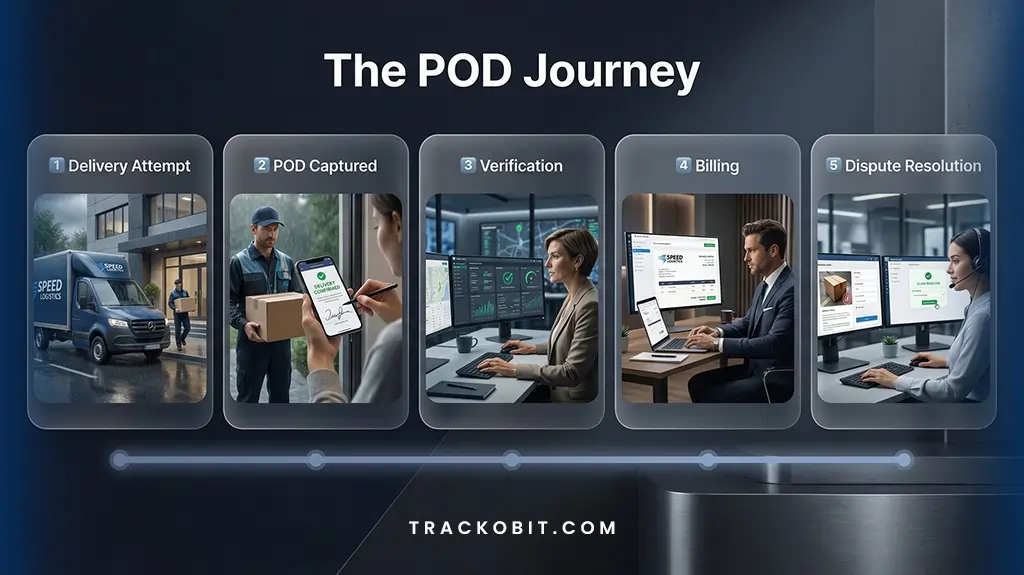
POD follows a structured and system-driven workflow. Every step is designed to eliminate confusion and reduce risks. This creates a verifiable delivery record that finance teams can depend on.
Step 1: Order Dispatched
A dispatched order is digitally tagged with shipment details. This includes:
- Order ID
- Route to be followed
- Driver details
- Expected delivery window
This combination ensures that every delivery is traceable. Right from the moment it leaves the hub or warehouse till it reaches the customer’s doorstep.
Step 2: Driver Reaches Destination
The system validates the stop when drivers reach their destination. This is done using GPS coordinates and timestamps. It confirms that the driver is at the correct spot before confirming the delivery.
Step 3: POD is Captured
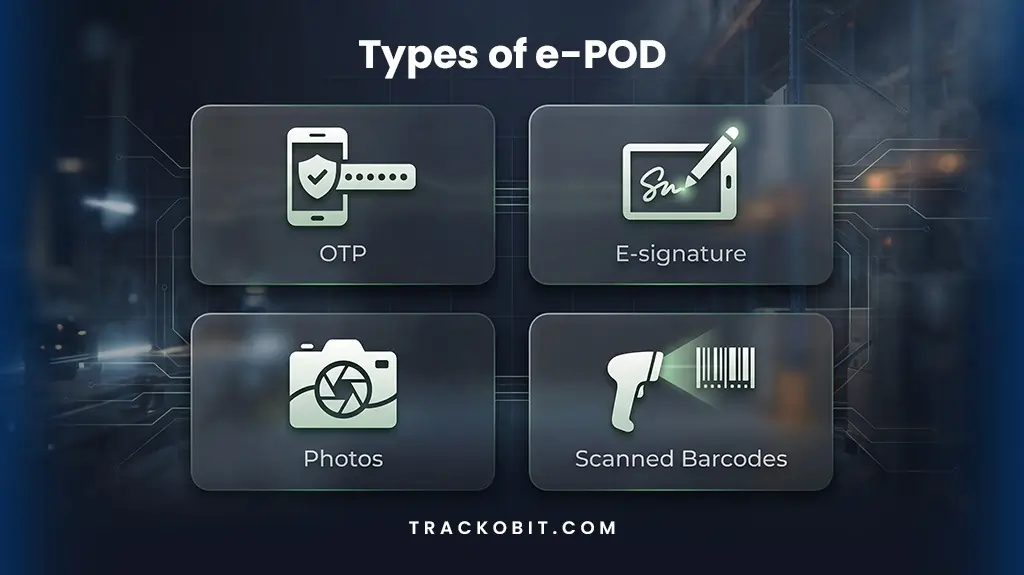
Recipient signature, OTP, or barcode scan is recorded at delivery destination. This creates indisputable evidence that the rider completed delivery as planned.
Types of POD
Step 4: Real-Time Dashboard Sync
This captured evidence is then synced to the central dashboard. Operations team gain real-time visibility into delivery status. Exceptions and completion metrics are also captured. All of this, without dependency on manual follow-ups.
Step 5: Customer and Backend Confirmation
Delivery confirmation is shared with customers and backend systems. This triggers the next step of workflows like billing, SLA validation, and analytics. The delivery loop is then closed with 100% accountability.
By standardizing how deliveries are confirmed, POD in logistics transforms last-mile execution. It becomes a measurable, auditable, and scalable process.
What are the 5 Key Components of a Modern POD System?
A modern proof of delivery software goes beyond basic confirmation. It combines multiple data points to build a complete and verifiable delivery record. Below are the key components of a POD that are built for scale and accountability.
1. Digital Signatures
Captures recipient’s acknowledgement electronically. It eliminates paper-based errors and helps with instant confirmation of a successful delivery.
2. Geo-Tagged Location
Automatically records precise delivery coordinates. This ensures that consignments are delivered to the right location. It reduces any location-related disputes.
3. Timestamped Proof
Records the exact date and time of delivery. It helps logistics teams validate SLA adherence. They can also track delivery performance accurately.
4. Photos/Videos of Delivered Goods
Visual evidence of the delivered products adds a layer of verification. This protects businesses from false claims and delivery disputes.
5. Cloud-Based Storage
Stores all delivery records securely in one unified system. It allows easy access and quicker audits. There is a seamless integration with billing too.
What are the Challenges Without a Proof of Delivery System?
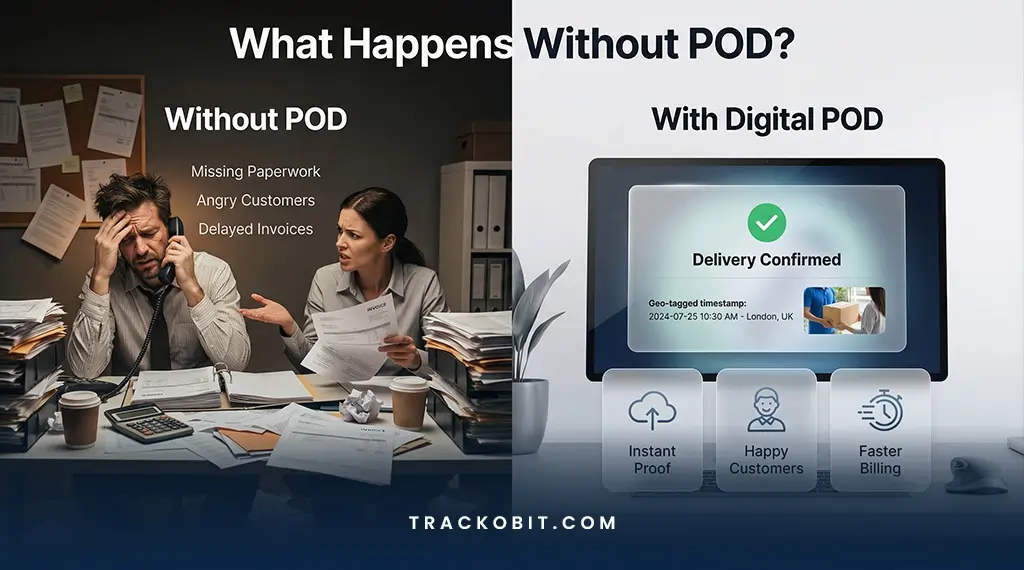
Without a structured Proof of Delivery (POD), logistics operations are exposed to gaps. When not addressed, these impact revenue and trust.
What Happens Without POD?
1. Delivery Disputes
Business struggles to resolve disputes when there is no verifiable delivery proof. They tend to absorb setbacks like losing customers and profit loss. Stakeholder confidence can also be impacted in the process.
2. Fake Delivery Claims
In the absence of authentic delivery evidence, false confirmations might go unchecked. This can cause gaps in revenue and accountability.
3. Delayed Billing Cycle
When delivery confirmation is delayed or disputed, invoicing is affected. This directly impacts cash flow while extending the billing cycle.
4. Manual Errors
Paper-based POD are prone to human errors. Documents could be misplaced, and records might be inconsistent. As a result, audits become slow and unreliable.
5. Lack of Delivery Visibility
Teams lack visibility into last-mile execution without real-time or recorded data. This makes it tough to identify failures. Performance, ultimately, starts dropping.
The POD Journey
How Digital Proof of Delivery Solves These Challenges?
Digital proof of delivery replaces manual confirmation methods with verified, app-driven evidence. It helps close gaps that slow down last-mile operations. There are fewer chance of risks as well. Read in detail.
1. Geo-Tagged Evidence
Geo-tagged delivery proof captures the exact delivery location. This helps businesses validate deliveries with confidence. Risks of disputes or broken delivery processes are also reduced. It ensures accountability and protects against false claims.
2. Instant POD Confirmation
Real-time POD capture helps with immediate delivery confirmation. It accelerates invoicing while shortening the bill cycles. This improves overall cash flow.
3. Automated Workflows
Automated POD workflows eliminate paper-based processes. This reduces the risks of costly human errors. Delivery data is captured, validated, and stored consistently across all last-mile operations.
4. Real-Time Delivery Tracking
Live tracking provides end-to-end visibility into all last-mile executions. Managers can monitor delivery status and identify exceptions early. Overall, this improves operational performance. There is a positive impact on brand reputation and profits.
5 Proof of Delivery (POD) Industry Use Cases
POD is important in industries where last-mile directly impacts revenue and compliance. While the core objective remains intact, the way POD is applied varies. It depends on operational dynamics and industry-specific risks.
1. Logistics and Courier Companies
For Last Mile logistics providers, POD ensures that every shipment is delivered. This is done at the right place and time. Digital PODs help:
- Resolve disputes faster
- Meet SLA commitments
- Maintain audit-ready records
2. E-Commerce and Retail
In high-volume e-commerce landscape, PODs validate doorstep deliveries. This reduces returns linked to failed deliveries. Real-time confirmation with OTP improves customer communication. It ultimately speeds up post-delivery billing.
3. FMCG Distribution
FMCG distribution relies on frequent deliveries to retailers and distributors. POD provides visibility into every delivery completion. This helps reconcile invoices accurately, which prevents revenue leakages across large distribution networks.
4. Pharma & Healthcare
POD is critical for compliance and traceability in this sector. Timestamped and geo-verified records ensure sensitive products are received by authorized people only. This way, companies are able to maintain regulatory accountability.
5. Field Sales and Service Teams
POD confirms task completion at customer location. This helps managers verify visits and track performance. They can maintain reliable service records without repeated manual follow-ups.
Proof of Delivery Software: A Buyer’s Checklist
Choosing the right POD software is non-negotiable for logistics and distribution teams. Beyond basics, the right solution must strengthen operational control. It should also scale with growing volumes and integrate smoothly with existing systems.
1. Mobile POD App
A robust mobile POD app helps drivers capture delivery proof during handover. So, look for software that is fast and intuitive. This makes it ideal for on-ground usage to increase adoption by the field teams.
2. Offline POD Capture
Offline capability is critical for deliveries in low or no-network zones. The software must allow uninterrupted POD capture. The data must sync automatically to the dashboard once connectivity is restored.
3. Real-Time Sync
Real-time data sync ensures delivery information is instantly available to teams. Customer support teams must also receive all data updates on time. This reduces the risks of delays and improves visibility.
4. ERP/TMS Integrations
Seamless integrations with ERP or TMS integrations are critical. This makes sure delivery data flows directly into billing and reporting. Altogether, eliminating manual data transfers and inconsistencies becomes easy.
5. Custom POD Formats
POD formats vary by industry. So, choose last-mile delivery software that supports customizable formats. This means e-signatures, OTP, barcode scans, and images. All, without complex configurations for easy handling.
The Future of Proof of Delivery
Proof of delivery has emerged as a core component of last-mile delivery control. With the adoption of AI, POD systems are validating deliveries using location data. Timestamps and visual proof are other important elements. Features like video-based POD and automated compliance reporting will help businesses reduce disputes. Audits are simplified, and delivery standards are consistent.
Looking ahead, POD software will enable strong predictive insights. This would be made possible with delivery data to spot risks and inefficiencies. As logistics scale, POD will play a major role in visibility and accountability. It will soon become the differentiator between successful operations and a failed one.
FAQs
-
What industries typically use POD?
Proof of Delivery is used across industries that depend on physical goods movement. Common sectors are e-commerce, retail distribution, and pharmaceuticals. Others are FMCG, logistics & transportation, food delivery, and manufacturing. It is also critical in healthcare and B2B supply chains.
-
What types of Proof of Delivery are supported?
Modern ePOD systems support multiple formats to suit different delivery needs. These include digital signatures, OTP verification, and photo capture. Others are barcode scanning, GPS-stamped confirmations, and electronic documents (ePOD).
-
Is Proof of Delivery suitable for last-mile delivery operations?
Absolutely! Proof of Delivery is valuable in last-mile delivery operations where customer interaction occurs. Since last-mile deliveries are prone to disputes and delays, POD ensures documented confirmation.
-
How does POD improve delivery transparency?
POD provides real-time visibility into delivery completion status with time and location proof. It allows businesses to instantly verify successful deliveries without relying on manual follow-ups. Customers can receive confirmation notifications, increasing trust and satisfaction.

Shemanti is a Content Marketing professional with 7+ years of experience in shaping credible narratives across B2B products. As the Content Team Lead for TrackoBit, TrackoField, and TrackoMile, she br... Read More


Related Blog
Last Mile Delivery in Construction: Challenges, Solutions & Optimization Strategies
This guide explains how last mile delivery construction software can help improve efficiency, visibility and site coordination.
Last Mile Delivery for Grocery and Food Industry
This blog talks about last mile delivery for grocery & food industry. We will look at how advanced software improves…
Pros and Cons of Last Mile Delivery: A Guide for 2026
This blog explores the pros and cons of last mile delivery. It also looks at how businesses can overcome common…
Customer Intelligence & Verified Dispatch: Now Live in TrackoMile
Strengthen last-mile visibility and reliability with TrackoMile’s latest release. See delivery performance as it happens, adjust dispatch plans mid-trip, and…


Your inbox awaits a welcome email. Stay tuned for the latest blog updates & expert insights.
"While you're here, dive into some more reads or grab quick bites from our social platforms!"Stay Updated on tech, telematics and mobility. Don't miss out on the latest in the industry.