
Quick Summary

- A Loan Origination System (LOS) digitizes the entire loan application process, improving efficiency and reducing errors.
- It automates tasks like document verification and risk assessment, enabling faster loan approvals and better compliance.
- Financial institutions benefit from an LOS through lower operational costs, enhanced customer experience, and improved data accuracy.
- Choosing the right LOS involves considering ease of use, integration capabilities, automation, scalability, and security features.
From application to approval, a loan origination system simplifies lending, reduces risk and boosts customer experience.
Every loan follows a lifecycle. It moves from sourcing to underwriting. This is then followed by disbursement and recovery. Lenders select potential borrowers, conduct risk assessment, check financial history, collect documents and approve the application.
In the case of NBFC and MFIs, field agents carry out background checks, asset image verification, and document collection. Credit and risk teams then review the data and approve the loan. Only then do the borrowers receive the money.
This entire journey from application to approval is called loan origination.
Traditionally, this process relied heavily on paperwork, manual verification and multiple back-and-forth interactions between borrowers, credit teams and field agents. It was a slow and error-prone process.
This is where a loan origination system (LOS) becomes necessary. It digitalises the entire loan application journey. It helps lenders process applications faster, reduce errors and improve decision-making.
What Is a Loan Origination System?
A Loan Origination System (LOS) is a digital tool that helps lenders manage the entire lifecycle of a loan application.
It digitises the process of receiving, verifying and approving loan applications. Instead of using multiple spreadsheets, emails and paperwork, everything is handled digitally.
A typical LOS manages tasks like:
- Loan application intake
- Borrower information collection
- Document verification
- Credit checks
- Risk assessment
The system acts as a central hub where loan agents, credit teams and managers collaborate to process applications. The global LMS market is set to double in valuation by 2032.
By automating repetitive tasks and maintaining organised records, an LOS reduces processing time and improves accuracy.
Why Financial Institutions Need a Loan Origination System?
LOS ensures faster approvals, minimal paperwork and better risk assessment. It helps meet the rising loan demand across banks, NBFCs and microfinance institutions.
Without a structured system, managing loan applications can become chaotic. Here are the main reasons financial institutions rely on loan origination systems.
1. Faster Loan Processing
Manual processes slow down loan approvals and increase delays. A loan origination system automates data entry, borrower verification and field agents‘ tasks. It helps lenders process applications faster and reduce turnaround time.
2. Better Risk Assessment
An LOS can integrate with credit agencies to assess borrower risk more accurately. This helps lenders evaluate creditworthiness quickly and make more informed lending decisions.
3. Improved Compliance
Financial institutions must follow strict regulatory guidelines. An LOS maintains proper documentation, digital records and audit trails. This helps lenders meet compliance requirements.
4. Efficient Operations
Instead of using multiple tools, loan agents can manage the entire loan process from one platform. This improves coordination between teams and reduces time spent on manual tracking and reporting.
5. Scalability
As loan volumes grow, an LOS allows lenders to handle more applications without increasing staff workload. This enables lenders to scale operations smoothly without requiring system changes.
Loan Origination Process (Step-by-Step Workflow)
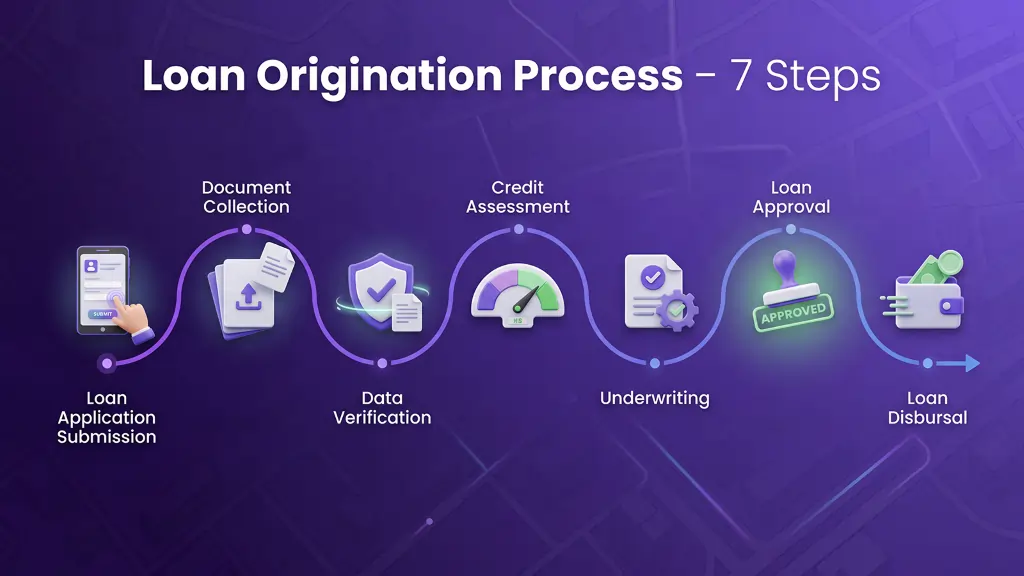
Steps in Loan Origination Process
The loan origination process is fairly straightforward. An LOS ensures each step is properly tracked and documented. The steps in loan origination include:
1. Loan Application Submission
The borrower submits a loan application through a branch, field agent or online portal. The LOS captures key details such as personal information, loan amount and purpose. This initiates the loan origination process.
2. Document Collection
Supporting documents such as identity proof, income details and address verification are uploaded. Field agents may gather these documents during visits. All records are safely stored within the system.
3. Data Verification
The lender verifies borrower information through credit bureaus, KYC systems and internal databases. This step confirms identity and financial information before moving the application forward.
4. Credit Assessment
The system evaluates the borrower’s repayment capacity based on income, assets and credit history. This helps lenders determine the level of risk involved in approving the loan.
5. Underwriting
Loan officers review the application and assess borrower risk in detail. Based on predefined policies, the loan may be approved, rejected or sent for additional review.
6. Loan Approval
Once approved, the final loan terms are determined. This includes interest rate, loan tenure and the repayment schedule.
7. Loan Disbursal
After completing final documentation and approvals, the loan amount is disbursed to the borrower. The loan then moves into the repayment stage.
5 Key Features of a Modern Loan Origination System
Main features of a modern LOS include automated workflows, digital application, and document management. Here are 5 key features to look for in an LOS.
1. Digital Loan Applications
Borrowers can submit loan applications online through web portals or mobile apps. This reduces paperwork and manual data entry. It also speeds up the application process and makes loan requests easier for borrowers.
2. Automated Workflows
Tasks such as document verification, eligibility checks and approvals are automated. This reduces manual work and ensures every application follows a structured approval process.
3. Credit Bureau Integration
The system connects with credit bureaus to fetch borrower credit scores instantly. This allows lenders to conduct risk assessment easily and make faster loan decisions.
4. Document Management
All borrower documents are stored digitally in a central system. This makes it easier for teams to access, review and verify records during the loan process. No paperwork dependency.
5. Analytics and Reporting
Managers can track application volumes, approval rates and processing timelines through dashboards. These insights help lenders to:
- Identify gaps
- Track staff performance
- Improve the efficacy of loan origination steps
5 Main Benefits of Using a Loan Origination System
Faster approvals, lower operating costs and improved customer experience are some of the key benefits of an LOS. Here are all the benefits businesses can experience by using an LOS.
1. Faster Approvals
Automation reduces manual processing time and speeds up loan decisions. Tasks such as document verification, eligibility checks and approvals get done faster. It helps lenders process more applications in less time.
2. Lower Operational Costs
Less paperwork and fewer manual processes reduce administrative expenses. Teams spend less time managing documents and wasting time on repetitive tasks. Thus, organisations can operate more efficiently while handling larger loan volumes.
3. Better Customer Experience
Borrowers receive clear communication during the loan process. Faster approvals and smoother application process further improves borrower satisfaction. Overtime, lenders build stronger long-term relationships with customers.
4. Improved Data Accuracy
Automated data capture reduces the chances of human errors. Borrower information, documents and application details are logged digitally with precise timestamps and geotags. This helps maintain an accurate digital trail of field activities.
5. Enhanced Transparency
Managers gain full visibility into each stage of the loan lifecycle. Centralised dashboards make it easier to track application progress. So, managers can easily monitor performance and identify delays in the loan approval process.
Challenges in Traditional Loan Origination
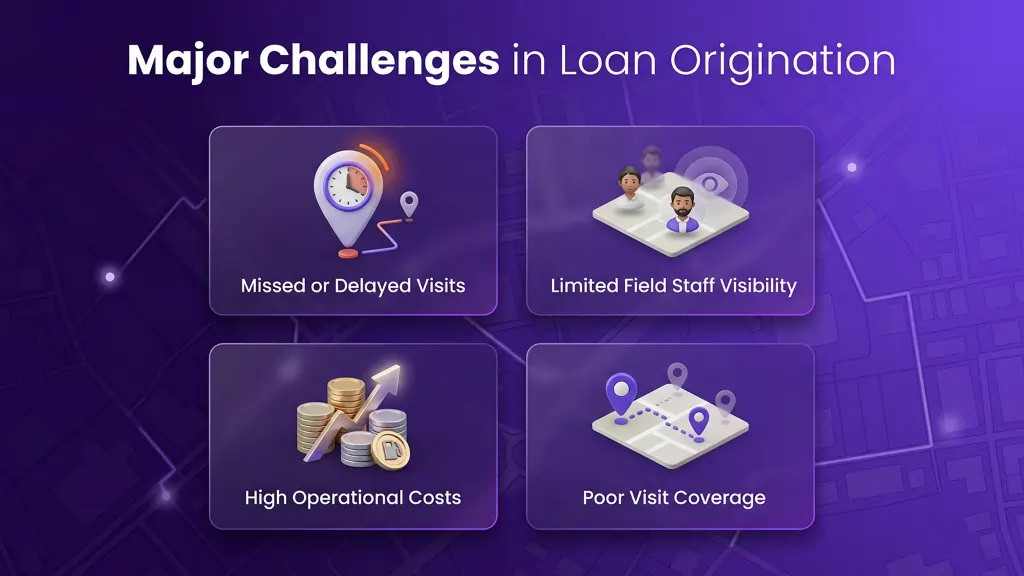
Slow turnaround time, delayed visits and limited visibility are some of the major challenges in loan origination. Most challenges in loan origination arise due to field inefficiencies and the use of traditional processes.
1. Missed or Delayed Visits
Field agents often miss scheduled borrower visits or reach locations late. Poor scheduling and lack of route planning often lead to these delays. This affects customer service, slows collections and reduces overall operational efficiency.
2. Limited Visibility
Managers don’t have visibility into the exact status of employees and loan. This makes tracking performance difficult. The result is poor decision making and lack of control over the lending process.
3. Manual Status Reporting
Agents often report visit updates through calls, messages or spreadsheets. This manual reporting process causes delays and incomplete updates. Managers may not receive real-time information about borrower interactions or field activities.
4. Poor Verifications
In the absence of proper monitoring, verifications may be rushed. Important borrower details may end up being skipped or recorded incorrectly. This increases the risk of errors and weakens verification quality.
Major Challenges in Loan Origination
5. Slow Turnaround Time
Manual verification and document handling delay loan approvals. Applications often move slowly between teams for checks and approvals. This increases processing time and can frustrate borrowers waiting for quick loan decisions.
6. High Operational Costs
Paper-based workflows require more manpower and administrative effort. Teams spend time managing documents, verifying information and updating records manually. This increases operational costs and reduces overall efficiency.
7. Poor Visit Coverage
Agents may not be able to cover all assigned borrowers within a given time. This can happen due to large territories, lack of manpower and poor task planning. It leads to missed or delayed visits, no follow-ups and late verifications.
8. Risk of Errors
Manual data entry increases the chances of mistakes. Incorrect borrower details, missing documents or calculation errors can delay approvals. Such errors also create compliance risks and require additional time to correct.
9. High Agent Idle Time
Without proper task allocation and beat planning, field agents may spend a long time waiting between visits. Idle time reduces daily productivity and limits the number of borrowers that agents can meet.
10. Compliance Gaps in Center Meetings
Center meetings require proper attendance records and activity documentation. Without digital tracking, it becomes difficult to confirm whether meetings actually took place. This creates compliance risks for lenders.
These issues reduce efficiency and affect customer satisfaction.
How Does Field Force Automation Improve Loan Origination?
Loan origination is not entirely digital. Many important activities still happen in the field. These include:
- Borrower address verification
- Document collection
- Asset inspection
- Customer onboarding
Field Force Automation Software helps lenders manage these activities more efficiently.
1. Real-Time GPS Tracking
Managers can monitor the live location of field agents during working hours. This ensures assigned visits are completed as planned. It also helps managers identify delays, optimise routes and improve collection coverage.
2. Geoverified Visits
Borrower visits are recorded with location coordinates and timestamps. This confirms that agents actually visited the assigned location. Geoverified records also create a reliable audit trail for compliance and performance monitoring.
3. Digital Document Capture
Agents can upload borrower documents, photos and voice notes directly from the field. This removes the need for paperwork and manual submissions. It also ensures documents are instantly available to managers.
4. Faster Reporting
Field updates are submitted instantly through the mobile app. No more waiting for EOD reports. Managers receive real-time information about visits, borrower interactions and payment updates.
When integrated with an LMS, FFA ensures that both office and field teams work in sync.
How to Choose the Right Loan Origination System?
To choose the right LOS, you need to look for ease of use, integration capabilities, automation, and scalability while choosing an LOS.
1. Ease of Use
The platform should be low-code and easy-to-use for both agents and borrowers. A simple interface reduces training time and errors. It also helps speed up loan applications and improves the overall borrowing experience.
2. Third-Party Integration
The system should integrate with credit bureaus, FFA and LMS. Integrations ensure agents don’t have to juggle multiple systems. Borrower data can sync smoothly across systems.
3. Automation Capabilities
Loan origination includes a lot of repetitive processes like:
- Eligibility checks
- Document verification
- Route planning
By automating these processes, lenders can save a lot of time. They can also reduce manual efforts, speed up loan processing and handle more applications.
4. Scalability
Ensure that your LOS doesn’t give up if your company grows rapidly. It should be able to handle increasing loan volumes and users without slowing down.
5. Security and Compliance
Loan origination systems have to handle sensitive borrower data. Ensure the platform has strong security features like data encryption, access control and cloud storage.
6. Reporting and Analytics
The system should provide managers with smart dashboards and quick reports. These insights help track loan application progress, approval rates and operational performance. Thus, lenders can easily identify bottlenecks and resolve them quickly.
Conclusion
Loan origination is the backbone of lending operations. Without an organised process, loan approvals become slow, inaccurate and difficult to manage. A loan origination system solves this problem by automating workflows, improving data collection and providing complete visibility into the lending process.
However, most lending operations still happen in the field. Combining LOS with field force management tools like TrackoField can further improve your workflow. When combined, these systems help lenders process loans faster, reduce operational costs and lend to credible borrowers. To get a glimpse of TrackoField in action, book a free trial today.

Frequently Asked Questions
-
What is the difference between LOS and LMS?
A Loan Origination System (LOS) manages the loan process before disbursal. It handles applications, verification, credit checks and approvals. A loan management system (LMS) manages the loan after disbursal. It tracks repayments, interest, collections and loan status.
-
How long does loan origination take?
Loan origination can take a few hours to several days. The timeline depends on the lender, borrower needs, loan type and the verification process. Digital systems can reduce approval time significantly.
-
Can an LOS support multiple loan products?
Yes. A modern LOS supports multiple loan types. These can range from personal loans, business loans and vehicle loans to home loans. Lenders can configure workflows for different products.
-
Who uses loan origination systems?
Several industries use LOS. The major ones are banks, NBFCs, credit unions, microfinance institutions and digital lenders. LOS helps these organisations process loan applications faster and manage borrower verification.
-
What features should banks look for in loan origination software?
Banks should look for the following features while picking an LOS. Digital applications. Automated workflows. Credit bureau integration. Document management. Smart risk assessment. Reporting dashboards.

Mudit is a seasoned content specialist working for TrackoField. He is an expert in crafting technical, high-impact content for Field force manage... Read More


Related Blog
Field Operations Manager: Roles, Challenges & How to Optimize Performance
Field operations managers handle on-ground activities with challenges like visibility, control, and coordination. This blog covers their roles, key challenges,…

What is Face Recognition Attendance Software & How Does It Work?
This blog explains the concept of face recognition attendance software. We will also explore how it enhances attendance monitoring for…
How TrackoField Stops GPS Spoofing and Buddy Punching in Field Teams
Your field team’s attendance data looks clean. The question worth asking is whether it’s real. Here’s how GPS spoofing actually…

Field Worker Challenges in 2026: Problems, Impact & Smart Solutions
This blog explores the major field worker challenges in 2026. Also, learn how businesses can solve these with better control…


Your inbox awaits a welcome email. Stay tuned for the latest blog updates & expert insights.
"While you're here, dive into some more reads or grab quick bites from our social platforms!"Stay Updated on tech, telematics and mobility. Don't miss out on the latest in the industry.