

Quick Summary

- Grameen Credit Score (GCS) is a behavior-focused credit scoring system for rural lending, assessing borrower actions post-disbursement.
- Traditional credit assessments often fail in rural areas due to fluctuating economies and evolving group dynamics, leading to delayed risk identification.
- GCS transforms rural lending from static eligibility checks to continuous monitoring, improving credit assessment accuracy and borrower insights.
- Investing in reliable field processes enhances MFI and NBFC confidence, reducing risk and promoting sustainable growth in rural lending portfolios.
Rural lending doesn’t usually go wrong at approval.
It drifts when what’s happening on the ground stops being visible.
Rural lending in India did not change in a single moment.
It changed through accumulation.
Disbursement cycles became faster. Branch networks expanded. MFI and NBFC portfolios scaled across districts and states. But the way institutions continuously understand borrower behaviour at the center level did not evolve at the same pace.
Most MFIs and NBFCs still assess borrower risk primarily at approval, using documents, bureau scores, and manual field verification. After disbursement, visibility depends on center meetings, field reporting, and periodic audits. These processes are necessary, but they are supervision mechanisms. They are not systems designed to continuously observe risk.
At smaller scale, this approach worked.
At today’s centre-heavy portfolio sizes, it does not.
What Grameen Credit Score Is
Grameen Credit Score, or GCS, is a behaviour-led credit scoring framework designed specifically for rural and group-based lending models.
It does not score borrowers only on documents or one-time eligibility.
It reflects how borrowers and groups actually behave after disbursement.
The score draws from signals such as:
- Repayment consistency
- Centre meeting attendance
- Group discipline within JLGs
- Verified field-level borrower interactions
In simple terms, GCS answers a question existing credit scores do not:
How reliably is this borrower or group behaving on the ground, over time?
Why Existing Credit Assessment Falls Short in Rural India
In MFI-led lending, risk rarely originates at approval.
It builds during execution.
Borrowers operate in informal and seasonal economies. Cash flows fluctuate. Group dynamics evolve. Field realities change faster than reports capture them.
To manage this, institutions rely heavily on center meetings and field reporting. These processes are critical, but as center volumes grow, they introduce subjectivity, delay, and fragmentation.
By the time stress appears in portfolio numbers, the behavioural patterns behind it have often been present for months.
GCS exists to reduce this time lag.
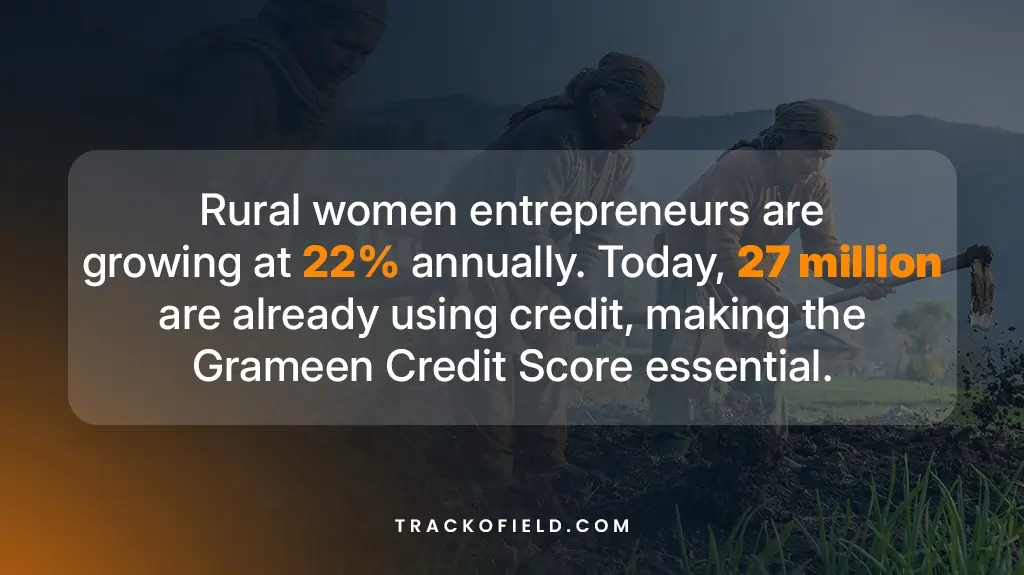
Rural Women Entrepreneur Stats
The Shift from Static to Observable Lending
Existing credit assessment establishes eligibility.
GCS extends assessment into execution.
It shifts rural lending from being assumption-led to being continuously observed.
This does not replace human judgement.
It makes judgement measurable and defensible.
Credit assessment becomes an ongoing process, not a one-time event.
Field Execution Becomes a Credit Input
In MFIs, field execution is often treated as an operational responsibility.
In practice, it is a credit driver.
Attendance authenticity at centers, visit integrity, and genuine borrower interaction directly influence repayment behaviour and portfolio stability.
When center execution is consistent, credit confidence improves.
When execution weakens, risk accumulates silently.
GCS formalises this relationship by linking field reality to credit understanding.

Leadership Thought
What This Changes for MFIs and NBFCs
Credit, risk, and operations can no longer function in isolation.
In MFI-led portfolios, portfolio quality increasingly reflects center-level discipline and field visibility, not just underwriting logic.
Institutions that invest in clean field processes and reliable center data lend with greater confidence, lower volatility, and faster decision cycles.
Over time, this will separate MFIs and NBFCs that scale with control from those that scale with hidden risk.
Closing
Rural lending will always be built on trust.
What is changing is how that trust is verified.
Grameen Credit Score reflects a move toward rural lending that is continuously observed, behaviour-led, and grounded in field reality.
The next phase of MFI-led rural lending will favour institutions that see clearly, not just those that move quickly.


Pulkit Jain is the Director and Co-Founder of InsightGeeks Solutions, where he leads the vision and product strategy behind SaaS platforms for fleet management, field force optimization, and last-mile... Read More



Related Blog

Face Recognition: What It Is, How It Works & Benefits for Field Teams
Facial recognition is a way of identifying or confirming an individual’s identity using their facial features. Read this guide to…

Field Operations Manager: Roles, Challenges & How to Optimize Performance
Field operations managers handle on-ground activities with challenges like visibility, control, and coordination. This blog covers their roles, key challenges,…

What is Face Recognition Attendance Software & How Does It Work?
This blog explains the concept of face recognition attendance software. We will also explore how it enhances attendance monitoring for…

How TrackoField Stops GPS Spoofing and Buddy Punching in Field Teams
Your field team’s attendance data looks clean. The question worth asking is whether it’s real. Here’s how GPS spoofing actually…


Your inbox awaits a welcome email. Stay tuned for the latest blog updates & expert insights.
"While you're here, dive into some more reads or grab quick bites from our social platforms!"Stay Updated on tech, telematics and mobility. Don't miss out on the latest in the industry.