
Quick Summary

- The Grameen Credit Score (GCS) is a new framework aimed at enhancing financial inclusion for rural borrowers in India, particularly targeting underserved groups like SHGs and JLGs.
- GCS incorporates various data sources, including cash transactions and repayment patterns, to provide a more accurate credit assessment compared to traditional models like CIBIL.
- This scoring system addresses the unique challenges faced by rural borrowers, such as lack of collateral and informal income verification, enabling easier access to credit.
- By adopting GCS, NBFCs and MFIs can improve risk assessment, offer fair interest rates, and ultimately contribute to poverty alleviation in rural communities.
Empower the underserved Joint Liability Groups (JLG), Self-Help Groups (SHG), and residents of rural India with better credit assessment and financial inclusion.
Hon’ble Finance Minister Nirmala Sitharaman announced the Grameen Credit Score (GCS) in the Union Budget 2025-26. It is a powerful credit scoring framework to promote financial inclusion and formalize lending transactions within India’s rural credit market. This is a transformative step since it provides a formal rural centric credit scoring system. It aims to accelerate grassroot level financial inclusion.
The Grameen Credit Score is also a step closer towards understanding the financial patterns of rural India. It means the score will reflect the following:
- Mixed credit products like crop loans and asset loans.
- Migration trends between the rural and urban areas
- Repayment patterns on micro-loans.
This is in line with RBI’s initiative to strengthen rural credit access. As founders, CXOs, and growth leaders in financial services, embracing this shift isn’t optional. It is a strategic imperative for market leaders in rural lending.
What is a Grameen Credit Score?
Grameen Credit Scoring is a segmented credit scoring model. It is being developed by PSBs in collaboration with credit bureaus like TransUnion, CIBIL and Experian. Grameen Credit Score will work alongside traditional bureau scores like CRIF Highmark and CIBIL. It will particularly focus on credit assessment of SHG/JLG groups and MSME women entrepreneurs.
Farmers and marginalized communities will also be factored in. The primary goal of this initiative is to address the challenges faced by the underserved in applying for and receiving the required credit in a formal manner.
Having a Grameen score in place will provide a clear picture of the borrower’s ability to repay. This helps with faster lending decisions and accurate risk analysis. NBFCs and MFIs can track the records of the SHG/JLG credit history. This will be maintained at the village level by group members and verified by block-level officials.
“The Grameen Credit Score will include cash transactions”.
Apart from that, it will factor in UPI transactions, utility bill payments, and benefits from government welfare schemes like Ladli Behna, Ladki Bahin Yojana, and others.
Why Grameen Credit Score for Rural India?
More than 160 million Indians are credit-underserved due to no traditional financial history. A major chunk of this is in the rural areas where potential borrowers are ‘credit invisible’. They cannot access formal loans due to improper documents and lack of collateral. This is where traditional credit scoring fails. It generally considers the 5Cs – character, capacity, capital, collateral, and conditions. From a credit perspective, people in rural regions are unable to fulfill these hence they rely on non-bank options.
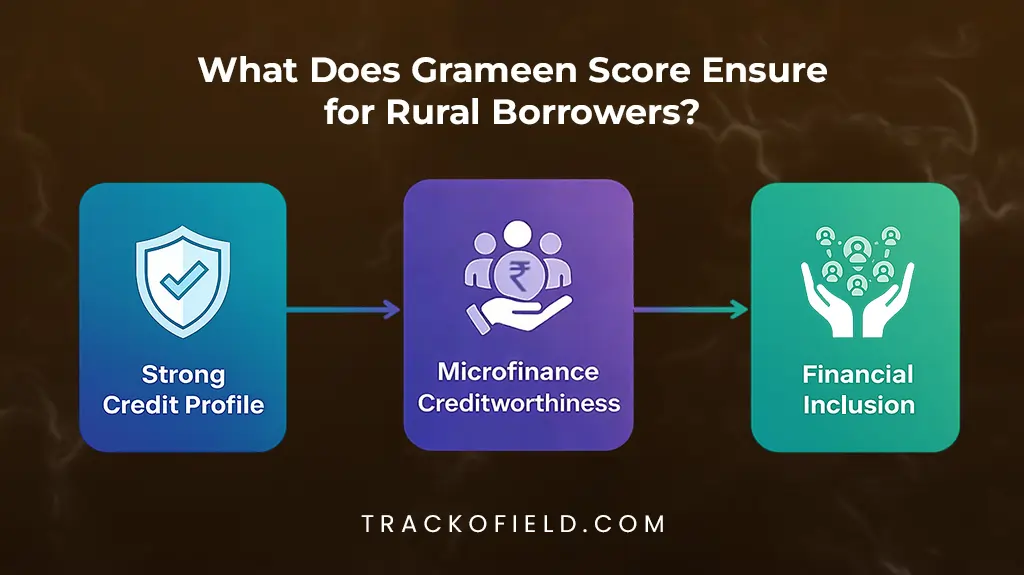
Grameen Credit Score – Benefits
Let’s decode the key reasons why existing credit scoring systems like CIBIL is not suitable for rural India.
1. Informal Income and Assets Verification
Existing credit models, unfortunately, do not assess rural assets like farm field size, livestock, and agricultural equipment. Urban-centric financial institutions do not cater to unique financial dynamics like irregular seasonal incomes tied to weather conditions as well. Agricultural cycles are also not considered under the standardized income model.
2. High Risk Factors
Banks often consider rural borrowers as ‘high-risk’. This is simply due to the following:
- Lack of collateral like a property, vehicles, or investments (bonds or stocks)
- Inconsistent revenue or inconsistent cash flow
- Low literacy levels and limited exposure to formal banking
- No formal documents like income statements and identity proof
- Geographical constraints, poor transport, and internet connectivity in rural areas.
So, it becomes tough for farmers, women entrepreneurs, and small businesses owners in rural India to acquire the necessary finance for themselves.
3. Cash-Based Behavior
A significant portion of the rural economy is predominantly cash-driven. This has little or no trail. Since existing credit scoring depends on documented financial records, assessing creditworthiness gets tough.
4. Thin Credit Files
In rural India, borrowers hardly take a formal loan. They have access to credit through local money lenders, SHG, and JLGs. While they might show strong repayment discipline, transactions are not reported to credit bureaus. Such insufficient data is not enough to generate a traditional score resulting in a thin or non-existent credit file.
What are the Key Benefits of Grameen Credit Score?
The introduction of the Grameen Credit Score is all set to unlock a meaningful shift in how rural borrowers are assessed and financed.
1. Better Credit Assessment
Grameen credit score offers a digital framework for evaluating creditworthiness. This helps eliminate existing gaps in the credit bureau system. Better credit underwriting would be possible with SHG/JLG repayment patterns.
2. Easier Credit Access
Grameen credit score helps open better financial access like loans. It will help women, SHG, and JLG groups expand their small businesses. Improving their overall lifestyle also becomes easier. All of these will be possible without a limited or zero credit history.
3. Custom Interest Rates
With a proper risk assessment with Grameen Credit Score, lenders can align interest rates to actual risk profiles. This is a more practical approach rather than broad assumptions. This helps promote fair pricing and transparency. Rural borrowers, who are typically overcharged, are able to trust this credit access process.
4. Poverty Alleviation
Persistent issues like poverty are tackled well when a Grameen Credit Score is in place. This is because it enables fair and precise credit checks which helps the underserved with affordable loans. They do not have to depend on informal lenders who typically charge high interest rates. Over time, Grameen Credit Score ensures financial resilience.
Grameen Credit Score Vs CIBIL
Here’s a quick-view comparison table to help understand the basic difference.
|
Feature |
CIBIL |
Grameen Credit Score |
| Target Borrowers | Urban, salaried, and formally banked. | Rural, low-income, informal segment. |
| Cash-Based Behavior | Largely ignored. | 100% accommodated. |
| Data Source | Banks, NBFCs, and Fintech institutions. | SHGs/JLGs and the rural population. |
| Assessment | Standardized bureau data like loans or credit cards. | Repayment behavior, cash flows, and JLG/SHG records. |
| Field Verification Role | Minimal or none. (Urban, Semi-Urban) | High field visits. (Rural) |
| Outcome | Limits access to borrowers with no credit history | Allows responsible credit access. |
How Does the Grameen Credit Score Work?
The Grameen Credit Score is expected to range between 300 to 900. This is similar to that of the credit bureaus. Here’s a detailed look into it for easy understanding.
Step 1: Data Collection
There is a whole list of data that is collected to compute a Grameen Credit Score. For instance:
- Self Help Group (SHG) and Joint Liability Group (JLG) records.
- Household expenses like electricity and water.
- Mobile and TV recharges.
- Informal borrowings from relatives or lenders.
- KYC-linked financial records.
- Agricultural cycles to assess livelihood patterns.
- Others
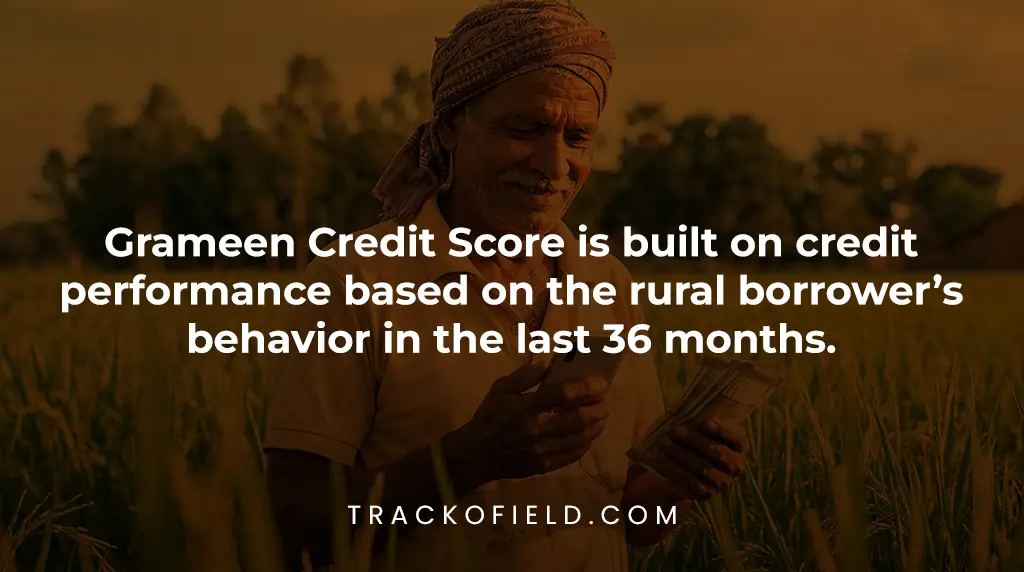
Grameen Credit Score – Database
Step 2: Data Analysis
The above data is thoroughly analyzed. This helps identify patterns and create risk levels. Using AI/ML models, the data is translated into clear risk levels. It helps NBFCs/MFIs make informed and data-backed lending decisions.
Step 3: Generating Score
The score is generated by evaluating several on-ground and behavioral parameters. So, the next step is categorizing it into different buckets to simplify the credit assessment. This includes low risk, medium risk, and high risk. Altogether, it helps in a more structured and informed lending decision.
Step 4: Integration
Lenders now integrate Grameen Credit Score into their LOS and LMS systems. It directly supports credit assessment for faster and more consistent workflows. This is a trusted way to analyze borrowers with limited formal credit history.
What Are the Benefits for NBFC/MFIs and Field Teams?
While Grameen Credit Score improves the overall system, the impact varies across stakeholders.
NBFC/MFIs
- Low dependency on collateral due to data-backed lending.
- Better risk assessment for underserved communities.
Field Teams
- Structured framework for on-ground credit assessment.
- Consistent decisions are backed by measurable field data.
The Role of TrackoField (Field Force Automation)
Grameen Credit Score defines which data matters. But effective implementation depends on how it is captured and validated. TrackoField bridges this gap by digitizing lending and collections with AI-powered workflows.
- Streamlining field operations to ensure GCS adoption is fast and consistent
- Real-time task assignment for borrower onboarding and verification
- Automated data capture: ID proofs, photos, and geotagged visits
- Attendance, distance tracking, and BEAT planning to ensure filed productivity
- Ensuring compliance: no missed visits, no manual errors, no unverified borrowers
- Building a reliable data pipeline that supports accurate GCS scoring.
The Future of Rural Lending with Grameen Credit Score (GCS)
The rural credit ecosystem is maturing, and Grameen Credit Score is poised to become a cornerstone in digital lending. Soon, NBFCs and MFIs can expect to see deeper integration of GCS into lending platforms via LOS/LMS systems.
The Grameen Credit Score can be reinforced with advanced analytics and AI. Supporting data sources like location intelligence and community trends are also being considered. These can help lenders transition from basic inclusion to risk-proof lending. It will help balance growth and risk while expanding credit access.
Conclusion
The Grameen Credit Score marks a fundamental shift in how India checks creditworthiness. It aligns lending choices with the real financial lives of rural borrowers, thus creating sustainable livelihoods.
For MFIs and NBFCs, GCS backed by TrackoField’s AI-led automation helps with strong risk assessment and quicker credit decisions.
In a nutshell, adopting credit evaluation frameworks like Grameen Credit Score (GCS) powered by field force management software like TrackoField will be helpful for lenders looking to scale at speed but responsibly.

FAQs
-
How can field force management software improve Grameen Credit Score accuracy?
A field force management software ensures that borrower data is captured directly from the ground in real time. This makes it more accurate and reliable. Features like geo-tagged visits, timestamps, and automated validations reduce manual errors.
-
What field-level data is critical for building accurate Grameen credit profiles?
Field-level data plays a crucial role in building accurate and reliable Grameen credit profiles. Geo-verified field visits help confirm borrower location and regular engagement with field agents. Repayment behavior data captures timeliness, frequency, and discipline across group and individual repayments.
Further, attendance patterns at JLG/SHG meetings reflect consistency and commitment. Together, these are strengthened by behavioral indicators such as savings habits and everyday financial discipline.
-
Can field tracking tools help MFIs scale Grameen credit programs efficiently?
Yes. Field tracking tools help MFIs scale Grameen Credit programs efficiently by standardizing field processes. They help ensure verified data capture and reduce manual supervision. This makes large-scale GCS adoption faster, more consistent, and easier to manage.

Shemanti is a Content Marketing professional with 7+ years of experience in shaping credible narratives across B2B products. As the Content Team Lead for TrackoBit, TrackoField, and TrackoMile, she br... Read More



Related Blog

Sales Territory Management: 6 Best Practices for High-Performing Teams
Poor sales territory management can quietly stifle sales growth. Understand how companies can create high-performing territories.

TrackoField’s Manager Bot: Bringing the Future of Field Force Intelligence to You Today
TrackoField’s AI Manager Bot transforms field force management into field force intelligence by turning operational data into instant AI-powered insights.

Face Recognition: What It Is, How It Works & Benefits for Field Teams
Facial recognition is a way of identifying or confirming an individual’s identity using their facial features. Read this guide to…

Field Operations Manager: Roles, Challenges & How to Optimize Performance
Field operations managers handle on-ground activities with challenges like visibility, control, and coordination. This blog covers their roles, key challenges,…


Your inbox awaits a welcome email. Stay tuned for the latest blog updates & expert insights.
"While you're here, dive into some more reads or grab quick bites from our social platforms!"Stay Updated on tech, telematics and mobility. Don't miss out on the latest in the industry.