
Quick Summary

- EV Fleet Management enhances efficiency and reduces costs by providing real-time insights into battery performance and route planning.
- With 64% of fleet professionals adopting electric vehicles, advanced EV Fleet Management systems are essential for optimizing operations and minimizing downtime.
- Key features include battery health monitoring, predictive alerts, and intelligent route planning, all crucial for effective Electric Vehicle Fleet Management.
- As EV adoption grows, businesses must leverage technology to overcome challenges like battery performance and charging visibility for sustainable operations.
Manage your EV fleet with smarter planning and real time insights. EV fleet management helps improve efficiency, reduce costs, and solve key operational challenges.
EV adoption is growing fast across industries. Around 64% of fleet professionals already use electric vehicles.
As fleets grow, managing them becomes more difficult. Businesses with EV fleet will need better control over battery, charging and routes. Having an EV fleet management system will make the job easier and faster. It will improve efficiency and reduce operational challenges.
What is Electric Vehicle (EV) Fleet Management?
Electric vehicle fleet management is the use of software to manage EVs and operations. It helps with tracking vehicles, monitoring battery performance and managing charge. With its help fleet management becomes more efficient and easier to control.
Unlike ICE fleets, EV vehicles require battery and charging management. Businesses must track and optimize energy use and for that they need to plan routes carefully. Lack of the system makes it difficult to manage range, charging and uptime. This can negatively affect daily operations and profit margins.
Why is Electric Vehicle Fleet Management Important in 2026?
EV fleet management is becoming non-negotiable as businesses shift to EVs. Nearly 36% of logistics businesses expect 20 to 50% of their fleet to be electric by 2025. Also, 87% plan electrification in the next five years.
The rising fuel costs and stricter emission norms are driving EV adoption. However, EV fleets really need careful planning when it comes to charging and battery range. As basic tracking is no longer enough to make the transition and scale.
Businesses now want deeper visibility of –
- How far each vehicle can and will travel on current charge
- Where and when to charge
- How battery health is impacting vehicles’ performance
- How routes can be optimized around charging constraints
All these concerns are taken care of by EV fleet management software. It collects raw data and processes it into actionable insights. This helps businesses plan routes and trips optimally. Also enables scaling of operations.
What are the Benefits of EV Fleet Management?
EV fleet management is not just about tracking vehicles. It helps businesses control energy, improve operations, and reduce long-term costs. When supported by advanced systems, it becomes a strong competitive advantage.
1. Complete Visibility Across Fleet and Battery
Traditional fleet tracking only shows vehicle location. EV fleet management goes deeper. It gives real time visibility into battery charge, health, and vehicle performance. Managers can track metrics like range, efficiency, and last charge cycles, all from one dashboard.
2. Better Range Utilization and Trip Planning
One of the biggest concerns about EV fleets is the range. The range is generally– 200-350 miles. With accurate insights of the current distance and battery levels, managers plan trips with more confidence and accuracy. This minimizes range anxiety. Also ensures that vehicles are able to complete the trip without any hiccups.
3. Lower Downtime Through Predictive Alerts
Downtime in EV fleets is often caused by missed charging or battery issues. Battery and thermal issues contribute to 15% of downtime. Having an advanced software will send out alerts in case of –
- Low charge
- Maintenance needs
- Abnormal battery behavior.
This helps teams act early and avoid operational delays.
4. Improved Battery Life and Performance
Battery health directly impacts cost and efficiency. Features like battery health monitoring, SOH, voltage tracking, and smart balancing are really helpful in maintaining optimal battery performance. Also, this reduces long-term replacement costs.
5. Data Driven Performance Optimization
EV fleet systems provide deep insight into trips, energy use and vehicle behavior. This data can be used by businesses to –
- Streamline operations
- Cut down on energy waste
- Enhance routes over time.
6. Enhanced Safety and Risk Control
Features like driver behavior monitoring, alerts for abrupt battery disconnect enhance safety. With the right data in hand, managers are able to monitor risky driving patterns and take corrective action on time. This is vital for reducing accidents and preventing damage and losses.
7. Stronger Sustainability Tracking
India is aggressively promoting EV adoption to achieve net-zero emissions by 2070. This is done to meet environmental goals. Fleet systems help track energy usage and efficiency. Thus, making it easier to measure impact and report sustainability progress.
What are the Key Features of Electric Vehicle Fleet Management?
A powerful EV fleet management system offers features like battery management, SOC tracking, and SOH monitoring. They combine tracking intelligence with operational insights.
1. Battery Management System (BMS Integration)
Battery management system is the core of electric vehicle fleet management. It is responsible for monitoring –
- Battery health
- Temperature
- Voltage
- Charge cycles.
Unlike basic tracking systems, it provides deep insights into how the battery is performing over time.
2. Real Time State of Charge (SOC) Tracking
Managers and drivers are able to see the exact battery charge level at any given moment. Historical SOC gets stored, helping managers compare data, identify patterns, and improve planning.
3. Battery Health Monitoring (SOH)
Battery health monitoring tracks how the battery is aging. It considers factors like –
- Charge cycles
- Performance drop
- Energy efficiency.
Alerts are triggered as soon as battery conditions start deteriorating or if there is an anomaly.
4. Live Voltage and Performance Tracking
Voltage is a critical parameter in EV performance. Issues like overcharging or undercharging get detected with real-time voltage tracking. This is vital for ensuring battery safety and for extending its lifecycle.
5. Smart Battery Balancing
Battery cells need to distribute charges evenly. Smart balancing will ensure that no single cell is over or underused. This improves battery health and life. Also vital for maintaining consistent performance.
6. Intelligent Route Planning with Charging Awareness
Routes are optimized not just for distance, but also for battery range and charging points. Using software will help in planning a route that has charging hubs and ensuring smooth trip completion.
Do you know?
India crossed 12,000+ charging stations in 2024! This signals rapid growth that continues to strengthen EV fleet viability in 2026.
7. Driver Behavior Analysis
Driving patterns directly impact battery efficiency. Monitoring events like harsh braking, acceleration, and speed helps improve driving habits and extend battery life.
8. Insights and Advanced Reports
Detailed and automated reports provide visibility into –
- Fleet performance
- Trip efficiency
- Energy consumption.
Businesses will use these insights to make strategic decisions.
5 Key Challenges in Managing EV Fleet
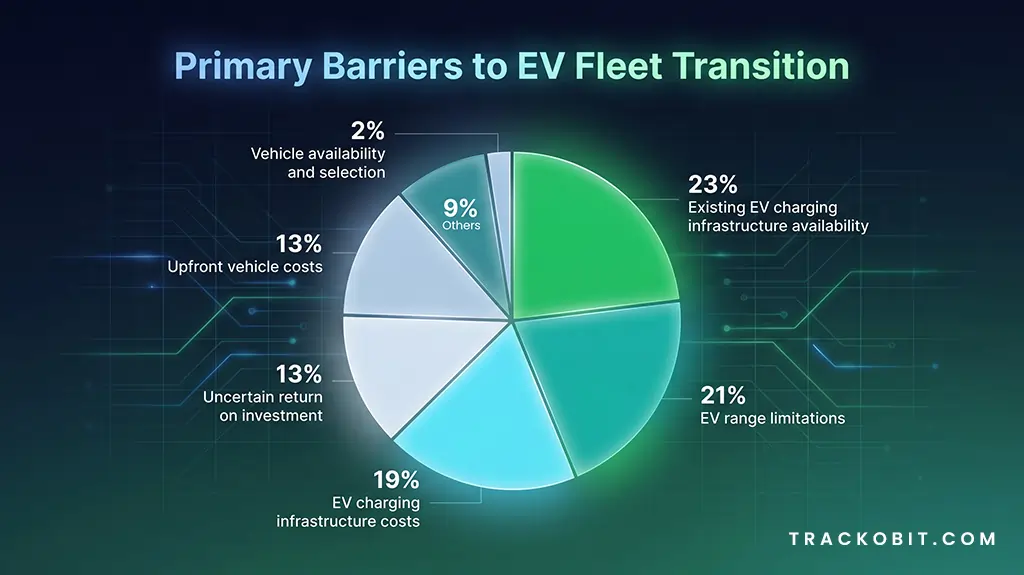
Challenges to EV Fleet Adoption
Adoption of electrical fleet is not so easy. It has challenges like scaling battery performance, lack of knowledge of charging status, inefficient route planning, and more. Such challenges affect both costs and efficiency if not managed properly.
1. Managing Battery Performance at Scale
As fleet size increases, monitoring battery health for each vehicle becomes difficult. Without a proper system, issues like degradation or imbalance can go unnoticed until they cause failure.
2. Lack of Real Time Charging Visibility
Charging is a critical part of EV operations. However, without real time insights into charge status (SOC), businesses struggle to plan trips and avoid delays.
3. Inefficient Route Planning Without Energy Context
Traditional route planning does not consider battery constraints. This leads to inefficient routes, unexpected stops, and missed delivery timelines.
4. Unplanned Downtime Due to Missed Alerts
Without automated alerts, issues like low battery, maintenance needs, or faults are often detected too late. This increases downtime and affects service quality.
5. Safety Risks and Unauthorized Activities
EV fleets face risks such as battery tampering or unsafe driving behavior. Without monitoring systems, these risks can lead to losses and safety concerns.
How to Manage EV Fleet Effectively? (5 Key Solutions)
To overcome EV fleet challenges, businesses robust and advance technology with a good strategy. Solutions like battery intelligence, efficient route monitoring, and real-time alerts are important. They create a much more reliable fleet operation.
1. Use a System with Deep Battery Intelligence
Managing EV fleets without battery insights is not effective. Businesses should use systems that provide SOC, SOH, voltage tracking, and battery balancing. This ensures better control over battery performance.
2. Enable Real Time Monitoring and Alerts
Real-time tracking of vehicles and battery status allows faster decision making. Alerts for low charge, maintenance, or faults help teams respond before issues escalate.
3. Optimize Routes with Charging Integration
Routes should be planned based on both distance and charging availability. Systems that suggest nearby charging hubs help reduce range anxiety and ensure uninterrupted operations.
4. Automate Maintenance and Servicing
Regular maintenance is critical for EV performance. Automated reminders and predictive alerts ensure that servicing is done on time, reducing breakdowns and downtime.
5. Monitor Driver Behavior for Better Efficiency
Driver behavior has a direct impact on battery usage. Monitoring and improving driving patterns can significantly increase range and reduce energy consumption.
5 Best EV Fleet Management Software Providers
The best EV fleet management software providers like TrackoBit, Samasara and Zenobe can be ideal choices. They offer battery status checking, analytical reports, efficient route planning, and other solutions. But the choice depends on your fleet size, operational needs and other factors.
1. TrackoBit
TrackoBit is an EV fleet management software. It combines vehicle tracking with advanced battery intelligence. It offers features like –
- Real-time SOC and SOH monitoring
- Battery health insights
- Smart route planning
- Nearby charging detection
- Predictive alerts.
It is ideal for businesses that want to optimize fleet operation, bring intelligence, and enhance visibility into EV battery performance.
2. Verizon Connect
Verizon Connect provides fleet management solutions in combination with strong telematics and tracking capabilities. It focuses on-
- Real-time vehicle tracking
- Driver behavior monitoring
- Operational visibility.
While it supports EV fleets, its true strength lies more in overall fleet tracking.
3. Fleetio
Fleetio is a fleet management platform designed to simplify maintenance, tracking, and reporting. Businesses are using it to-
- Manage vehicle records
- Schedule maintenance
- Track operational costs.
It is useful for fleet organization, though EV-specific battery insights are not as advanced as offered by other platforms.
4. Samsara
Samsara is offering an IoT-based fleet management system. It has real time tracking, risk monitoring and deep analytics. The system supports Electrical vehicles with battery and charging insights and easy integration features. Its main strength is its scalability and advanced reporting. This is what makes Samsara a suitable choice for companies with large fleet.
5. Zenobe
Zenobe focuses specifically on electric fleet management. Its goal is to make clean energy accessible. It offers tools for managing –
- Charging infrastructure
- Battery performance
- Energy usage.
It is ideal for businesses that want to optimize EV charging and reduce energy costs at scale.
How to Choose an EV Fleet Management Company?
Choosing the right EV fleet management solution requires careful evaluation. Not all platforms offer the same level of capability.
Businesses should consider:
- Depth of battery analytics, not just basic charge data
- Real time visibility across all vehicles
- Ease of integration with existing systems
- Scalability as fleet size grows
- Budget friendly pricing with measurable long-term ROI
- User experience, as complex systems reduce adoption
A good solution should not only provide data but also help interpret it. The goal is to simplify operations, not add complexity.
Conclusion: Future Trends in EV Fleet Management
EV fleet management is moving towards intelligent and automated systems. As fleets grow, manual processes will be replaced by data-driven platforms.
AI will play a major role in predicting battery performance and optimizing routes. Charging infrastructure will become more connected and efficient. Real-time analytics will drive faster and better decisions through EV fleet management software.
In the coming years, the difference between efficient and inefficient fleets will depend on how well they use technology. Businesses that invest in advanced fleet management software like TrackoBit, early will gain a clear operational advantage.

Frequently Asked Questions
-
What is EV fleet management?
EV fleet management is the process of managing electric vehicles using advanced software. It has features like real time tracking, monitoring battery health and route planning. This is helping businesses improve their operational efficiency. It also reduces cost and gains stronger control over fleet operation.
-
What should EV fleet operators focus on?
EV fleet operators should focus on battery health, charging efficiency, real time tracking, and driver behavior. These factors directly affect vehicle health and performance. Also impacts energy consumption and operational costs. All this is essential for maintaining consistency in operations.
-
How does EV fleet management work?
EV fleet management works by collecting real-time raw data from vehicles. It does through telematics and battery systems. This data is analyzed using software. It monitors vehicle performance, tracks battery status and manages charging schedule. Thus, helping fleets run on schedule without any disruption.

Tithi Agarwal is an established content marketing specialist with years of experience in Telematics and the SaaS domain. With a strong background in literature and industrial expertise in technical wr... Read More


Related Blog
What Are the Roles and Responsibilities of a Fleet Owner?
Behind every well-run fleet is a fleet owner juggling tasks like vehicle maintenance and driver management without letting anything fall…
What Is Fleet Intelligence? TrackoBit Goes Beyond GPS Tracking
Fleet intelligence is the layer of trustworthy data, driver-level accountability, and consistent identity that sits above GPS tracking. It turns…
Fuel Intelligence, Driver Accountability & WhatsApp Integration: Now Live in TrackoBit
Fuel intelligence in fleet management is the use of sensor and telematics data to select accurate fuel sensors, filter road-induced…
Fleet Monitoring: The Ultimate Guide (2026)
Fleet monitoring means using GPS, telematics, and software to track vehicles. This guide helps managers dive deeper into this ecosystem…


Your inbox awaits a welcome email. Stay tuned for the latest blog updates & expert insights.
"While you're here, dive into some more reads or grab quick bites from our social platforms!"Stay Updated on tech, telematics and mobility. Don't miss out on the latest in the industry.