
Quick Summary

- Hyperlocal delivery companies are essential for fast, efficient last-mile logistics, with some offering deliveries in as little as 10 minutes.
- Top players like Shadowfax, XpressBees, and Dunzo are leading the hyperlocal delivery market with innovative solutions and customer-centric services.
- Challenges in hyperlocal delivery include poor connectivity, unpredictable demand, and the need for advanced route optimization to ensure timely deliveries.
- When choosing a hyperlocal delivery partner, consider factors like delivery speed, tracking capabilities, customer reviews, and safety measures to ensure reliability.
This blog explores the top hyperlocal delivery companies in 2026. We will also look at the common last mile challenges they face along with solutions.
Behind every 10-minute delivery is a complex last mile operation working in real-time. Hyperlocal delivery uses nearby inventory and local delivery partners to deliver orders to customers as quickly as possible. You must have heard of names like Shadowfax, Mover, and Farmers Fresh Zone. They are pioneers in the efficient hyperlocal delivery space. From groceries and household essentials to custom-supply chain solutions and on-demand transportation.
But how do these companies manage such fast and large-scale operations? In this blog we will look at 8 leading hyperlocal delivery companies in 2026 and explore how they manage their last-mile operations.
Hyperlocal Companies: What are the Biggest Challenges and Solutions?
Inefficient route planning, manual dispatch management, and lack of real-time visibility are the common challenges faced by hyperlocal companies. We have broken them down along with solutions.
1. Inefficient Route Planning
Planning delivery routes manually can slow down hyperlocal operations. Traffic, multiple delivery stops, and last-minute order changes make it difficult to choose the fastest path. This leads to longer delivery times, high fuel costs, and missed ETAs.
To overcome this challenge, hyperlocal companies use advanced route optimization software. It creates the most efficient routes based on traffic, distance, and delivery locations.
2. Manual Dispatch Management
As order volume grows, managing deliveries manually becomes difficult. Dispatchers have to check rider availability, delivery locations, and skills. They also consider the workload before assigning every order. Doing this for every delivery takes time and can lead to delays and missed deliveries.
However, companies solve this challenge by using a dispatch management software. It automatically assigns orders to delivery partner based on different factors. These are locations, availability, and workload.
3. Lack of Real-Time Delivery Visibility
Once a delivery partner leaves the hub, companies struggle to know what is happening on the ground. Managers often have to call riders for updates while handling customer WISMO calls. This wastes time and makes it difficult to handle delays.
To solve this, last mile companies now use real-time tracking for their deliveries. Managers can track live order location, monitor order status, and receive alerts if a delivery goes off route. At the same time, you can share live tracking links with customers.
4. Failed Deliveries and Customer Disputes
Wrong addresses, missed deliveries, and customers claiming they never receive the order. All these create disputes for hyperlocal logistic companies. This affects both operational efficiency and customer trust.
To reduce these disputes, companies use proof of delivery solutions. Delivery partners can capture OTP verification, photos, or customer signatures at the doorstep. This creates a clear record that orders were successfully delivered.
Now that we have looked at the biggest last-mile challenges companies face, let’s now look at the leading hyperlocal delivery companies in India.
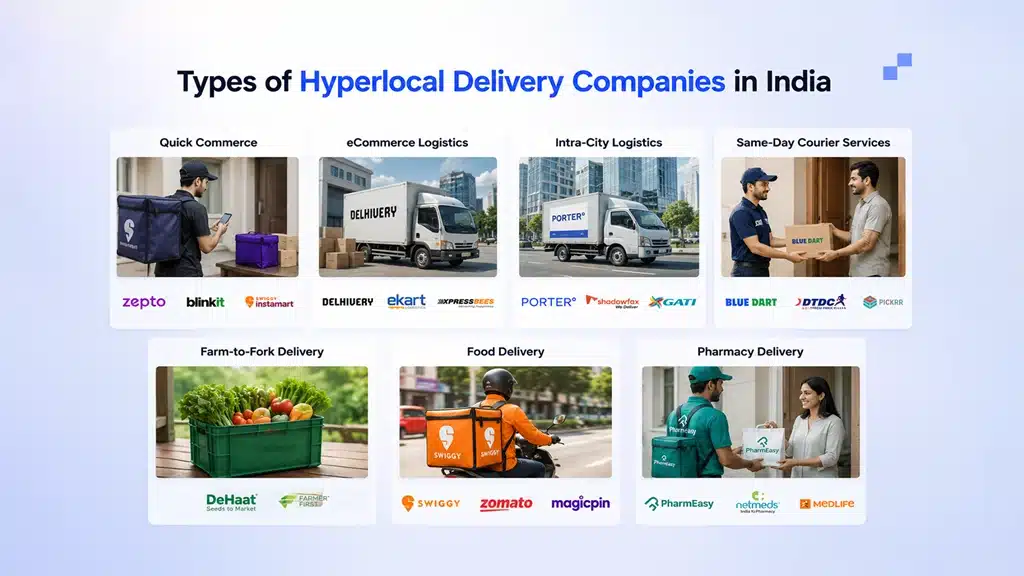
Types of Hyperlocal Delivery Companies
8 Best Hyperlocal Delivery Companies in 2026
Shadowfax, Dunzo, and Blinkit proudly stands among the best hyperlocal last mile delivery companies in 2026. Continue reading to know more.
1. Shadowfax: Best for On-Demand Delivery Services
Founded in 2015, Shadowfax is one of the India’s fastest-growing logistics and hyperlocal companies. It works with more than 100+ leading eCommerce businesses.
The company offers on-demand transportation, slot-based same-day delivery, and express hyperlocal delivery. This ensures your orders are completed within an impressive 45 minutes. As a result, it is rapidly gaining popularity as the go-to choice for retail deliveries.
2. XpressBees: Best Hyperlocal Delivery Partner of eCommerce
XpressBees has built a strong presence in the Indian hyperlocal delivery service providers. It is useful for eCommerce businesses that have high-volume orders. Since its launch in 2015, the company has expanded its network to support both B2B and B2C operations.
The company provides various services from same day shipping to hyperlocal delivery as per business demand.
3. Mover: Truck Booking App
MOVER is an on-demand intracity hyperlocal delivery app for last mile deliveries. MOVER, an online bike and truck booking app, connects SMEs to nearby logistics vehicles in real time with the help of technology.
With the MOVER app, anyone can book mini trucks online for shifting. They can also book the 2-wheeler for same hour hyperlocal delivery for smaller parcels, in just a few steps. MOVER makes sure your orders are delivered safely. All thanks to its Geofence, OTP verifications and professional drivers.
4. Farmers Fresh Zone: Best Farm-to-Fork Hyperlocal Delivery Brand
Farmers Fresh Zone (FFZ) is a consumer brand that prioritizes safe and fresh produce through a farm-to-fork supply chain. It is powered with robust technology and a unique business approach. FFZ provides consumers with fresh and safe-to-eat fruits and vegetables.
By following a “local farmers producing for local consumption” model and “demand-driven farming,” FFZ helps improve farmer’s income. It also delivers fresh and nutritious produce to customers within 20 hours of harvest.
5. Grofers now Blinkit– Best for 10-minute Delivery at Customer Doorsteps
Grofers, now Blinkit, founded in 2013, is India’s leading online grocery platform. It delivers fresh produce and household essentials to doorsteps. Based on a hyperlocal model, it offers convenience, competitive pricing, and efficient logistics.
Currently, by using the hyperlocal model, it partners with local stores and supermarkets. So, it can ensure quick deliveries of a wide range of daily groceries and essentials.
6. Porter: Best for Intra-City Logistics
Porter is one of the leading hyperlocal logistics companies in India. It was founded in 2014. It helps both businesses and individuals to move goods using bikes, mini trucks, tempos, and other commercial vehicles.
Whether it’s a small parcel or large shipment, Porter offers a range of services depending upon the requirement. Its large driver network helps businesses complete last mile deliveries more efficiently.
7. Borzo: Best for Same Day Courier Delivery
Borzo, formerly known as WeFast, is a hyperlocal delivery company operating over 22 cities across India. It is mainly known for its same-day and on-demand delivery services.
The company works with local businesses, online sellers, and SMEs. They need fast deliveries without maintaining their own fleet. Its large rider network and simple booking process help businesses complete deliveries quickly.
8. Zepto: Best for 10 Minutes Grocery Deliveries
Founded in 2012, Zepto is one of India’s fastest growing quick commerce companies. It provides groceries, daily necessities, and household items via a network of dark stores which are situated near customers.
The company focuses on ultra-fast deliveries and uses a hyperlocal model to fulfill order within minutes.
Final Thoughts
The hyperlocal delivery companies mentioned above, such as Blinkit, Zepto and XpressBees, are playing a significant role in transforming the last mile delivery business. They all have one objective with each delivering to different markets: faster and more reliable deliveries.
However, achieving this is not always easy. Challenges like inefficient route planning, lack of delivery visibility, and failed deliveries can impact daily operations. This is why these companies continue to invest in reliable last-mile delivery software to manage their operations better. With the right software, companies can reduce delivery costs per order and offer better customer experience.
Frequently Asked Questions
-
What software do hyperlocal delivery companies use?
Hyperlocal delivery companies use last-mile delivery management software to manage their operations. It helps them to plan routes, track deliveries, manage riders, and collect ePOD. So that companies can reduce costs and ensure first-attempt deliveries.
-
Is hyperlocal delivery profitable?
Yes, hyperlocal delivery models are profitable for businesses. However, it depends on how businesses manage their last mile operations. Last mile alone costs up to 53% of the total supply chain. So, to stay profitable companies must control routing, failed deliveries, and fuel costs. This is the reason why many companies now onboard last mile delivery software.
-
How fast is hyperlocal delivery?
Hyperlocal delivery generally takes 10 minutes to a few hours. For some items, such as groceries and daily necessities, it only requires 10-15 minutes. However, the speed also depends on the distance of the store and how you manage delivery operations.
-
What is the future of hyperlocal delivery in India?
Hyperlocal delivery in India is growing very fast. According to Makreo Research, the market is growing at over 50% every year. This growth is driven by quick commerce, more online shopping, and rising demand for fast doorstep delivery. In the future we will see more use of local warehouse, dark stores, and AI-driven micro-fulfillment networks.

Parul is a content writer with 2+ years of experience in B2B and SaaS domains. She creates clear, actionable content for TrackoBit and TrackoMile, focusing on fleet management, last-mile delivery, and... Read More


Related Blog
What Is Delivery Management? Process, Challenges & Best Tools
Delivery management streamlines order allocation, route optimisation, dispatch, and tracking to reduce costs, improve efficiency, and boost customer experience.
Building Resilient Delivery Operations with TrackoMile in 2026 and Beyond
Logistics businesses build resilient delivery networks with TrackoMile. But how exactly? With real-time route optimization, automated scheduling, and end-to-end fleet…
How to Scale Quick Commerce Beyond 10 Minutes with TrackoMile
TrackoMile transforms chaotic last-mile logistics into a predictable, automated, and high-margin retail powerhouse. See how it works in quick commerce.
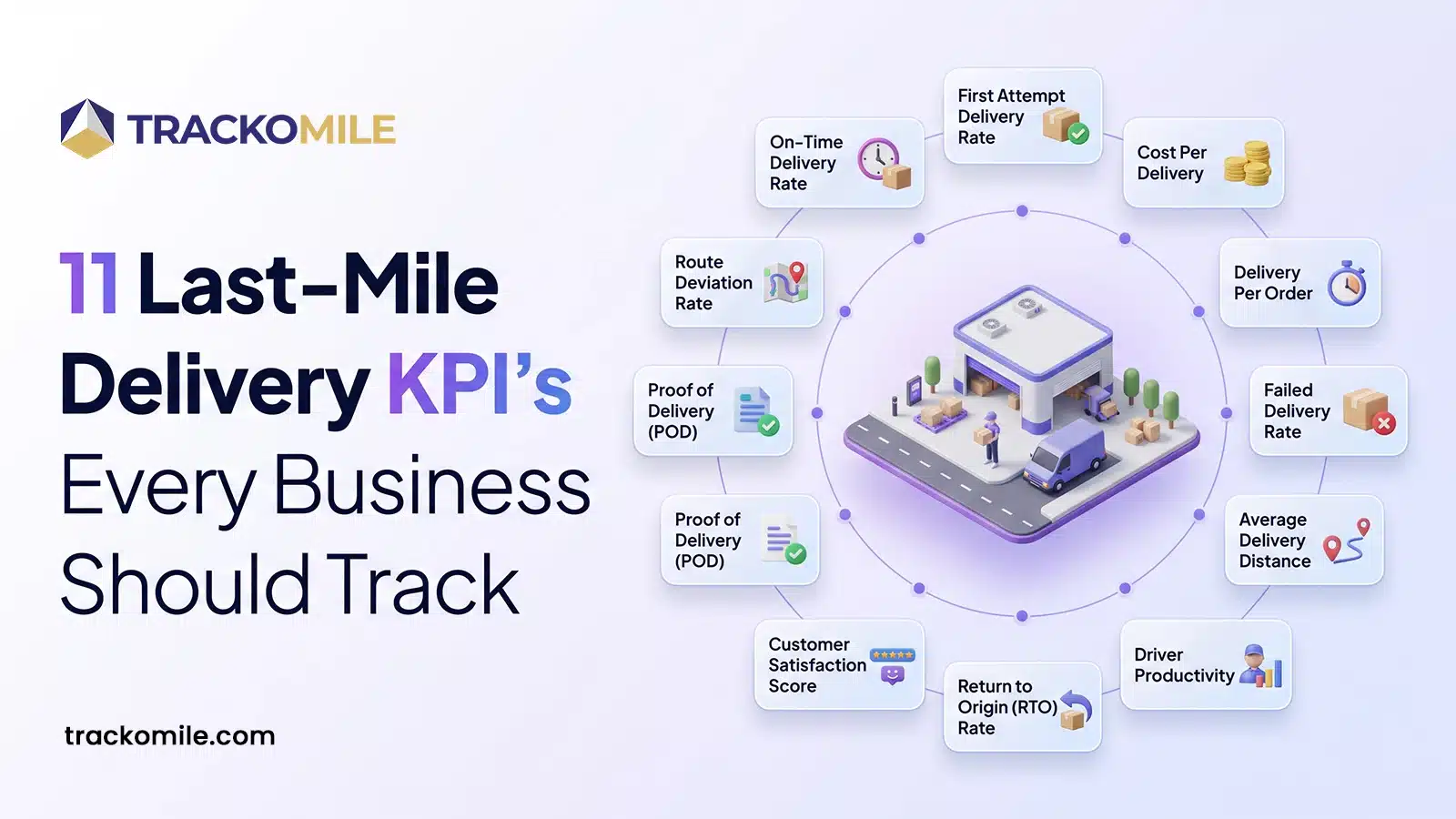
Last Mile Delivery KPIs & Metrics: 11 Essential Metrics to Track
To improve last mile operations, it’s important to track 11 essential last mile delivery KPIs like on-time delivery rate, cost…


Your inbox awaits a welcome email. Stay tuned for the latest blog updates & expert insights.
"While you're here, dive into some more reads or grab quick bites from our social platforms!"Stay Updated on tech, telematics and mobility. Don't miss out on the latest in the industry.