
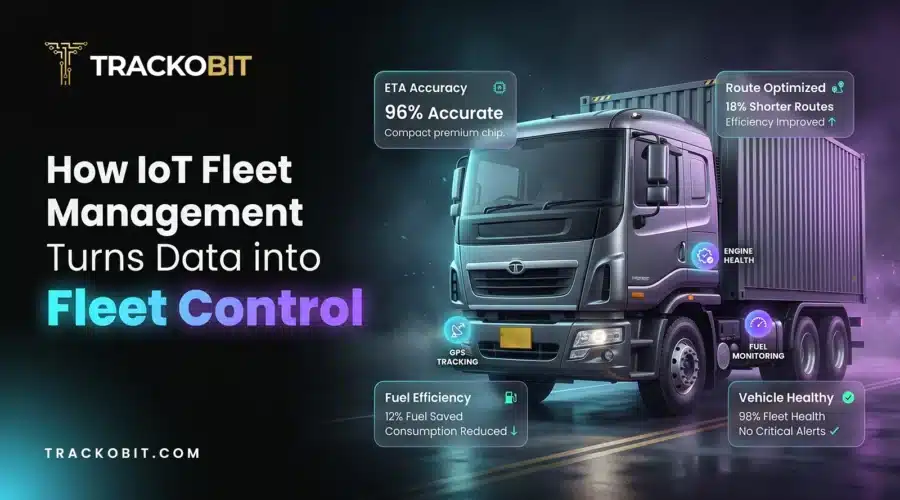
Quick Summary

- IoT fleet management enhances safety and efficiency by integrating vehicles, telematics, and software into a unified system, reducing data silos.
- Key benefits include predictive maintenance, real-time tracking, and driver behavior monitoring, which collectively improve vehicle uptime and reduce fuel waste.
- IoT technologies like GPS, sensors, and AI enable better visibility and operational control, allowing for proactive decision-making in fleet management.
- Industries such as logistics and construction leverage IoT for real-time monitoring, ensuring compliance and optimizing resource use across fleet operations.
Discover how beneficial IoT fleet management is. Learn how it is making fleet operations much safer and more optimized.
Fleet operations become more complex as they grow. That is why adopting technology becomes essential to maintain visibility and efficiency. Modern fleets need connected systems. These track vehicles, fuel use, and trip activity in one place. But managing all the aspects through multiple tools will create data silos. This hampers decision making.
That is where IoT fleet management is changing the industry. It connects vehicles, telematics devices and software into one connected system. The result is better use of resources and improved vehicle uptime. In this blog we explore how IoT is improving fleet management. Also its benefits and use cases.
What Is IoT Fleet Management?
IoT fleet management integrates internet-connected devices, sensors, and telematics software. Businesses can track vehicles, fuel usage, and driver activity. They are able to view trip movement through live operational data.
Unlike traditional GPS tracking software, IoT systems do more than show vehicle location. They help fleets detect fuel theft, unsafe driving, and route deviation. Engine issues and delivery delays are also detected through connected sensors and alerts.
How is IoT Used in Fleet Management?
IoT in fleet management helps with predictive maintenance, tracking, and fuel management. It also improves several other areas of fleet operations. Check the list below.
Predictive Maintenance
IoT-enabled telematics software continuously collects vehicle diagnostics data from the engine. Also from battery, brakes, transmission, and CAN bus network. Fleet managers can detect abnormal engine behavior, fault codes, and overheating risks. Alerts are generated if component wear before vehicle failure impacts operations.
This helps fleets:
- reduce unplanned downtime
- optimize maintenance cycles
- improve vehicle uptime
- extend asset lifespan
Real Time Vehicle Tracking
Systems use GPS trackers, telematics, and live connectivity to monitor vehicles. It generates data on fleet movement, trip status, stoppages, and route travel.
This improves:
- dispatch visibility
- delivery coordination
- ETA accuracy
- fleet utilization
Driver Behavior Monitoring
IoT telematics platforms continuously analyze driving patterns using accelerometers and vehicle sensor data. Fleet managers can monitor:
- harsh braking
- overspeeding
- rapid acceleration
- excessive idling
- sharp cornering
- distracted driving events
This helps improve driver safety, reduce accident risks, and lower fuel wastage. It also strengthens compliance monitoring.
Fuel Management
IoT fuel monitoring systems track fuel consumption and fuel activity in real time. Businesses can detect:
- fuel theft
- abnormal fuel drops
- fuel refill mismatches
- excessive idle fuel burn
- inefficient driving behavior
This creates stronger fuel accountability across large fleet operations.
Compliance and Automated Reporting
IoT fleet management software automatically stores trip records. It analyzes driver activity, idle hours, and vehicle utilization data. This reduces manual paperwork and improves compliance tracking across fleet operations.
Environmental and Cargo Monitoring
Temperature-sensitive fleets use IoT sensors to monitor cargo conditions during transit. Real time alerts help operators prevent spoilage and maintain cold chain compliance.
Geofencing and Security Monitoring
With IoT fleet management software, businesses can create virtual boundaries. This could be in important locations like warehouses and delivery hubs. Even around halts and restricted zones, geofences can be created. This is done so managers get alerts when vehicles enter/exist fences. Also, alerts are created if they deviate from the predefined route.
6 Proven Benefits of IoT Fleet Management
Predictive maintenance and unified management are proven benefits. Read below to discover what else IoT fleet management can do for your fleet business.
1. Improve Operations with Event Based Monitoring
Traditional tracking systems treat route activity, fuel usage, and driver behavior separately. IoT systems connect these events in real time to create operational context.
For example, if a vehicle shows:
- route deviation
- prolonged idling
- sudden fuel drop
The platform can instantly identify a possible misuse or fuel pilferage event. It does not show disconnected alerts.
2. Reduce Downtime with Predictive Maintenance
IoT telematics devices collect diagnostics data directly through sensors and CAN bus integrations. Fleets can detect engine faults or battery issues before breakdowns happen.
This improves:
- vehicle uptime
- maintenance planning
- delivery reliability
by shifting fleets from reactive repairs to condition-based maintenance.
3. Reduce Fuel Waste with Sensor Based Tracking
IoT fuel monitoring software combine fuel sensor data with telematics. It generates trip analytics to explain why fuel consumption changes.
Businesses can identify losses caused by:
- excessive idling
- unauthorized trips
- aggressive driving
- fuel theft
This helps fleets reduce hidden fuel leakage across daily operations.
4. Manage Fleet Issues Faster with Real Time Alerts
IoT vehicle tracking automates operational monitoring through real time exception detection. Instead of manually tracking every vehicle, managers receive alerts only for critical events. Such as:
- unsafe driving
- unauthorized stoppages
- route violations
- abnormal fuel activity
This improves response time and reduces manual supervision.
5. Improve Driver Safety with Continuous Risk Monitoring
IoT telematics solution use GPS, accelerometers, and video telematics to analyze driving behavior. Fleets can proactively detect harsh braking, overspeeding, and aggressive acceleration patterns.
This strengthens:
- driver coaching
- accident prevention
- safety compliance
across large fleet operations.
6. Get Complete Fleet Visibility Across Operations
Many fleets still use separate systems for tracking, fuel monitoring, safety, and maintenance. IoT fleet management connects these data streams into one centralized intelligence layer.
TrackoBit combines:
- GPS tracking
- telematics
- fuel analytics
- video monitoring
- maintenance alerts
into one connected operational ecosystem for better fleet visibility and decision-making.
What are the Key IoT Technologies Powering Fleet Management?
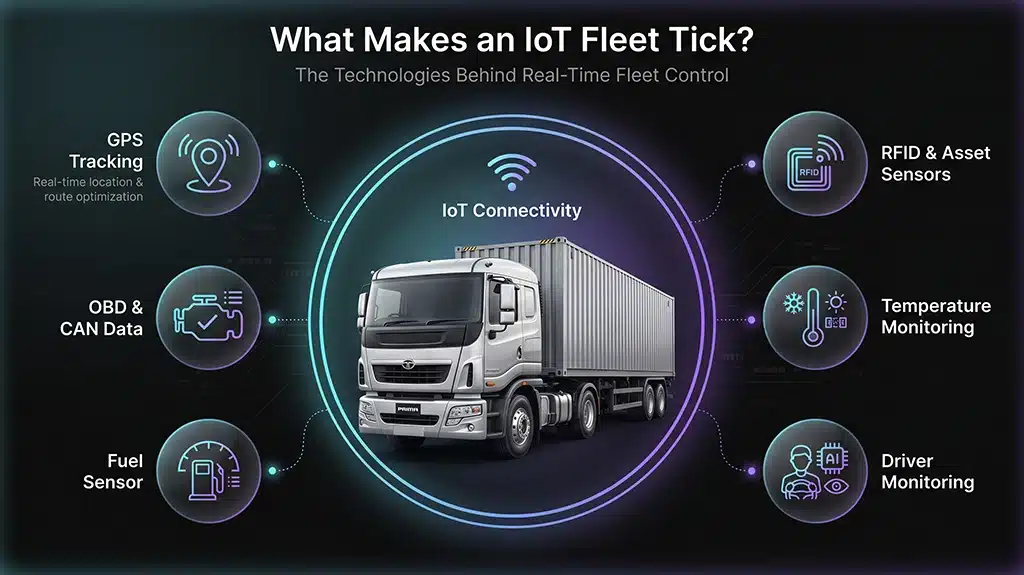
Technologies Powering Fleet Management
OBD, GPS trackers and sensors are some of the key IoT technologies.
GPS Tracking System
GPS technology enables real-time vehicle tracking and route monitoring and more. It improves dispatch efficiency and operational control.
OBD and CAN Integration
OBD and CAN plug into vehicle systems. They pull engine diagnostics and performance data in real time.
RFID and Smart Sensors
These sensors monitor assets, cargo conditions and tire pressure. Thus, improving visibility and security.
BLE (Bluetooth Low Energy)
BLE enables a short range of communication between devices. It supports driver identification, asset tracking, and sensor connectivity. These sensors work on minimal power consumption.
LoRa Technology
It transmits data over long ranges using low power. This keeps remote assets connected even beyond network coverage.
AI and Machine Learning
Analyzes fleet data pattern to predict next maintenance need. It is vital for identifying risks, automate decisions and improve fleet efficiency.
AI Dashcams and Video Telematics
Combines camer and AI to detect unsafe driving. It monitors road conditions and provide incident evidence.
These sensors monitor assets, cargo conditions and tire pressure. Thus, improving visibility and security.
IoT Fleet Management Use Cases by Industry
IoT fleet management use cases vary significantly across industries. Some of the major industries are logistics, construction and mining fleet tracking, etc.
Logistics and Transportation
Logistics fleets use IoT vehicle tracking systems to create real time visibility. It sheds light on dispatch movement, trip progress, fuel activity, and vehicle diagnostics. Connected telematics devices continuously monitor:
- route adherence
- idle duration
- transit delays
- engine behavior
- fuel usage
This helps operators identify delays, route inefficiencies, or potential breakdown risks.
Cold Chain and Refrigerated Logistics
Cold chain monitoring uses IoT temperature and humidity sensors to monitor cargo conditions. This is critical during transit. Operators receive live updates into:
- cargo temperature
- refrigeration unit activity
- door opening events
- route-level environmental history
The system instantly flags if the cargo temperature rises. It unearths reasons behind it as well as unauthorized stop or too much idling.
Mining and Construction Fleets
Heavy equipment fleets use IoT telematics systems to monitor:
- engine load
- hydraulic activity
- fuel burn
- idle-to-work ratio
- equipment diagnostics
This helps businesses identify underutilized equipment. Also detect harsh operating conditions and move toward predictive maintenance planning.
FMCG and Distribution Networks
FMCG fleets use IoT systems to monitor route execution and dispatch efficiency. They also track distributor dwell time and vehicle turnaround. Businesses identify bottlenecks across high frequency distribution operations. They are not relying on basic trip tracking.
IoT fleet management helps FMCG businesses monitor:
- route execution efficiency
- distributor dwell time
- secondary delivery movement
- vehicle turnaround cycles
- engine idle patterns during dispatch activity
Fuel and Hazardous Goods Transportation
Fuel transportation fleets use IoT sensors and telematics systems to monitor:
- tanker movement
- route deviation
- fuel discharge activity
- unauthorized stoppages
Modern systems also correlate fuel discharge events with geofenced delivery locations. It helps detect possible compliance or security violations instantly.
Challenges in IoT Fleet Management & How to Solve Them
Fragmented infrastructure and data and network inability are some of the challenges. But where there is a will, there is a way. These challenges can be solved with a TrackoBit-like fleet management software provider.
Challenge 1 – Fragmented fleet infrastructure
Many fleets still use separate systems for tracking, fuel monitoring, and video telematics. This creates disconnected operational visibility and slows down decision-making.
Solution – Centralized IoT fleet intelligence platforms
Modern IoT fleet management systems unify all of it. Be it telematics, diagnostics, fuel analytics, and driver monitoring into one operational layer. TrackoBit helps businesses manage fleet intelligence from a centralized dashboard. There is no need for multiple disconnected tools.
Challenge 2 – High-volume telematics data without actionable insights
IoT-enabled fleets generate massive amounts of sensor and telemetry data every second. Without intelligent filtering, operators face dashboard overload instead of operational clarity.
Solution – Exception-based analytics and automated alerts
Advanced IoT systems use rule engines, AI-driven analytics, and event correlation. They collectively surface anomalies like route violations, abnormal fuel activity and engine faults.
Challenge 3 – Network instability during long-haul operations
Remote mining zones, highways, and rural logistics routes often face inconsistent connectivity. Thus, interrupting live telemetry transmission.
Solution – Edge computing and onboard data buffering
Modern IoT gateways temporarily store telemetry data locally. It syncs automatically once connectivity is restored. This prevents operational data loss and maintains trip continuity.
Challenge 4 – Hardware interoperability challenges
Enterprise fleets usually operate mixed vehicle types like ICE and EVs. They have different telematics devices, CAN protocols, sensors, and OEM hardware ecosystems.
Solution – Multi-device and CAN-compatible IoT architecture
Scalable IoT fleet platforms support third-party hardware integration. They have CAN bus compatibility, modular sensor deployment, and cross-device telemetry standardization.
Why TrackoBit Is the Best Choice for Connected Fleet Operations in 2026
Modern fleet operations can no longer rely on isolated tracking tools. They must invest in connected operational visibility across fuel and video telematics. This is where TrackoBit stands out in 2026.
TrackoBit is not a standalone IoT platform. It uses IoT-driven telematics, sensor integrations, and analytics to strengthen fleet intelligence. These capabilities improve visibility across fleet operations. Businesses monitor fuel anomalies and route deviations through one centralized system. They also track unsafe driving behavior, idle patterns, and vehicle health.
TrackoBit unifies multiple fleet functions into one workflow. Businesses no longer need to manage disconnected systems. Video telematics and CAN integration take fleets beyond reactive monitoring. Businesses can make real time operational decisions instead.
Frequently Asked Questions
-
How does IoT improve fleet management?
IoT connects vehicles, sensors, and software into one live system. Fleet managers get a single view of all operations. Fuel usage, driver behavior, and vehicle health become easy to track. Delivery movement stays visible too. The result is faster decisions and safer, more efficient daily operations.
-
What industries benefit most from IoT fleet management?
Logistics, cold chain, mining, and construction benefit the most. So do FMCG, fuel transportation, and employee mobility. Why? These industries run large, complex fleets. Gaps in visibility cost them money. They need live tracking, fuel monitoring, and predictive maintenance daily. Environmental tracking and operational control are just as critical at scale.
-
What are the key components of an IoT fleet management system?
An IoT fleet management system has several key components. These include GPS trackers, telematics devices, fuel sensors, and CAN bus integrations. AI dashcams and analytics dashboards are part of it too. Together, they collect and process live operational data. Every data point gets monitored in real time. That means vehicles, drivers, fuel consumption, diagnostics, and trip performance.
-
What is the difference between GPS tracking and IoT fleet management?
GPS tracking does one thing well. It shows you where your vehicles are. IoT fleet management does much more. It connects telematics, sensors, diagnostics, and fuel systems into one ecosystem. Analytics sit on top of all that data. So instead of just location, businesses get a full operational picture. Businesses can monitor vehicle health and driver behavior. Fuel activity and maintenance risks become visible too. All of it updates in real time.

Tithi Agarwal is an established content marketing specialist with years of experience in Telematics and the SaaS domain. With a strong background in literature and industrial expertise in technical wr... Read More


Related Blog
Safer Alerts, Shareable History, Faster Maintenance in TrackoBit
TrackoBit now adds an Evidence Model and authority-based access for ADAS and DMS alerts in video telematics, Vehicle History Sharing…
Fleet Management Requirements: The Complete Guide for 2026
Every wondered what exactly fleet management requirements are? Or, why do they matter? This guide helps you understand in detail.
7 Fleet Management Best Practices Every Fleet Manager Needs
Learn 7 fleet management best practices to improve safety, vehicle utilization, efficiency, and fleet performance in 2026.
What Are the Roles and Responsibilities of a Fleet Owner?
Behind every well-run fleet is a fleet owner juggling tasks like vehicle maintenance and driver management without letting anything fall…


Your inbox awaits a welcome email. Stay tuned for the latest blog updates & expert insights.
"While you're here, dive into some more reads or grab quick bites from our social platforms!"Stay Updated on tech, telematics and mobility. Don't miss out on the latest in the industry.