
Quick Summary

- Rural last mile delivery faces unique challenges like poor infrastructure, long distances, and unclear addresses, making operations complex and costly.
- Businesses must adopt tailored strategies for rural logistics, including smart route optimization and real-time rider visibility to enhance efficiency.
- Utilizing technology such as last mile delivery software can significantly improve rural delivery operations and customer satisfaction.
- The future of rural last mile delivery is promising, driven by rising smartphone usage and e-commerce growth, necessitating investment in innovative logistics solutions.
Smart delivery tracking and route planning help businesses solve rural last mile delivery challenges and improve efficiency in remote areas.
Be it urban or rural regions, customers expect fast, doorstep deliveries. For businesses operating in rural India, this creates a major operational challenge. Villages and small towns lack proper roads, network connectivity, and clear addresses. The operational costs are 2-3x higher due to long distances.
However, logistics businesses strive to cater to the rising rural demand. last mile delivery for E-commerce, FMCG, and agri input sectors that are rapidly expanding into rural markets. This has made rural last-mile delivery a key business priority in 2026.
Businesses must adopt a different strategy for last-mile delivery in rural areas. Urban delivery models aren’t viable in rural territories. This guide explains the unique nature of rural last mile delivery. Read on to know how you can tackle the biggest challenges and improve delivery efficiency with digital tools.
What Makes Last Mile Delivery in Rural Areas Unique?
Rural last mile delivery works quite differently from urban logistics. Compared to cities, the differences in villages or tier 3 towns include:
- Low population density
- Poor road connectivity
- Non-standard addresses
- Higher fuel and travel costs
- Longer delivery turnaround times
- Weak mobile or internet connectivity
A single delivery may require travelling across multiple villages over long distances. The same could be completed in half the time by a rider in a big city. Navigation is easier and travel distances are shorter in urban areas. Riders can complete more deliveries in less time.
Rural customers also have different expectations and purchasing behaviour. Cash-based transactions remain common. Customers also depend more on phone calls for coordination instead of app-based tracking.
Top 5 Challenges in Last Mile Delivery to Rural Remote Areas
Poor infrastructure, weak network and unclear addresses are the biggest challenges rural last mile delivery operations.
1. Poor Road Infrastructure
Rural regions still lack proper roads and transport access. Seasonal conditions such as rain, floods, or landslides further exacerbate issues. This can increase vehicle maintenance costs and put the rider at risk.
2. Long Travel Distances
Remote deliveries often involve commuting large distances between delivery points. Low customer density reduces route efficiency and increases fuel usage. This makes rural deliveries far more expensive than urban operations.
3. Lack of Accurate Addresses
Many villages and remote regions do not follow a fixed address nomenclature. Delivery agents often rely on landmarks, informal addresses, local directions, or customer calls. This slows down deliveries and increases the chances of failure.
4. Limited Workforce Visibility
Managers often struggle to monitor delivery teams operating in remote areas. They cannot be proactive without visibility. They cannot make quick decisions or assist riders in real time. Poor visibility also affects customer communication and ETAs.
5. Connectivity Issues
Internet and mobile network coverage remain inconsistent in some remote areas. This affects live tracking, ePOD collection, and internal communication.
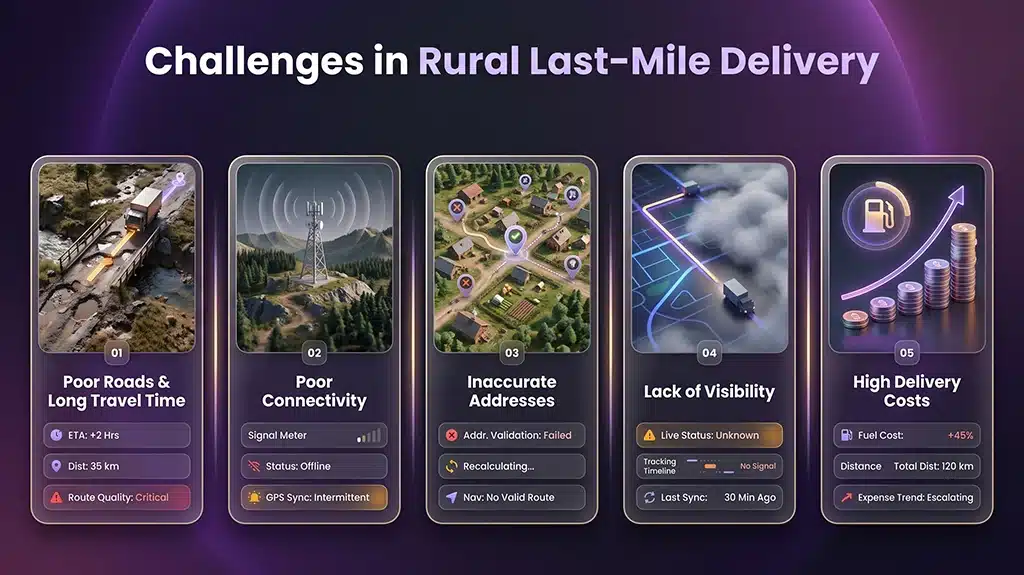
Major Challenges in Rural Last Mile Delivery
8 Proven Strategies to Improve Rural Last Mile Delivery
Smart route planning, real-time visibility and dynamic rider dispatch are among the best strategies to improve last mile delivery in rural areas. Read in detail.
1. Intelligent Route Optimisation
Smart route optimisation helps delivery teams reduce travel time and fuel usage. Businesses can assign routes based on delivery clusters, road conditions, and order priority. Thus, riders can reach customers quickly and complete more daily deliveries.
2. Smart Order Allocation
By analysing factors like order density and rider availability, managers can better assign orders to riders. Multiple orders on the same route or in the same village can be grouped together. Faraway orders can be assigned to any local riders in the area. This helps save riders’ time and fuel while boosting their productivity.
3. Real-Time Rider Visibility
GPS tracking helps managers monitor delivery operations in real time. Businesses can track routes, delivery progress, delays, and workforce activity from one dashboard. Better visibility improves operational control.
4. Enable Offline Data Collection
Last mile delivery apps with offline functionality help riders continue working even in areas with low network. Data automatically syncs once internet access becomes available. This reduces reporting gaps in remote locations.
5. Electronic Proof of Delivery (ePOD)
Digital proof of delivery reduces disputes and improves customer trust. Riders should collect the following after completing deliveries:
- Photo & documents
- Digital signatures
- Voice notes
- OTP verification
Geo-verification and timestamping of the proof of work also helps maintain an accurate audit trail.
Read Blog – Importance of ePOD in Last-Mile Delivery
6. Optimise Territory Allocation
Structured territory management reduces route overlap and improves rider productivity. Businesses should divide delivery zones carefully to reduce unnecessary travel and workload imbalance.
7. Strengthen Customer Communication
Customers in rural regions depend heavily on direct communication. Delivery teams should provide regular updates through calls, SMS, or WhatsApp notifications. Better communication reduces failed delivery attempts and improves customer satisfaction.
8. Build Local Delivery Networks
Many companies now partner with local delivery agents, rural stores, and distribution hubs. Local riders understand routes and customer locations and local language better. This improves delivery speed and success rate.
These strategies can be best implemented using last mile delivery software like TrackoMile. It significantly improve your rural last mile deliveries with advanced solutions like:
- Rider tracking
- Route optimisation
- Order allocation
- Algorithm-based dispatch
Rural vs Urban Last Mile Delivery: Key Differences
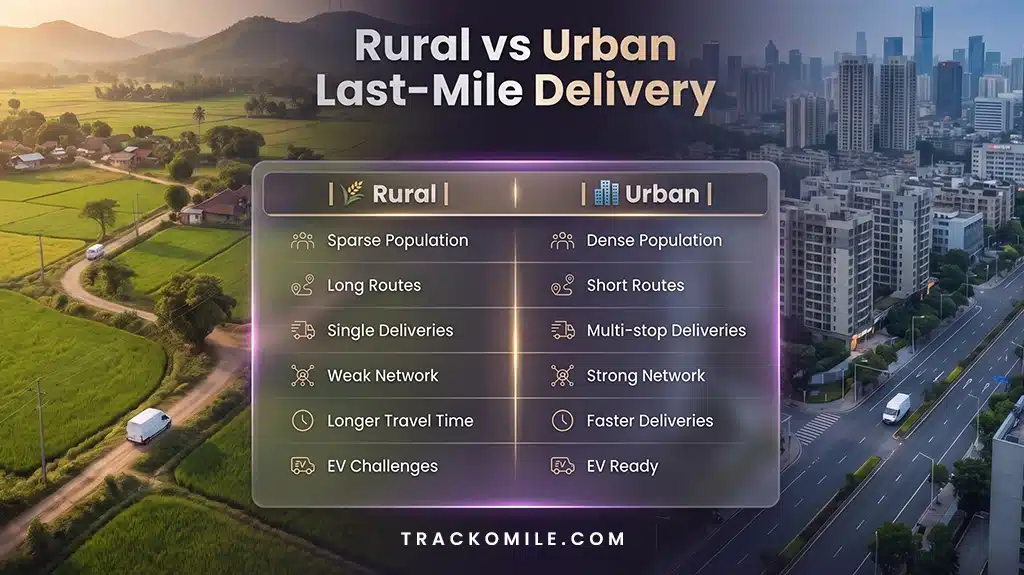
Rural vs Urban Last Mile Delivery Operations
Urban logistics focuses heavily on speed and high delivery volume. Rural logistics focuses more on operational flexibility, workforce coordination, and route efficiency.
Businesses that use the same delivery model for both markets often face rising costs and operational issues.
How TrackoMile Powers Rural Last Mile Delivery
TrackoMile is among the best last mile delivery software in the industry. It boasts a proven track record of streamlining rural and urban deliveries. It’s a great choice for companies looking to expand in rural markets.
TrackoMile offers advanced last-mile solutions and is suitable for large and small companies. The platform supports logistics companies, distributors, e-commerce businesses, and more.
Some important capabilities of TrackoMile include:
- Real-time GPS tracking of riders
- Dynamic dispatch & delivery scheduling
- Smart route optimisation
- ETAs, OTPs & tracking links for customers
- Delivery status updates & ePOD
- Geo-verified attendance reporting
- Live dashboards & reports
TrackoMile improve delivery efficiency while reducing delays, fuel costs, and manual coordination.
The Future of Rural Last Mile Delivery in India
Rural logistics in India is expected to grow rapidly over the next few years due to:
- Rising smartphone usage
- Better digital payments
- Rural ecommerce growth
- Infrastructure improvements
This is creating new opportunities for logistics businesses wishing to explore new markets. At the same time, customer expectations will continue to rise. Rural consumers already expect fast and doorstep deliveries like their urban counterparts. This is especially true for bulk products like agricultural supplies. In the future, these expectations will only get bigger.
To meet them, businesses will increasingly invest in:
- AI-based route optimisation
- Offline rider tracking
- Hyperlocal rural delivery networks
- Electric delivery vehicles
- Drone-based delivery in remote regions
- Smart territory management systems
- Data-driven workforce planning
Automation and AI will play a major role in helping businesses manage last mile delivery in rural regions. But businesses should not wait for new technology to emerge. It’s the software solutions of the current era that will further evolve in the future. Companies that are using last mile delivery tracking software like TrackoMile today will gain a major competitive advantage in the future.
Conclusion
Rural last mile delivery is no longer a secondary logistics function. It has become a core business operation for companies expanding across India.
Logistics companies are tapping into the potential of rural markets. For example, Shadowfax and Delhivery are expanding in remote India rapidly. However, rural last mile delivery isn’t without challenges. In fact, it’s more difficult to execute than urban deliveries and requires intricate planning.
Poor infrastructure, long travel distances, low visibility, and high delivery costs make rural operations far more complex. The solution? A last mile delivery management software specialising in route optimisation and order allocation. Real-time rider tracking and territory planning further simplify remote delivery operations.
Software like TrackoMile helps businesses manage rural deliveries with ease. It offers better operational control, improved productivity, and smarter field coordination. Explore TrackoMile to learn how it can provide you with a competitive advantage in rural last mile deliveries.

Frequently Asked Questions
-
Why is last mile delivery difficult in rural areas?
Rural last mile delivery is difficult because of poor roads and spread-out villages. So, delivery agents end up spending more time travelling. Many areas also have weak mobile networks and unclear addresses. This increases delays, fuel costs, and delivery failure rates.
-
What technology helps in rural last mile delivery?
Last-mile delivery management software can help improve rural deliveries. It offers features like GPS tracking, route planning, and automated dispatch. These features help businesses track rider, assign orders, reduce delays, and plan routes better. Offline apps also help field teams work smoothly in areas with poor internet coverage.
-
How can logistics companies reduce rural delivery costs?
Logistics companies can reduce costs with better route planning. They can also use local delivery partners and group nearby deliveries together. This reduces fuel usage, rider travel time, and repeat trips. Real-time tracking also helps managers handle operations more efficiently in rural areas.
-
How does route optimisation help rural delivery?
Route optimisation software helps delivery teams choose shorter and faster routes. This saves fuel and reduces travel time. It also helps riders complete more deliveries in a day. Thus, they can avoid unnecessary travel between villages and work more efficiently.

Mudit is a seasoned content specialist working for TrackoField. He is an expert in crafting technical, high-impact content for Field force manage... Read More


Related Blog
How Last Mile Technology Improves Delivery Speed, Visibility, and Customer Experience
Learn how last-mile technology combines routing, dispatch, tracking, ePOD, and analytics. Improve your businesses’ delivery speed, visibility, efficiency, and customer…
What is On-Demand Delivery Management Software: Types, Features, & Benefits
This blog explores on-demand delivery management software, its key benefits, and must-have features. Also, we will explore how to choose…
Last Mile Delivery in Construction: Challenges, Solutions & Optimization Strategies
This guide explains how last mile delivery construction software can help improve efficiency, visibility and site coordination.
Last Mile Delivery for Grocery and Food Industry
This blog talks about last mile delivery for grocery & food industry. We will look at how advanced software improves…


Your inbox awaits a welcome email. Stay tuned for the latest blog updates & expert insights.
"While you're here, dive into some more reads or grab quick bites from our social platforms!"Stay Updated on tech, telematics and mobility. Don't miss out on the latest in the industry.