
Delivery management streamlines order allocation, route optimisation, dispatch, and tracking to reduce costs, improve efficiency, and boost customer experience.
Good delivery management is what decides whether a customer orders from your business again or blacklists you forever. Delayed orders, missed windows and high shipping costs often leave a bad impression on the customer. Add to that increasing order volumes and growing complexity of logistics, and managing deliveries manually becomes completely impractical.
What you need is an automated tool to streamline delivery management through smart rider allocation, route optimisation, and dynamic dispatching. Read on to know how a delivery management system works, which features matter, and how to pick the right solution.
What Is Delivery Management & Why Is It Important?
Delivery management is the process of planning, executing, tracking, and improving the movement of goods from businesses to the customers. It starts when the order is ready to leave the shop, warehouse or delivery hub and concludes when the order reaches the customer’s doorstep. At its core, the delivery management process provides managers answers to the following questions:
- What needs to be delivered?
- Who should deliver it?
- What route should they take?
- Is everything going to plan?
- Was the order delivered?
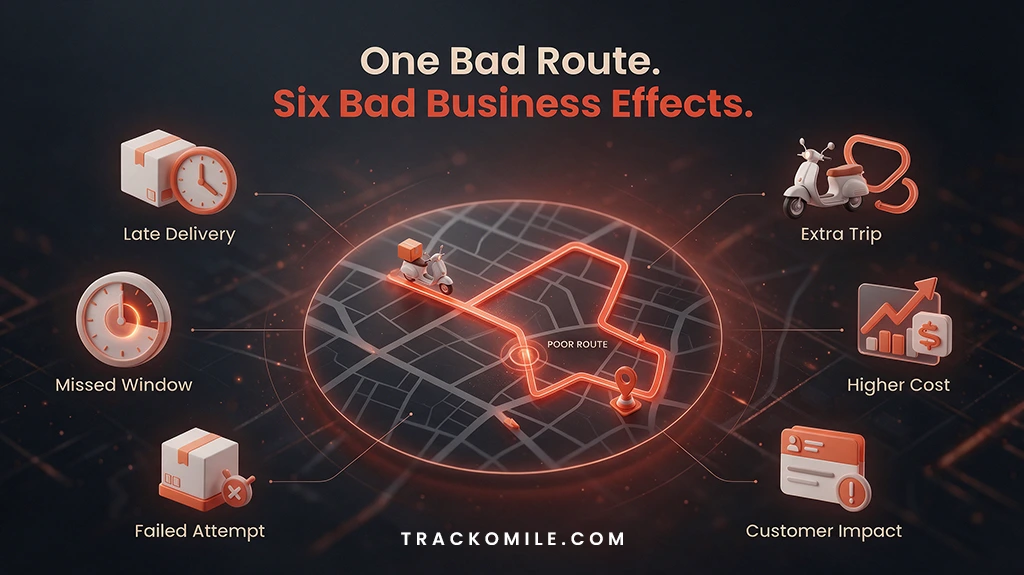
All these activities are connected. A poor route can make a rider late. A late rider may miss a delivery window, leading to a failed delivery, another trip, higher costs, and an unhappy customer.
The reason why last-mile delivery management is important is due to changing customer expectations and evolving market landscape. New technologies, AI, urbanisation, and sustainability rules are all impacting delivery operations.
Industry data shows last-mile delivery now makes up around half of total shipping costs, up to 53%. Scattered stops, traffic, and failed attempts can add up extra costs, which are often passed on to the customers, leading to a poor delivery experience.
Most customers nowadays already expect same-day or next-day delivery with minimum shipping costs. A good delivery experience decides whether the customer makes a repeat order in the future or not.
What Is a Delivery Management System (DMS)?
A delivery management system (DMS) is an automated tool that helps businesses plan, manage, track, and review deliveries from one central platform.
A DMS pulls order, fleet, and location data into one platform, and uses the data to plan and adjust deliveries in real time. There are many components of a DMS, such as:
- Order management
- Route planning & optimisation
- Rider scheduling & allocation
- Real-time tracking & dispatch
- Customer notifications
- Proof of delivery capture
- Data analytics & reports
Without a DMS, logistics companies might end up using multiple tools and manual methods involving scattered data. This can greatly complicate operations. Plus, it only works for small operations. As your business and team size grows, manual delivery management becomes slow and harder to manage, necessitating the need to integrate a DMS.
Who Uses a Delivery Management System?
A delivery management system can be used by any business that handles transportation and last mile delivery of goods. This includes:
| S.No | Industry | Use |
| 1 | E-commerce | Manage high order volume, demand peaks, routes, tracking, and customer updates. |
| 2 | Food & Grocery | Manage time-sensitive orders, riders, and short delivery windows. |
| 3 | Retail | Plan store and home deliveries across different locations. |
| 4 | Pharma | Handle urgent or sensitive deliveries with clear records and reliable confirmation. |
| 5 | Courier & 3PL | Coordinate fleets, clients, routes, and delivery records. |
How Does a Delivery Management System Work? (Step-by-Step)
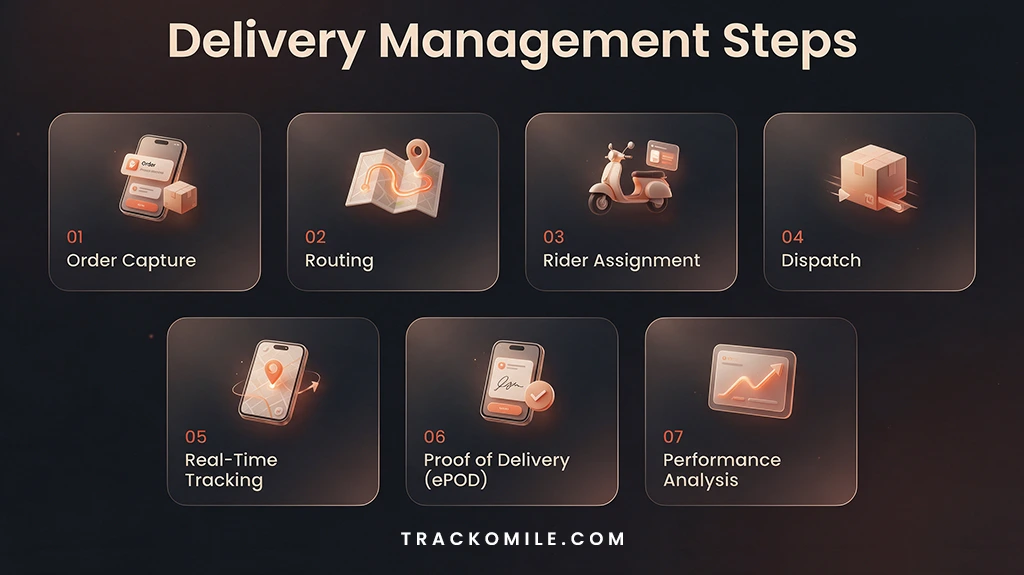
A delivery management system works by capturing orders, planning routes, assigning riders, tracking deliveries, updating customers, and recording proof of delivery in one workflow. Here’s how:
1. Order Capture
Orders come in from a store, app, or website and are sent to the DMS, along with the customer address, item, and delivery-window details.
2. Routing
The DMS builds an efficient schedule of delivery stops, weighing factors like location, traffic, vehicle capacity, and delivery windows.
3. Rider Assignment
Next, orders go to riders based on:
- Availability
- Shift timing
- Skills
- Location
- Capacity
Some systems also consider the vehicle type: a bike is better to travel across narrow lanes, while a van or truck takes the heavy loads.
4. Dispatch
The deliveries are monitored and managed in real time as daily conditions change. Rider unavailability, last-moment order cancellations, delays or new orders are accommodated into the schedule smoothly.
5. Real-Time Visibility
GPS data and status updates give both dispatchers and customers live visibility of deliveries. Managers can catch delays early and fix them, while customers get precise delivery alerts and tracking links.
6. Proof of Delivery (ePOD) Collection
Delivery teams capture a signature, photo, or OTP at the customer locations. This ePOD confirms the job is done and gives both the business and the customer a clear record.
7. Performance Analysis
Delivery data feeds back into the system for analysis by managers. This improves future routes and schedules, and it highlights patterns, such as a zone that consistently runs late or a time slot that customers never choose.
Delivery Management Steps
5 Common Challenges in Delivery Management
Lack of visibility, frequent delivery failures, address gaps and poor fleet utilisation are some widespread challenges in delivery management.
1. Poor Visibility
Without live tracking, managers may not know about delays until the customer complains. This limits their ability to adjust routes or contact customers.
2. High Delivery Failure Rate
Last-mile deliveries are quite error-prone. The reasons vary from customer cancellation to real-time, on-ground issues or complex routes. A failed delivery costs ₹180–₹400 in combined spend. Plus, it also hurts customer trust, and a second attempt rarely costs less than the first.
3. Address Gaps
Incomplete addresses, especially in Tier 2/3 markets, slow delivery teams. It also increases delivery attempts. A single missing unit number can turn a two-minute stop into a ten-minute search.
4. Poor Fleet Utilization
Some riders may have too many stops, while others have too few. Vehicles may also not be used to their full capacity, increasing inefficiency in operations.
5. Rising Customer Demands
Shoppers now expect narrow delivery windows, doorstep delivery, live tracking, and easy rescheduling as standard service. What counted as a premium option until a few years ago has now become a basic requirement of most customers. This is making deliveries more complex and costly.
How Bad Routing Affects Delivery Operations
Key Benefits of a Delivery Management System
The main benefits of a delivery management system include lower delivery costs, more productivity, better customer service and sustainable growth.
1. Lower Delivery Costs
Tighter routes and smarter dispatch cut repeat trips and raise the use of every vehicle. Fuel, maintenance and field expenses all drop as a result.
2. More Productive Teams
Automation reduces time spent on updating spreadsheets, calling riders to get status updates, and preparing routes manually. Managers can instead focus on actual supervisory work and improve their business operations while delivery teams work with more efficiency.
3. Better Customer Service
Live tracking, precise ETAs and timely messages give customers something to rely on, reducing WISMO calls and complaints.
4. Easier Growth
More orders, new service areas, a bigger team – a DMS absorbs all three without increasing the budget.
5. Better Decisions
Delivery history shows where routes, schedules, or staffing need a change and how riders are performing. Managers can then make decisions based on the data collected on the ground and fix operational gaps.
6. Faster Response to Problems
Managers can identify traffic delays, vehicle issues, rider absence, incorrect addresses, and customer changes sooner.
Key Features to Look for in Delivery Management Software
Every delivery management software should have key features like route optimization, automated dispatch, real-time tracking, digital proof of delivery, customer notifications, and analytics.
1. Route Planning & Optimization
The system should consider traffic, delivery windows, staff hours, vehicle capacity, road restrictions, and the number of stops. It should also allow managers to recalibrate routes during the day.
2. Automated Dynamic Dispatch
Automated dispatch can assign orders based on rider location, availability, vehicle type, workload, and delivery priority. This saves time and reduces delivery errors. Last mile delivery management software like TrackoMile factors in 50+ rules during dispatch.
3. Real-Time Tracking
Managers should be able to see live rider locations and delivery progress while routes are in progress. Useful alerts can help teams act before delays affect customers.
4. Digital Proof of Delivery
The software should support proof of delivery capture in the form of:
- OTPs
- Digital signatures
- Photos
- Document uploads
- Barcode scans
- Timestamps & geotags
Digital records are easier to store, find, and use when resolving disputes.
5. Customer Communication
Customers should receive timely and precise tracking links, ETA alerts, out-for-delivery messages, delay notifications, and delivery confirmation update.
6. Reports & Dashboards
The software should offer analytical reports to analyse team performance and spot gaps early. The reports should cover:
- On-time delivery
- Failed deliveries
- Cost per delivery
- Staff performance
- Route performance
- Average delivery time
- Customer feedback
Read More: Top 9 Delivery Management Software in 2026 – TrackoMile
How to Measure Delivery Management Performance (Key KPIs)
Key performance indicators, or KPIs, show managers what is working and where improvements are needed. Here are some useful KPIs to track and why they matter.
| KPI | What It Measures | Why It Matters |
| On-Time Delivery Rate | Orders delivered within the promised time | Shows whether delivery commitments are being met |
| First-Attempt Delivery Rate | Orders delivered on the first attempt | Helps reduce repeat trips and customer inconvenience |
| Cost Per Delivery | Average cost of completing one delivery | Helps track margins and operating costs |
| Average Delivery Time | Time from dispatch to delivery | Shows how quickly deliveries are completed |
| Vehicle Utilization | How effectively the fleet is used | Helps reduce empty capacity and unnecessary trips |
| Failed Delivery Rate | Orders requiring another attempt | Highlights address, access, routing, or availability issues |
How to Choose the Right Delivery Management System for Your Business
Before you choose the right delivery management software for your business, you must weigh in your business size, integration requirement, the rider application and overall budget. You need to have answers to the questions mentioned below
1. Business Size & Scalability
Is the system suitable for the current operations of your business? Is it scalable? Can it work with peak demand periods without any problems? A platform built for 100 deliveries will not be able to manage 10,000 deliveries smoothly.
2. Overall Cost
Can you afford this software, and does it come with any hidden costs for accessing certain features?
3. Ease to Use Mobile App
Can drivers and dispatchers operate a mobile app without any extensive training? If the mobile app is not easy to use, employees might avoid it and stick to manual delivery methods.
4. Integrations
Is it possible for the software to connect to the order management, warehouse, or ERP software via its APIs? Lack of integration often means manual data syncing, which is prone to errors.
5. Industry Fit
Does the DMS fit your industry-based needs, like cold chain supply for pharmaceutical companies or fixed delivery time constraints for perishable items? A standard delivery management application may lack industry-specific requirements.
Conclusion
Delivery management covers everything from order planning, route optimisation, and delivery tracking to ePOD capture. It brings all these functions into one seamless workflow. When order volume starts growing, managing them manually can get messy. The result? Costs surge, delays get more frequent, and keeping customers informed becomes challenging.
With a good delivery management system, teams respond to disruption sooner, vehicles and riders are used with more care, and decisions come from what is happening on the road, not from guesswork. Software like TrackoMile make operations smoother, boost delivery reliability, and help build a scalable process that actually keeps up with business growth.
Frequently Asked Questions
-
How to manage delivery using a delivery management system?
A delivery management system brings order intake, routing, and rider assignment into one place. Managers dispatch jobs and track live progress. They log proof of delivery too. This data then guides changes to routes and staffing.
-
What is the role of a delivery manager?
A delivery manager runs last-mile operations. They plan routes, assign riders, and track shipments. They also watch KPIs like on-time rate and cost per stop. They resolve delays between dispatch, riders, and customers each day.
-
What are the different types of delivery systems?
Delivery systems come in several types. These include direct store delivery and courier or 3PL networks. Other types include in-house fleets, gig-based delivery, and quick commerce. Each fits a different order volume and service need.
-
How does delivery management software enable end-to-end visibility?
Delivery software links order capture, routing, dispatch, and tracking in one system. Live GPS data and status updates give teams a clear view. This view runs from pickup to the customer’s doorstep in real time.

Mudit is a seasoned content specialist working for TrackoField. He is an expert in crafting technical, high-impact content for Field force management software With years of experience rooted in the me... Read More


Related Blog
Building Resilient Delivery Operations with TrackoMile in 2026 and Beyond
Logistics businesses build resilient delivery networks with TrackoMile. But how exactly? With real-time route optimization, automated scheduling, and end-to-end fleet…

How to Scale Quick Commerce Beyond 10 Minutes with TrackoMile
TrackoMile transforms chaotic last-mile logistics into a predictable, automated, and high-margin retail powerhouse. See how it works in quick commerce.
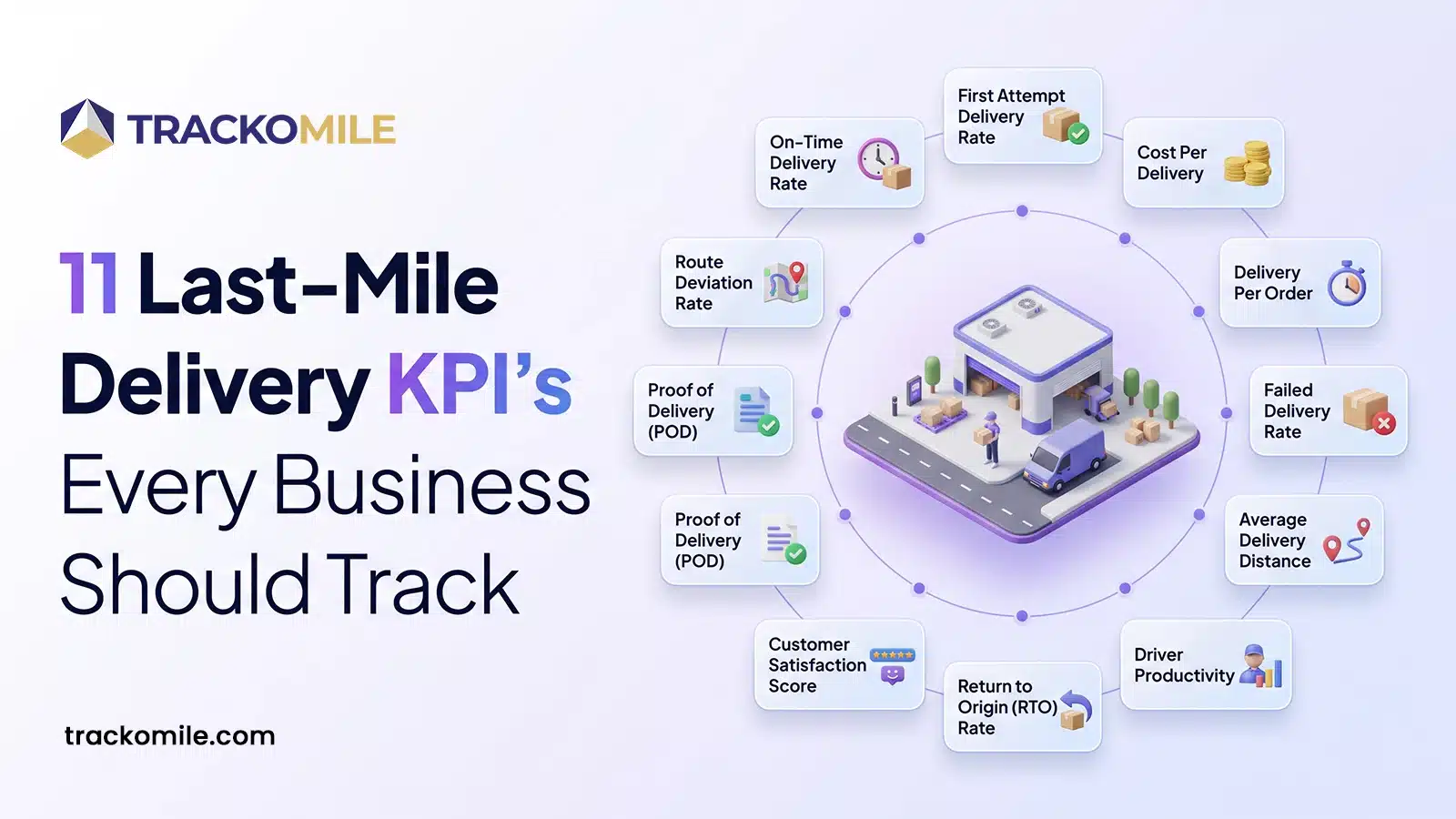
Last Mile Delivery KPIs & Metrics: 11 Essential Metrics to Track
To improve last mile operations, it’s important to track 11 essential last mile delivery KPIs like on-time delivery rate, cost…
Last-Mile Technology: 6 Technologies Transforming Delivery Operations
Learn how last-mile technology combines routing, dispatch, tracking, ePOD, and analytics. Improve your businesses’ delivery speed, visibility, efficiency, and customer…


Your inbox awaits a welcome email. Stay tuned for the latest blog updates & expert insights.
"While you're here, dive into some more reads or grab quick bites from our social platforms!"Stay Updated on tech, telematics and mobility. Don't miss out on the latest in the industry.