
Quick Summary

- Field worker challenges in 2026 include poor visibility, unverified attendance, and inefficient task management, impacting productivity.
- 57% of managers report that lack of real-time visibility leads to underutilized skills and declining team performance.
- Field operations face issues like fake check-ins and inefficient routing, necessitating advanced tracking solutions.
- Implementing software like TrackoField can enhance control, improve visibility, and streamline field operations for better outcomes.
This blog explores the major field worker challenges in 2026. Also, learn how businesses can solve these with better control and visibility.
Field operations today are becoming more complex. Missed updates, delayed tasks, and gaps in field execution are already visible across industries. This shows how field worker challenges are impacting daily operations. A 2026 Skills Visibility Report reveals that 57% of managers found poor visibility leads to underutilized internal skills. Another 56% cite declining team performance as a direct outcome of the same issue.
Together, these data point to a core operational gap. Managers don’t have real-time visibility into workforce capability and field execution. At the same time, it creates a gap in how decisions are made on the ground. Without real-time inputs, field force managers end up reacting late. Often after the issue has already affected operations. Whether it is missed visits, fake attendance, or inefficient routing. Over time, this weakens control over field execution. Plus, it increases operational leakage across teams.
In this sounds familiar, your field operations are already facing these challenges in 2026. In this blog we will explore their impact and how modern FFM software can solve them.
Data Source – TalentLMS Skills Visibility Report 2026
Who is a Field Worker and What They Do?
A field worker is an employee who performs job tasks outside the office. This is usually at customer locations, sites, or across assigned territories.
They are responsible for executing on-ground activities. It directly impacts service delivery, sales, or operations.
What Do Field Workers or Agents Do?
Field agents handle day-to-day tasks that require physical presence in the field. It typically includes:
- Visiting customer locations for service, delivery, or sales
- Completing assigned tasks within a defined territory or beat
- Updating task status and reporting work completion
- Coordinating with managers for schedules, issues, or follow-ups
- Managing travel routes and time between multiple locations
Since they work outside the office, managers struggle to gain real-time visibility. They cannot track task progress, expenses, routes, and attendance. This weakens transparency and accountability. Altogether, they snowball into major field challenges. Let’s dive deeper in the next section!
Top 5 Challenges to Manage Field Workers in 2026
Real-time visibility, unverified visits, and cases of proxy or inaccurate attendance check-ins are some common challenges faced by field employees and their managers.
1. Lack of Real Time Visibility into Field Activity
Managers cannot reliably track where employees are. Also, which routes they are following. Whether they have reached the client location, or how long they are spending at each stop. This leads to:
- No control over field movements and route adherence
- Reactive decision based on delayed reports
- Limited visibility into actual task progress during the day
To overcome these challenges, businesses need a field employee tracking software. It captures field activity including location, routes, and task status.
Do You Know?
Workforce analytics shows a clear gap between time logged and actual work done. In field teams, limited real-time tracking makes this gap harder to detect during the day.
2. Attendance vs Actual Field Presence
Unverified attendance is one of the major problems in field force management. In many cases, check ins are marked without being at the assigned location. This leads to:
- Fake or proxy check-ins
- Unverified working hours or shifts
- Reduced accountability in field execution
- Safety risks when employee’s location is unknown
Companies should use location-based and face AI attendance. So, they can ensure check-ins are recorded from the correct location and time.
3. Inefficient Field Visits
Field teams spend a major part of their day travelling or waiting between visits, instead of completing actual work. Visit schedules are not always aligned with location, priority, or real-time conditions. This results in:
- Fewer visits completed in a day
- High fuel costs caused by long routes
- Low productivity per field resource
To overcome these field worker challenges, companies should plan field visits. Based on location, priority, and availability.
4. Poor Expense Tracking
Field employees incur daily expenses on travel, fuel, and on-ground activities. When these are tracked manually or submitted later, it becomes difficult to verify. As a result, they cannot process reimbursements accurately. This leads to:
- Delays in expense reporting and approvals
- Difficulty validating actual spend vs claimed amount
- Lack of visibility into field-related costs
- Risk of over-reporting or missed entries
Companies should use structured expense tracking. Here, employees log expenses in real time with basic details like amount, category, and proof.
5. Inefficient Order and Task Management
Field teams often handle orders, collections, or service tasks during visits. When these are managed manually or across disconnected systems, it creates gaps in tracking and follow-up. It results in:
- Missed or delayed order updates
- Lack of clarity on task completion status
- Errors in reporting or documentation
- Poor coordination between field and office teams
Companies should make it easy for field teams to record basic details and proof in real time, in a centralized system. At the same time, task distribution should be context-aware. This includes location, skill, workload, and urgency-based allocation.
However, to bring all of these solutions together. Businesses can consider a field employee tracking and management software like TrackoField. It offers 100% visibility into field activities even in offline mode. Read on to learn how TrackoField can help you solve field worker challenges.
How TrackoField Helps Overcome These Challenges?
By offering real-time tracking, geo-verified task allocation, and AI-face recognition attendance into a centralized system. TrackoField helps you to solve challenges faced by field employees. Here’s how:
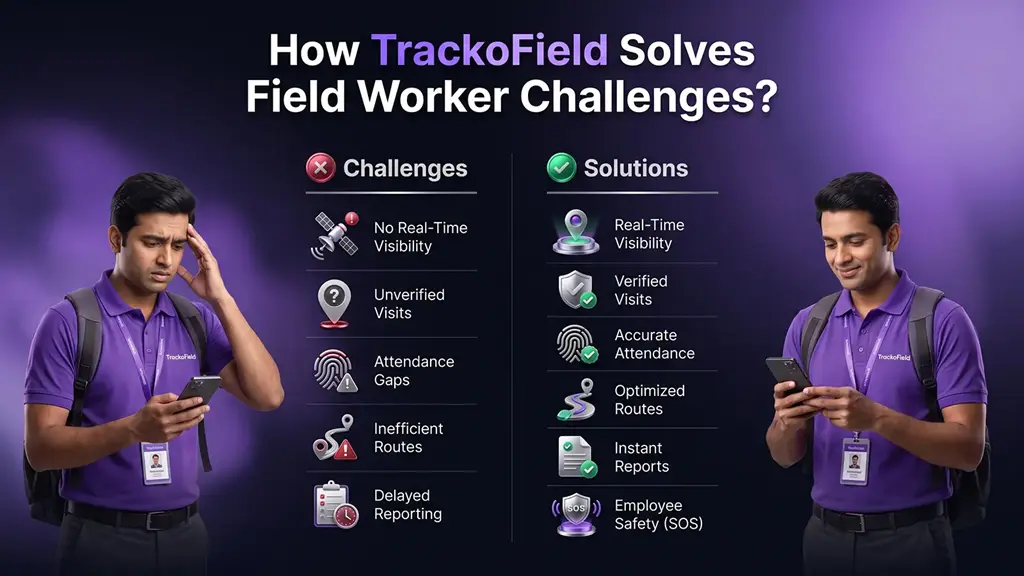
How TrackoField Solves Field Worker Challenges
AI Face Recognition
TrackoField’s AI face attendance software offer secure mark-in and mark-out along with location and time stamps with photo. This ensures that attendance is only captured when the right person is present at the right time.
With protection against GPS spoofing and time theft, it improves the reliability of attendance data. Plus, employees can mark their attendance even in offline mode.
Remote Task Management
TrackoField’s task management software allows managers to plan, assign, and monitor field work. That too, without losing visibility on execution. It offers clear insights into distance travel along with a comparison of actual working hours versus on-duty hours.
It also supports custom forms, document uploads, and scanner-based data capture. This educe errors and standardize field reporting. Plus, employees can also self-allocate tasks for better flexibility in execution.
Territory Management
TrackoField’s territory management helps businesses define who is responsible for which region. So, managers can ensure better ownership and complete field coverage. It removes confusion in assignments and helps managers organize field operations more systematically.
Managers can track territory-wise performance and understand how each region is performing. With map-based visualization, they get a clear view of field distribution.
Automated BEAT Planning
TrackoField helps managers plan visits in seconds by using AI-based optimization. It automatically suggests the most efficient routes. So, you can organize field visits, making daily planning faster and more structured.
Field teams can follow clearly assigned routes and visit priorities. This ensures that important locations are covered on time. Managers can also track real-time adherence to planned beats. Also, they can see whether field employees are following the assigned schedule.
AI Manager Bot
TrackoField’s AI Manager Bot helps field and operations leaders get quick answers. They do not have to go through multiple reports or dashboards. It is designed to simplify decision-making. This allows managers to query attendance, tasks, and field activity directly through text or voice.
It also supports role-based access, so users can access only relevant data as per their level. This reduces dependency on manual reporting. Also, managers can make faster and more informed decisions.
Conclusion
In 2026, field worker challenges are no longer about lack of effort. Here the real gap is lack of real-time visibility and control over field operations. Unverified visits, attendance gaps, inefficient planning, and delayed reporting. All of these issues impact productivity and ROI.
This is where the need shifts clearly toward a unified field force management software like TrackoField. It connects planning, visibility, and control into a single system. Managers can track field work in real time, check productivity, and verify tasks with clear reports and updates. It also supports smarter communication with voice notes to assign tasks faster and avoid confusion.
The result is better control, faster decisions, and more predictable execution. This is exactly what modern field teams need in 2026.

Frequently Asked Questions
-
How do field worker challenges affect business performance?
Field worker challenges directly affect operational efficiency. Unplanned routes, fake attendance, and lack of visibility over tasks. These leads to issues like delayed reporting, missed visits, and high operational costs. Over time, this reduces productivity. This makes it harder for managers to control field execution effectively.
-
What are the key Benefits of Solving Field Workforce Challenges?
By solving field workforce challenges, businesses can improve overall efficiency. Also, they can improve productivity of their field teams. It helps reduce delays, unnecessary travel, and manual errors. This gives managers better visibility and control over daily field activities. So, you can ensure smooth and reliable on-ground performance.
-
Which software is best for managing field workers?
TrackoField proudly stands among the Top field force management software. It offers planning, visibility, and control in one platform. Managers can plan visits, assign tasks, monitor attendance, and review performance from one dashboard. At the same time, field agents can create their own tasks based on field conditions. With real-time alerts, managers stay updated on every field movement.

Parul is a content writer with 2+ years of experience in B2B and SaaS domains. She creates clear, actionable content for TrackoBit and TrackoMile, focusing on fleet management, last-mile delivery, and... Read More


Related Blog
Sales Territory Management: 6 Best Practices for High-Performing Teams
Poor sales territory management can quietly stifle sales growth. Understand how companies can create high-performing territories.
TrackoField’s Manager Bot: Bringing the Future of Field Force Intelligence to You Today
TrackoField’s AI Manager Bot transforms field force management into field force intelligence by turning operational data into instant AI-powered insights.
Face Recognition: What It Is, How It Works & Benefits for Field Teams
Facial recognition is a way of identifying or confirming an individual’s identity using their facial features. Read this guide to…
Field Operations Manager: Roles, Challenges & How to Optimize Performance
Field operations managers handle on-ground activities with challenges like visibility, control, and coordination. This blog covers their roles, key challenges,…


Your inbox awaits a welcome email. Stay tuned for the latest blog updates & expert insights.
"While you're here, dive into some more reads or grab quick bites from our social platforms!"Stay Updated on tech, telematics and mobility. Don't miss out on the latest in the industry.