

Poor sales territory management can quietly stifle sales growth. Understand how companies can create high-performing territories.
Your sales team could have experienced representatives and a solid sales funnel. If sales territories are imbalanced, however, performance may still be compromised. Some reps spend hours going from one customer to another. The result? Lost sales, inconsistent customer service, and sluggish sales.
The challenge is that many businesses create sales territories and don’t touch them again. However, markets evolve, demands change, and sales teams expand. What worked well six months ago, might not work well today.
This is where sales territory management comes in. It helps businesses distribute accounts and territories more strategically. So, businesses can balance workloads and improve customer coverage. As a result, every representative has a fair opportunity to perform. Plus, every territory has the potential to deliver better results.
What is Sales Territory Management?
Sales territory management is the process of planning and managing sales territories to keep them balanced and effective. The goal is to ensure that every sales representative has the right mix of customers, opportunities, and workload.
Sales territories need not be geographically based. Another way to segment territories for businesses is by:
- Customer type
- Industry
- Account value
- Product line
- Sales potential
In addition, sales territory management also includes tracking the performance of each territory. Territories should be reviewed and updated to remain balanced when markets change, and sales teams expand.
Why Sales Territory Management Matters?
Sales territory management is important because it is directly related to sales productivity, customer coverage, and sales revenue. Alexander Group estimates that sales organizations can boost sales productivity by 10–20% by optimizing their sales territory.
If territories are not managed correctly, it affects the business. There are territories that are overloaded, and others are untouched that have potential. High-value accounts might not receive the attention that they deserve. This results in loss of sales opportunities, reduced productivity, and high sales costs.
Good sales territory management helps businesses to:
- Boost sales productivity by assigning well-rounded territories to each rep.
- Spend more time on customer coverage to ensure that high-potential customers aren’t lost.
- Reduce travel time and increase the time spent selling.
- Distribute selling resources in areas that will yield the greatest return.
- Grow your business without always increasing your sales staff.
Let’s now discuss territory management strategies that will help you create well-balanced, high-performing territories.
6 Best Practices for Sales Territory Management
The sales territory management best practices are defining your ideal customer profile (ICP), balancing sales territory capacity and managing territory performance. Read on to find out more.
1. Define Your ICP Before Creating Territories
If there is no clear Ideal Customer Profile (ICP), it can be challenging to make balanced sales territories. Some territories may end up with high potential clients, while others have limited revenue potential.
Prior to assigning territories, businesses should consider the following:
- Industry
- Company size
- Annual revenue
- Buying potential
- Product fit
- Growth potential
After determining the ideal customers, divide the accounts with similar revenue potential. This means businesses can find a way to achieve more market coverage. Also, you can minimize revenue imbalance between territories.
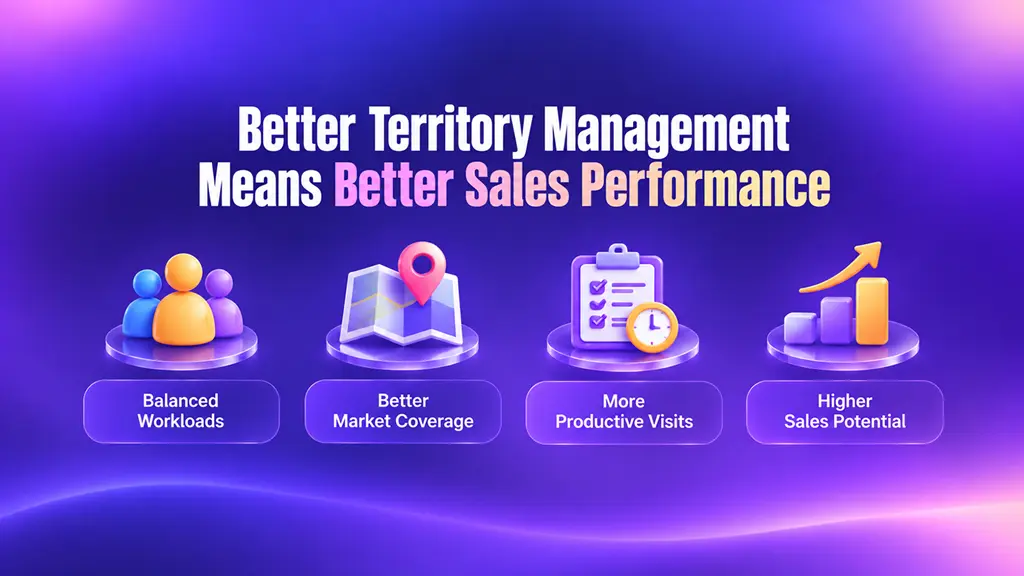
High Performing Territories Leads to High Sales
2. Balance Territory Capacity
Many companies distribute an equal amount of accounts to each salesperson. However, an equal number of accounts does not equate to an equal workload. There could be big enterprise accounts in one territory that require regular meetings. However, another might have smaller accounts that are sold quickly.
When planning the capacity of territories, take into account the following:
- Revenue potential
- Number of active accounts
- Visit frequency
- Sales cycle length
- Travel time
- Existing pipeline
Thus, businesses can make sure that each and every sales representative has sufficient chances to excel without overloading them.
3. Use Territory Mapping to Identify Coverage Gaps
With a sales team expanding, it can be hard to determine if all markets are being served correctly. There could be strong sales activities in some areas. Others can get little attention.
Territory mapping enables managers to visualize the areas in which their teams are working and where they can concentrate more. It helps businesses to discover:
- Uncovered regions
- Overlapping territories
- Regions having growth potential
It will help to increase market coverage and direct sales efforts to the appropriate markets.
4. Plan Customer Visits Based on Territory Priority
All customers are not created equal. Some accounts require regular visits. Some may require follow-ups every now and then. Businesses can organize visits on the basis of:
- Account priority
- Visit frequency
- Business potential
Managers can also save on unnecessary travel time and costs with a structured BEAT plan. Not to mention, it provides better customer coverage.
5. Monitor Territory Performance Regularly
Creating sales territories is only the first step. Sales managers also must be aware of the performance of each territory. They should measure things such as:
- Revenue generated
- Target vs achievement report
- Customer coverage
- New account acquisition
- Sales activity
- Conversion rate
Frequent reviews enable managers to recognize trends, coach sales person, and make informed decisions on territory adjustments.
6. Use Sales Territory Management Software
A few sales territories can be managed using spreadsheets. But as your sales team grows, managing territories becomes more complex. Territory updates are needed for each new account, employee, or market change.
Sales territory management software can help companies:
- Establish and maintain hierarchy of territories
- Designate territories to appropriate sales people.
- Draw a map of the territory area
- Plan customer visits and beat plans
- Monitor territory-wise performance
This allows managers to have more visibility, less manual work, and easier scaling of territory planning.
What Are the Common Sales Territory Management Mistakes to Avoid?
Uneven territory allocation, poor market coverage, unclear ownership, and relying on manual planning are the common territory management mistakes to avoid. The table below highlights the best way to avoid them.
| Common Mistake | Best Practices |
| Uneven revenue potential across territories. | Balance territory capacity. |
| Too much travel between customer visits. | Optimize territory coverage and beat plans. |
| Overlapping territory ownership. | Assign clear territory ownership. |
| Low coverage of high-value accounts. | Prioritize accounts using ICP. |
| Delayed territory adjustments. | Monitor territory performance regularly. |
| Managing territories in spreadsheets | Use sales territory management software. |
Conclusion
Sales territory management is not just about dividing regions or assigning accounts. It is about giving every sales representative a fair opportunity to meet their sales targets. So, ultimately businesses can achieve better market coverage and revenue growth.
This is exactly what field force management software like TrackoField helps businesses achieve. With built-in territory management software, it provides structured territory planning. Businesses get clear ownership, beat planning, and real-time performance visibility. This all from a single platform. So, you can build balanced sales territories, improve sales productivity, and support growth.

Frequently Asked Questions
-
How do you design a balanced sales territory?
Start with your ideal customer and their revenue potential. Then divide accounts by workload, travel time, and business opportunity. Geography alone won’t give you a balanced split. Review territory performance regularly and adjust as your business grows.
-
What software is used for sales territory management?
Sales teams use territory management software like TrackoField to create and manage territories. It helps managers plan customer visits, track territory performance, and run field sales from one platform.
-
What are the different types of sales territories?
The most common types are geographic, industry-based, customer-based, product-based, and account-based territories. Businesses can pick the one that fits their sales model, or combine two.
-
How does TrackoField support sales territory planning?
TrackoField lets businesses build multi-level territory hierarchies. They can also assign territory ownership, and map sales reps to the right territories. It also supports beat planning, territory-wise reporting, and real-time visibility. So, field sales operations are easier to scale.

Parul is a content writer with 2+ years of experience in B2B and SaaS domains. She creates clear, actionable content for TrackoBit and TrackoMile, focusing on fleet management, last-mile delivery, and... Read More



Related Blog

TrackoField’s Manager Bot: Bringing the Future of Field Force Intelligence to You Today
TrackoField’s AI Manager Bot transforms field force management into field force intelligence by turning operational data into instant AI-powered insights.

Face Recognition: What It Is, How It Works & Benefits for Field Teams
Facial recognition is a way of identifying or confirming an individual’s identity using their facial features. Read this guide to…
Field Operations Manager: Roles, Challenges & How to Optimize Performance
Field operations managers handle on-ground activities with challenges like visibility, control, and coordination. This blog covers their roles, key challenges,…

What is Face Recognition Attendance Software & How Does It Work?
This blog explains the concept of face recognition attendance software. We will also explore how it enhances attendance monitoring for…


Your inbox awaits a welcome email. Stay tuned for the latest blog updates & expert insights.
"While you're here, dive into some more reads or grab quick bites from our social platforms!"Stay Updated on tech, telematics and mobility. Don't miss out on the latest in the industry.