
Quick Summary

- Territory management assigns geographical areas to field teams, improving task ownership and customer coverage.
- It reduces overlapping visits and enhances visibility for managers, leading to better operational control.
- Challenges like unclear ownership and manual management can hinder efficiency, but automated systems like TrackoField offer solutions.
- Effective territory management is crucial across industries, ensuring balanced workloads and optimized field operations for improved productivity.
Check out the complete guide to territory management for field sales teams. Learn how software like TrackoField improves coverage and operational visibility.
Field operations teams suffer when territory ownership is unclear. Two reps may visit the same customer. Some regions may receive no visits at all. Structured, region-wise reporting also becomes a challenge. So, managers struggle to track field activity across different clusters. These problems only get bigger as businesses scale.
This is where field sales territory management becomes important. It allows businesses to:
- Assign regions clearly
- Manage task ownership
- Balance employee workload
- Improve customer coverage
- Reduce duplicate visits
- Get territory-wise insights
The result? Better control and visibility over field operations. The workload of field agents are also balanced which improves productivity.
This guide explains territory management in detail. Read on to know why it matters, common challenges, implementation steps, and industry use cases. Also discover how AI-powered field force automation software can simplify sales territory management.
What Is Territory Management?
Territory management is the process of assigning and managing geographical areas for field teams. It helps businesses:
- Better define ownership of tasks
- Improve customer coverage
- Reduce work overlaps
- Track region-wise field performance
Territory management has two-way benefits. It ensures every field employee knows where they should operate. Field force managers get better team oversight.
Here’s more:
- Businesses avoid duplicate visits.
- Managers gain better visibility of field operations.
- Employees work with more clarity.
- Customers receive better service.
Many companies also call this process zone-based sales management. This is because field teams are assigned specific operational zones.
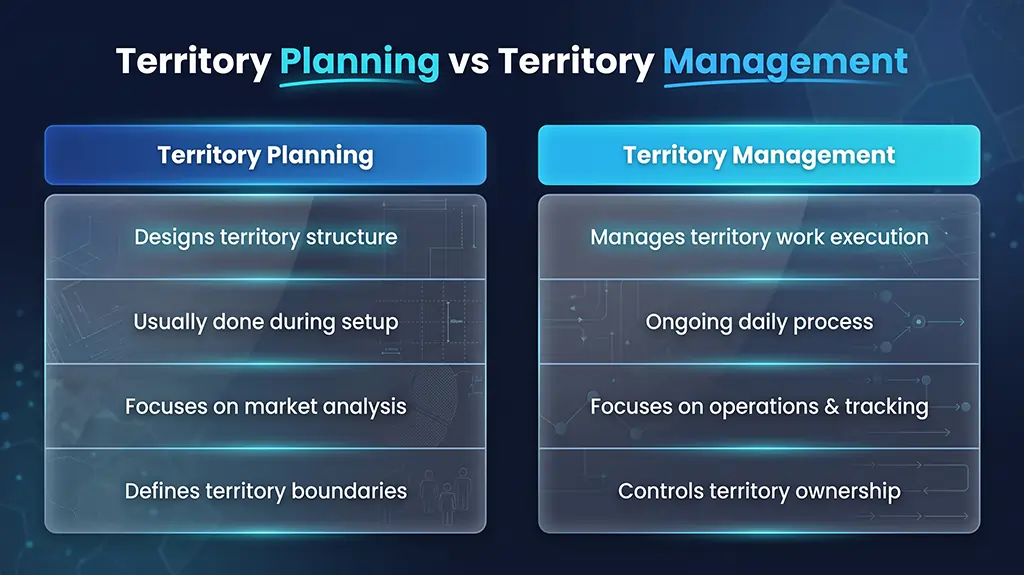
Territory Management vs Territory Planning
Territory management is often confused with territory planning. They sound similar but are quite different.
Territory planning focuses on creating territories. Businesses divide markets by analysing customer density or scope of operations.
Territory management focuses on execution of daily works. This includes:
- Assigning employees
- Monitoring activities
- Review performance
- Continuously optimising territories
Both processes go hand in hand. Planning creates the structure while management keeps operations organised every day.
Territory Planning vs Territory Management
Why Territory Management Matters for Field Sales Teams
Field sales teams perform better when territories are organised properly. Businesses using structured territory management systems report considerable improvement in rep productivity. Coverage also improves and sales reps’ travel time is reduced.
Without field sales territory management, on-ground operations become difficult to control. Small inefficiencies arise which create major operational problems later.
Here are some common issues businesses face without proper sales territory management:
- Overlapping visits across the same market
- Uncovered zones with missed sales opportunities
- No area-wise visibility for managers
- Poor accountability among field teams
- Uneven workload distribution
- Higher fuel and travel costs
- Slower customer response time
An automated territory management system solves these problems through:
- Clear ownership of every region
- Better field movement planning
- Faster customer response time
- Improved employee accountability
- Structured territory-wise reporting
- Easier expansion into new markets
- Better visibility for managers
Positive customer experience is key for success in the sales realm. Field sales territory management helps improve it. Customers interact with the same field representative regularly. This builds a better rapport and helps in relationship management.
Managers also gain stronger control over field execution. They help identify low-performing regions faster. They rebalance workloads quickly which improve territory coverage.
Common Territory Management Challenges (and How to Solve Them)
Businesses face many challenges while managing territories like work overlaps and low visibility.
Many businesses still manage territories manually. They rely on spreadsheets, static maps, or use WhatsApp. These systems may work for small teams. However, they become difficult to manage as operations grow.
Below are some common territory management challenges and practical solutions.
|
Challenge |
Solution |
| Manual zone assignment creates confusion and ownership conflicts |
Use a structured hierarchy system where levels, managers, and reps are managed centrally |
| Multiple reps visit the same area | Assign territories through controlled hierarchy rules and ownership logic |
| Reps resist territory changes because workloads feel unfair |
Use workload-based territory assignment for reps. Consider customer density, travel distance, and visit volume |
| Managers lack live visibility into field execution |
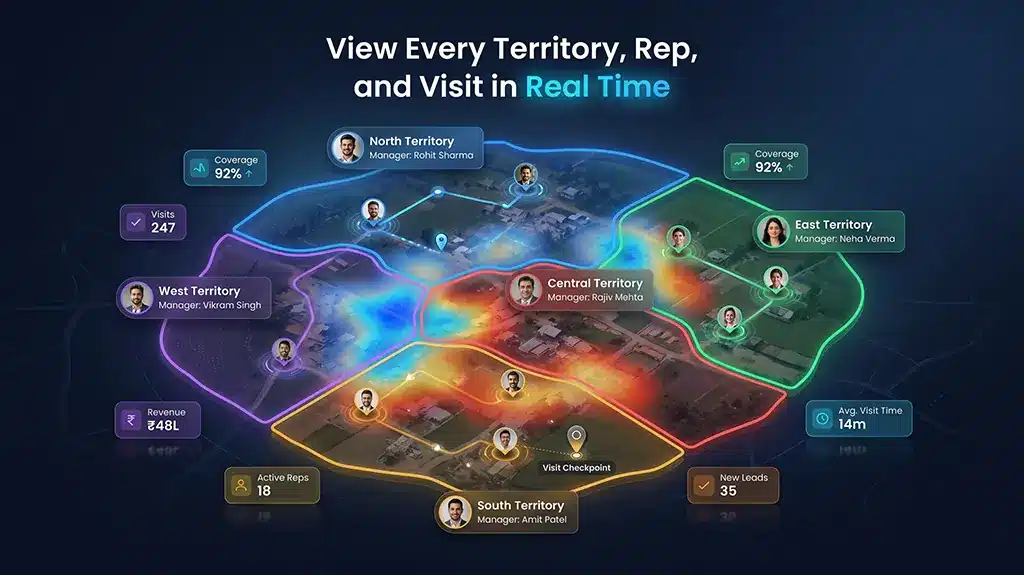
Use geofence territory planning with live tracking and territory-wise reporting |
| Low network connectivity affects reporting in rural areas |
Use mobile apps with offline functionality and auto data syncing |
These issues directly affect field sales workflow.
- Overlapping territories increase fuel costs and reduce coverage.
- Poor visibility creates reporting gaps and delays decision-making.
- Managers cannot identify whether reps are visiting assigned areas.
- Workload imbalance creates frustration among field teams. High-performers end up being overworked while others are underutilised.
Modern territory management tools solve these issues through automation and real-time tracking. TrackoField helps businesses create territories, assign ownership, map employees, and get territory-wise data. Managers get better operational control while field teams work with more clarity.
How to Build a Territory Management Plan: Step-by-Step
Building a territory management plan requires more than dividing regions on a map. It’s an intricate process that involves factors like:
- Customer coverage
- Travel distance
- Staff workload
- Regional infrastructure
A poorly planned territory structure can lead to long-term operational issues. Here is a step-by-step approach to build an efficient territory management plan.
Step 1: Define Your Territory Levels
The first step is creating a territory structure. Every business operates differently. Some businesses may structure territories as:
- Country → State → City → Zone
Others may use:
- Cluster → Region → Area → Branch
Thse levels create the operational foundation. Without properly defined levels, businesses struggle to manage ownership and reporting.
Field force management software like TrackoField let you configure up to 10 territory levels. This is based on operational requirements. This flexibility becomes useful for businesses operating across multiple regions.
Step 2: Map Existing Customers & Prospects by Geography
Once territory levels are defined, businesses should map customers and prospects geographically. This includes:
- Existing customers
- Leads
- Retail outlets
- Distributors
- Service locations
- Dealer networks
Geographic mapping helps businesses identify:
- High-demand regions
- Under-served markets
- Customer concentration
- Travel-heavy territories
This step is important. Without geographic mapping, businesses may assign territories unevenly. Some reps may become overloaded while others manage fewer customers.
Step 3: Assign Reps Based on Capacity & Workload
Territory assignment for sales reps should be balanced carefully. Managers should not assign territories randomly. Instead, they should evaluate:
- Customer volume
- Area size
- Daily visit capacity
- Travel requirements
- Existing workload
Balanced territories improve productivity. They also reduce employee frustration and improve retention. When workloads feel fair, field reps adapt to territory changes more easily.
Step 4: Set Territory Managers With Clear Ownership Rules
All territories should have a manager and they should know:
- Which regions they control
- Which employees report to them
- Which operational activities they supervise
Clear ownership improves accountability. It also improves reporting clarity. TrackoField follows a controlled hierarchy structure. Each territory can have one manager. Managers can control multiple territories within their hierarchy. This prevents cross-region confusion.
Step 5: Plan Beat Routes Within Each Territory
Territory planning should include beat planning. Once territories are assigned, businesses should define travel routes and visit schedules. This helps:
- Reduce travel time
- Improve visit consistency
- Increase daily coverage
- Lower operational costs
- Improve fuel efficiency
Beat planning is especially important for industries with high field movement like:
- FMCG
- NBFC & MFI
- Pharma
- Agri input
- BFSI collections
Poor route planning increases travel costs significantly. It also reduces the number of customer visits completed daily.
Step 6: Track Territory-Wise Performance
Territory management requires strong reporting. Managers should track:
- Territory-wise sales
- Visit completion rates
- Customer coverage
- Task completion
- Collection performance
- Rep productivity
- New customer acquisition
Zone-wise reporting helps businesses identify weak regions quickly. Managers can take corrective action faster.
Step 7: Review and Rebalance Quarterly
Territories do not remain fixed forever. Markets change continuously. Customer density grows. New regions open. Some territories become overloaded. Businesses should review territories quarterly.
This helps:
- Rebalance workloads
- Improve coverage
- Add new territories
- Remove inactive regions
- Optimise travel routes
Regular reviews help businesses scale operations without losing control.
View Every Territory, Rep, and Visit in Real Time
Territory Management Across Industries: FMCG, Pharma, Agri, BFSI
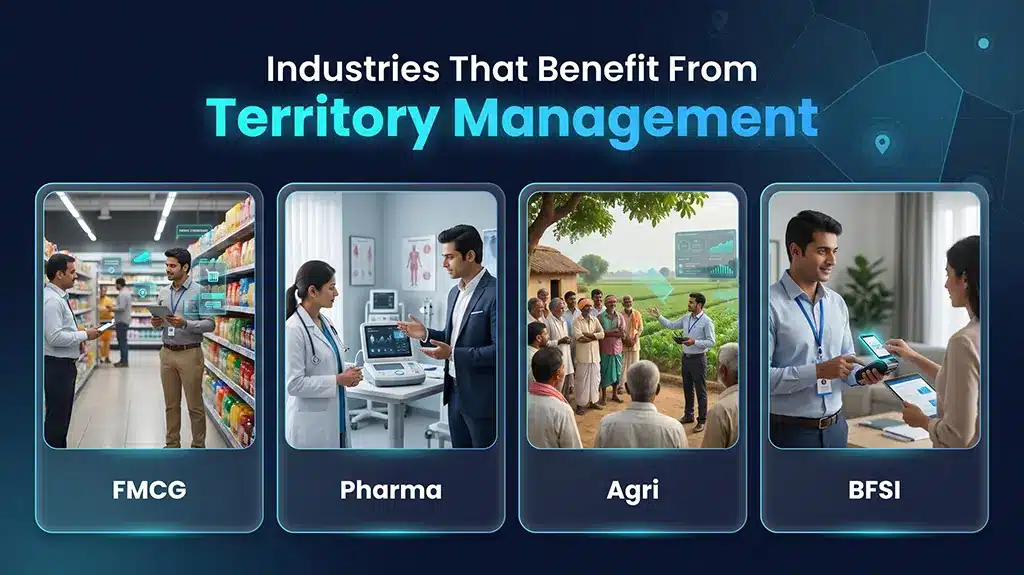
Territory management is useful across industries with distributed field operations. Industries use territory management differently. However, the goal remains the same. Improve coverage, ownership and field work execution.
1. FMCG
FMCG companies manage large retailer and distributor networks. Field teams visit hundreds of outlets every week. Without defined territories, duplicate visits and missed outlets become common. Territory management helps FMCG businesses:
- Assign sales reps area-wise
- Improve retailer coverage
- Manage beat plans better
- Reduce overlapping visits
- Track outlet-wise sales performance
This improves market penetration and distributor coordination.
2. Pharma
Pharma companies depend heavily on medical representatives. They visit clinics, hospitals, and pharmacies selling medical products. Territory management helps pharma businesses:
- Assign reps region-wise
- Optimise field visits
- Track rep productivity
- Maintain reporting discipline
3. Agri Input
Agri input companies operate across villages and rural markets. Field teams often travel long distances. Territory management helps agri businesses:
- Map villages and farmer clusters
- Improve rural coverage
- Assign field officers clearly
- Manage distributor networks
- Track field campaigns better
This becomes extremely important during seasonal demand periods.
4. BFSI
Banking institutions like NBFCs have large field teams for sales, onboarding, and collections. Territory management helps BFSI businesses:
- Assign borrowers territory-wise
- Improve collection tracking
- Reduce overlapping visits
- Improve customer response time
- Strengthen accountability
Industries That Benefit From Territory Management
What to Look for in Territory Management Software?
Live field visibility, territory-wise reporting and configurable territory levels are some of the essential features in a territory management platform. Here are all the important features businesses should to look for:
1. Configurable Territory Levels
Businesses should be able to create custom territory structures. The software should support:
- Country → State → City → Zone
- Region → Area → Branch
Flexible hierarchy management becomes important as operations expand.
2. Territory-Based Employee Assignment
Managers should be able to assign employees territory-wise. The software should support controlled ownership rules. This improves:
- Accountability
- Reporting clarity
- Operational discipline
- Task allocation
3. Live Field Visibility
Managers need live visibility into field activities across clusters. A strong territory management system should provide:
- Real-time tracking
- Area-wise monitoring
- Visit validation
- Task status visibility
This helps managers monitor field execution more effectively.
4. Territory-Wise Reporting
The software should generate automatic territory-wise reports. This speeds up the process and helps businesses analyse:
- Sales performance
- Customer coverage
- Productivity
- Collections efficiency
- Task completion
5. Mobile Accessibility
Field teams need visibility of territories while travelling. The software should provide mobile access for:
- Assigned territories
- Tasks
- Beat plans
- Customer locations
- Expense reporting
Mobile accessibility improves coordination between managers and field reps.
6. Scalability
As businesses grow, territory structures become more complex. The software should support:
- Large field teams
- Multiple territory levels
- Cross-region operations
- Flexible hierarchy updates
This allows businesses to scale smoothly.
How TrackoField Simplifies Territory Management For Field Teams
TrackoField provides field managers control and visibility all in one platform. Companies can create custom territory levels based on their operational needs. Territories can then be organised into parent-child hierarchies. TrackoField supports:
- Configurable territory levels
- Territory hierarchy management
- Territory-wise employee mapping
- Territory manager assignment
- Territory activation and deactivation
- Territory-wise reporting
- Mobile visibility for field teams
The platform also follows a single source of truth approach. Employee territory mapping automatically flows across modules like:
- Tasks
- Customers
- Sales orders
- Expense
- Reports
This removes manual territory tagging. It also improves reporting consistency. TrackoField provides visibility of territories on mobile applications as well. Managers and field reps can view:
- Territory mappings
- Reporting structures
- Assigned activities
- Team visibility
Thus, managers gain stronger visibility while field teams’ work with better coordination. Employees work within clearly defined territory boundaries. The result is no more overlaps, faster reporting, and improved productivity.
Conclusion
Territory management is often an overlooked process in field operations, especially in sales. Without territory ownership, businesses struggle with clashing visits, poor coverage, and low visibility. As your field force grows, these issues only multiply.
To tackle these problems, you need a smart strategy for handling territories. This can be achieved using field force automation software like TrackoField. It offers a dedicated territory management module. It helps you configure zone boundaries, create custom hierarchies, and get territory-wise reporting.
This can help you boost accountability, get visibility, and keep your field operations under control. TrackoField helps businesses build structured, scalable, and high-performing field operations. Get in touch today to know more!

Frequently Asked Questions
-
What is territory management in sales?
Territory management in sales means dividing areas of operations among field reps. These areas are based on location, company branches, customer density, and more. It helps businesses manage field work better and improve customer coverage. It is also called zone-based sales management because sales teams work inside fixed zones.
-
What is the difference between territory management and territory planning?
Territory planning means creating and dividing sales zones before field work starts. Territory management means handling daily work inside those zones. It includes task tracking, employee monitoring, and performance checks. Planning refers to building the structure. Management helps run it every day.
-
What is the best software for territory management in India?
Many companies in India use territory management software like TrackoField, LeadSquared, and Lystloc. TrackoField is popular among FMCG, pharma, agri-input, and BFSI companies. It offers several other useful features like offline mode, AI analytics, and beat planning.
-
What is beat planning in territory management?
Beat planning means creating fixed travel routes for field agents. These routes can be daily or weekly. They are planned in advance based on staff availability, traffic, and other conditions. Smart beat planning helps field reps meet customers on time, avoid extra travel, and reduce fuel usage.
-
What are the benefits of territory management for field sales teams?
Territory management helps field sales teams work in a more organised way. It gives clear ownership of customers and sales areas. It reduces duplicate visits and improves route planning. Businesses also get better reports and stronger control over field operations.
-
How does geofencing help in territory management?
Geofencing creates virtual boundaries around territories or customer locations. Employee movement inside and outside these zones is tracked. This helps businesses verify field visits and improve compliance. Any untimely exits from the geofence are immediately flagged.

Mudit is a seasoned content specialist working for TrackoField. He is an expert in crafting technical, high-impact content for Field force manage... Read More


Related Blog

Face Recognition: What It Is, How It Works & Benefits for Field Teams
Facial recognition is a way of identifying or confirming an individual’s identity using their facial features. Read this guide to…
Field Operations Manager: Roles, Challenges & How to Optimize Performance
Field operations managers handle on-ground activities with challenges like visibility, control, and coordination. This blog covers their roles, key challenges,…

What is Face Recognition Attendance Software & How Does It Work?
This blog explains the concept of face recognition attendance software. We will also explore how it enhances attendance monitoring for…
How TrackoField Stops GPS Spoofing and Buddy Punching in Field Teams
Your field team’s attendance data looks clean. The question worth asking is whether it’s real. Here’s how GPS spoofing actually…


Your inbox awaits a welcome email. Stay tuned for the latest blog updates & expert insights.
"While you're here, dive into some more reads or grab quick bites from our social platforms!"Stay Updated on tech, telematics and mobility. Don't miss out on the latest in the industry.