
Quick Summary

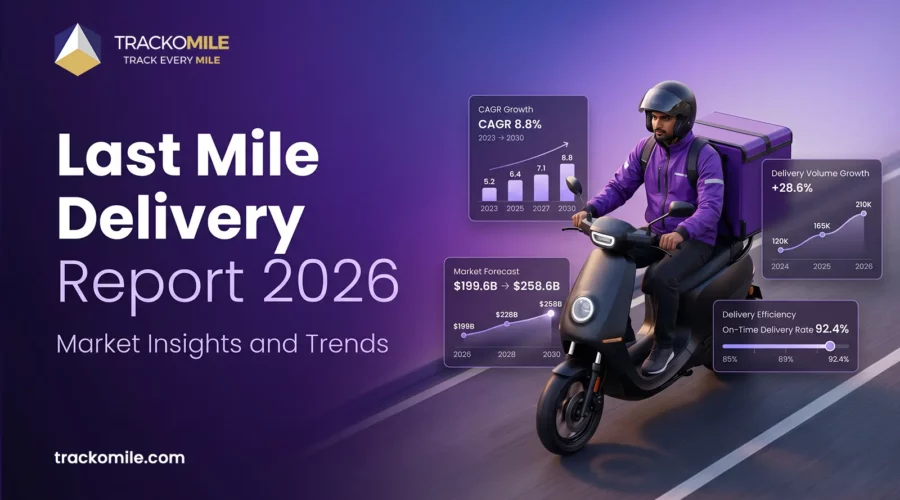
- Last Mile Delivery market is projected to reach $199.68 billion by 2026, driven by urbanization and tech advancements.
- Rapid e-commerce growth and rising consumer expectations are reshaping last mile delivery dynamics, emphasizing speed and efficiency.
- Key trends include same-day delivery, hyperlocal networks, and sustainability initiatives, transforming logistics operations.
- Businesses must adopt innovative technologies like AI and automation to stay competitive in the evolving Last Mile Delivery Market Report.
A comprehensive overview of market size, growth trends, and the future outlook. Dive deeper into last mile delivery market.
Last mile delivery is a core segment of the global logistics ecosystem. Its demand is accelerating in 2026. This is due to unparalleled boost in urbanization and technologies. This upward trend is further reinforced by the World Economic Forum. It projects a 78% growth in urban last-mile deliveries by 2030. The preference for 2-hours and same-day delivery is changing the dynamics of the competitive landscape.
This is where last mile delivery software are playing a critical role. AI, predictive scheduling and EV-powered routing are reshaping how last mile segment works. Businesses are thus prioritizing speed and control in 2026. This report provides a comprehensive analysis of market size, share, and key trends.
Market Overview
The last mile delivery market has a structured operational scope. It is the process of shipping items from the local warehouse or store to the customer’s home or pick-up location. The categories are specialized cargoes and e-commerce orders. Managing these last mile deliveries is complex since it includes varied time windows. Failed delivery attempts and parcel returns are common challenges.
But consumer dependence on e-commerce is rapidly growing. So, a smooth order-to-delivery experience is the holy grail of the retail industry.
This has translated into a rise in:
- Hyperlocal-based delivery models.
- EV-based last mile delivery fleets.
- Decentralized fulfillment centers.
- Automated dispatcher systems.
These are redefining sustainability benchmarks and cost structures. Delivery volumes are scaling. So, the harmony between several factors is becoming central to long-term business profitability. These are:
- Route optimization
- Technology integrations
- Flexible delivery options
- Core communication
- Customer interactions
Getting these right play a key role in ensuring market leadership. In short, last-mile management was just a backend function. Now it is a core driver of competitive differences.
Market Size & Forecast
A Futuristic Market Overview
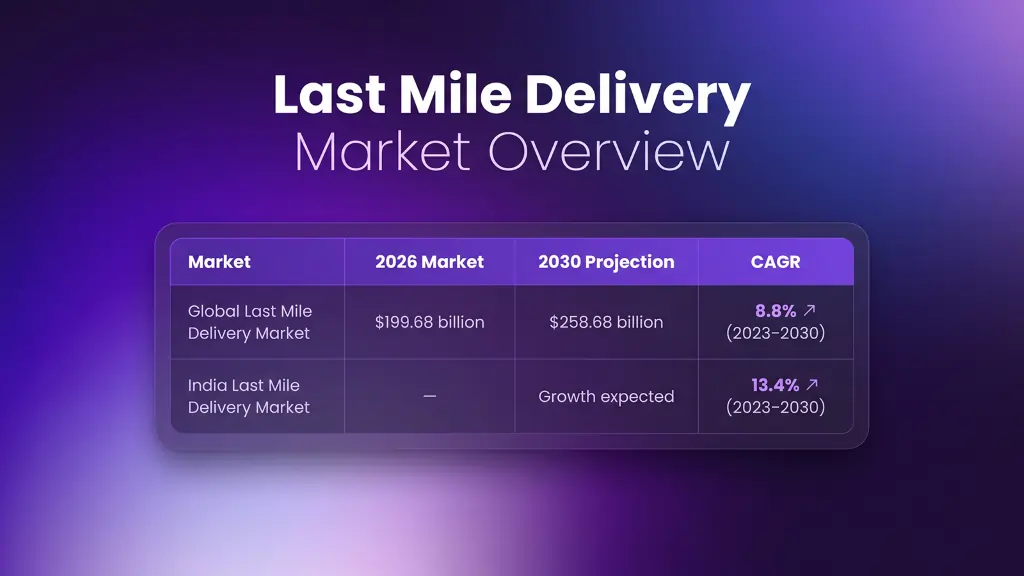
The global last mile delivery market size is expected to reach $199.68 billion in 2026. This growth marks a visible shift in the modern supply chain landscape. Ecommerce adoption and hyperlocal commerce continue to grow. Owing to this, businesses are rapidly investing in scalable infrastructure. Intelligent delivery technologies are their priorities too.
Looking ahead, the global last-mile delivery market size is expected to reach $258.68 billion by 2030. The CAGR is 8.8 between 2023 to 2030. It signals a strong demand for tech-enabled delivery ecosystems. India’s last mile delivery market is growing at 13.4% CAGR between 2023 and 2030 too.
Thus, businesses that fail to modernize operations will risk falling behind.Several companies today in the last mile are concentrating on utilizing innovative solutions. For example:
- Starship Technologies introduced delivery robots.
- Amazon is leveraging drones via Prime Air program.
- FedEx advance routing uses digital, pre-set routes.
These strongly align with the market forecasts. The future will be defined by automation and ultra-fast fulfillment ecosystem.
Key Growth Drivers and Challenges
The last mile delivery industry is being shaped by a powerful combination! This includes rising buyer expectations, explosive ecommerce growth, and higher operational complexity. The pressure on logistics networks is intensifying as businesses compete for faster deliveries. However, tech innovations are opening new doors.
Below are the key growth drivers and challenges:
1. Rapid E-commerce Growth
The global ecommerce sale is expected to reach $36 trillion by 2026. India will rank #1 among 20 countries worldwide. This is in retail ecommerce development between 2023 and 2027. Argentina and Brazil are other fast-growing markets, globally.
2. Increasing Last Mile Costs
The surge in global crude oil prices in the 1st quarter of 2026 has impacted logistics costs. Labor costs are high since riders alone account for 50-60% of expenses. Express deliveries command higher charges. Failed deliveries and reverse logistics add to the costs too.
Read Blog – Why is Last Mile Delivery Expensive?
3. Data-Driven Logistics
Data replaces intuition-based decisions. It improves demand forecasting by 20-50%. Businesses are utilizing the following data:
- Inventory levels
- Shipment status
- Traffic congestion
- Sales history/trends
- Warehouse stock
- Handling conditions
These are being leveraged to ensure last-mile logistics transformation. This growing dependence is a critical competitive advantage.
4. Tech-Led Optimization
AI, IoT, and automation are powering today’s last mile delivery sector. They encourage businesses to improve their efficiency. It also reduces operational overheads. Self-driving vehicles, drones, and robots are fast emerging tech. Smart routing and intelligent dispatcher systems are also gaining rapid popularity in 2026.
5. Rising Customer Expectations
Consumers today look for convenience and transparency. They demand free shipping, flexible delivery slots, and live tracking. Eco-friendly practices and personalization are other core priorities. Capgemini once found that over 55% of consumers will switch to competitors if they offer faster deliveries.
Key Market Trends and Insights
The key market trends are same-day delivery, sustainability, and a hyperlocal delivery network. Businesses do not compete on delivery capability alone. They keep an eye on speed and experience. They also strive to achieve operational intelligence. Learn in detail
1. Same Day and Instant Deliveries
Consumer expectations have shifted dramatically towards faster fulfilment. Same day, next-day, and 20-30-minute deliveries are key differentiators. Companies are thus heavily pushing towards dark stores and micro warehouses. In fact, the global dark store market is predicted to reach $721.98 billion by 2035.
Businesses adopting this are witnessing higher customer retention. Improved order frequency and stronger competitive difference are other impacts.
Do You Know?
The ‘Amazon Effect’ is redefining customer expectations! They demand free and fast shipping for instant gratification and seamless online shopping.
2. Hyperlocal Delivery Networks
This is a transformative trend in 2026, evolving from pilot projects into an essential. Efficient hyperlocal delivery networks reduce travel distance by 60-80%. This is because they utilize dark stores built near consumer hotspots for quick deliveries. They analyze best, nearest, and most cost-effective factors and create large-scale networks.
Businesses adopting hyperlocal delivery reduce delivery costs and time. It also helps boost operational efficiency across high-demand regions.
3. Sustainability-Driven Logistics
EV fleet, e-cargo cycles, and parcel lockers are gaining momentum. DHL, for example, is targeting >66% electrification by 2030. Reusable packaging and green warehouse initiatives are rising to lower carbon footprints. Altogether, high-performing businesses are the ones that are compliant with high sustainability standards.
Companies can save on long-term costs with sustainable logistics models. They also strengthen brand reputation and meet ESG compliance.
4. Q-Commerce Models
Quick commerce is enabled by AI routing and micro-fulfilment centers. This helps deliver goods within 30 minutes to 1 hour. It has emerged as the critical layer of the last mile and aligns with India’s PM Gati Shakti objectives. The ecosystem today comprises of 5000+ delivery hubs with expansion beyond Tier 1 cities.
Q-commerce helps businesses increase impulse purchase and unlock new revenue streams. Ultra-fast convenience also builds buyers’ trust, while customer loyalty programs can further support repeat purchases.
Technology & AI Impact
Technology and AI are entirely redefining the first and last mile delivery market. Logistics leaders rely on AI-powered route optimization and predictive analytics. Automated dispatcher engines help with real-time decisions and fleet efficiency.
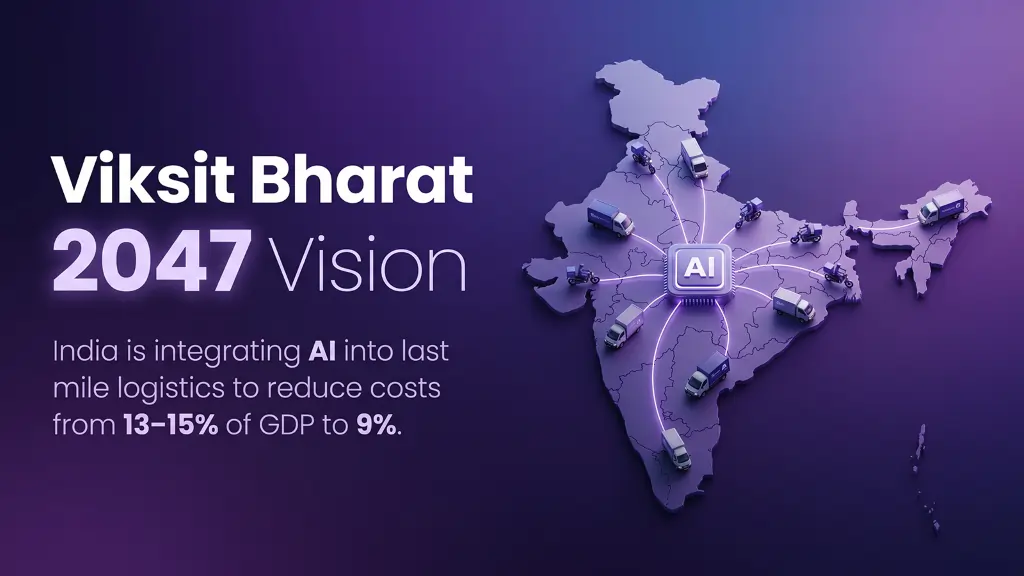
Indian Government’s AI Initiatives
The biggest shift of 2026 is towards ‘agentic’ systems. Here, autonomous AI agents plan, decide, and act. Drones, autonomous delivery robots, smart lockers, and sensor-driven deliveries are also being introduced. This is in mainstream logistics infrastructure.
Market Segmentation
The last mile delivery market is mainly segmented based on service type and tech adoption. Others are application areas and end-user industries.
1. Service Type Insights
The last-mile delivery market is segmented into B2B, B2C, and C2C deliveries. Among this, the B2C segment is expected to contribute 66.8% of the market share. This is due to fast growth in ecommerce, quick commerce, and hyperlocal platforms.
2. Technology Insights
The Industry 4.0 in LMD includes AI, blockchain, data analytics, cloud computing, and robotics. These come together to lead to digitalization and security on a larger scale. However, they require constant collaboration with humans to satisfy changing customer expectations. In fact, a deficiency in technology can increase costs by 28%.
3. Application Insights
Last mile delivery is popular for groceries, couriers, ecommerce, and retail. Ecommerce, however, remains in the largest application segment. It is driven by online shopping penetration and growing consumer demand.
Regional Insights
The global last mile delivery market continues to witness strong regional expansion in 2026. This is driven by digital logistics adoption. Other core factors are delivery expectations, urbanization, and ecommerce growth.
North America
The last mile delivery market size of North America is predicted to increase by $14.9 billion at 3.8% CAGR between 2024 and 2029. This growth is fueled by drones, parcel lockers, and autonomous vehicles. Key players are focusing on reducing delivery times and enhancing operational efficiency.
Europe
The last mile delivery market size of Europe is expected to hit $85.03 billion by 2033 from $41.87 billion in 2025. The core growth driver is major investments in the European logistics infrastructure. Others are evolving consumer expectations for faster deliveries and increasing consumer expectations.
Asia Pacific
The last mile delivery market size of Asia Pacific will reach $70,130.10 million by 2031 from $36, 110.20 million in 2024. The member countries like China, India, Australia, Japan, and South Korea are growing in last mile delivery due to several reasons. These are expanding ecommerce, urbanization, and same-day deliveries.
India
India’s last mile delivery market definition is shaped by critical factors. These are government investments and expansion of quick commerce. Other factors are advancements in logistics technologies. The last mile delivery market size reached $7.4 billion in 2025 and is expected to go up to $24.5 billion by 2034. Reliance, for example, is turning its retail business to cater to India’s thriving quick commerce industry. Other startups like Zepto, Swiggy, and Blinkit are transforming the online shopping patterns.
The Competitive Landscape
Key players in the last-mile market are Amazon, FedEx, Uber, UPS, Blue Dart, and Delhivery. They compete aggressively through speed optimization and hyperlocal and q-commerce delivery models. However, Amazon remains the dominant player, accounting for 50% of all e-commerce activities.
Recent developments across the market are growing AI-powered route optimization, autonomous delivery robots, and EV-led fleets. These are finding innovative market expansion strategies for last mile delivery services.

Frequently Asked Questions
-
Is AI and automation transforming last mile delivery?
Yes, both AI and automation are transforming the last mile delivery sector. They are improving speed and accuracy like never before. Last mile companies are using AI-driven route optimization. Predictive analytics and intelligent dispatch systems are equally critical. Drones, delivery robots, and EV fleets are gaining quick popularity too.
-
Which is the fastest growing region in the last mile delivery market?
Asia-Pacific is the fastest growing region in the last mile delivery market. The key growth drivers are China and India with rapid urbanization. However, North America maintains the largest market share. Asia Pacific is expected to lead by 2030.
-
What is the last mile delivery market growth rate?
India’s last mile delivery market growth rate is 13.4% CAGR between 2023 and 2030. The global last mile delivery market growth rate is between 7.6% and 9.59%. Their key growth drivers are ecommerce expansion and quicker fulfilment demands.
-
What are the core factors driving the last mile delivery market?
Ecommerce is growing fast. Hyperlocal deliveries are growing with it. These two forces are driving the last mile delivery market forward. Other factors are real-time tracking and AI-powered logistics technologies. Businesses are also investing in automation, IoT, and AI.

Shemanti is a Content Marketing professional with 7+ years of experience in shaping credible narratives across B2B products. As the Content Team Lead for TrackoBit, TrackoField, and TrackoMile, she br... Read More


Related Blog
Last Mile Delivery in Construction: Challenges, Solutions & Optimization Strategies
This guide explains how last mile delivery construction software can help improve efficiency, visibility and site coordination.
Last Mile Delivery for Grocery and Food Industry
This blog talks about last mile delivery for grocery & food industry. We will look at how advanced software improves…
Pros and Cons of Last Mile Delivery: A Guide for 2026
This blog explores the pros and cons of last mile delivery. It also looks at how businesses can overcome common…
Customer Intelligence & Verified Dispatch: Now Live in TrackoMile
Strengthen last-mile visibility and reliability with TrackoMile’s latest release. See delivery performance as it happens, adjust dispatch plans mid-trip, and…


Your inbox awaits a welcome email. Stay tuned for the latest blog updates & expert insights.
"While you're here, dive into some more reads or grab quick bites from our social platforms!"Stay Updated on tech, telematics and mobility. Don't miss out on the latest in the industry.