
Quick Summary

- Employee productivity is crucial for assessing how efficiently tasks are completed and resources are utilized.
- Key factors affecting productivity include work environment, training opportunities, processes, employee wellness, and tool availability.
- To calculate employee productivity, methods like the standard productivity formula, targets vs. achievement reports, and revenue per employee can be employed.
- Using tools like TrackoField can streamline the process of calculating employee productivity, helping identify underperforming areas and enhancing overall efficiency.
Here are the best methods to measure and boost field employee productivity using digital tools like field force automation software.
Employee productivity is calculated by how efficiently employees complete their tasks. These tasks could include hitting sales targets, closing tickets, or servicing clients. This calculation also measures how well the resources are being utilised.
Yet how can you tell whether your employees’ productivity is at its peak? You shouldn’t leave anything to chance. It becomes essential to calculate employee productivity for tracking employee performance. It also helps identify areas where the workforce may be lacking.
Ready to get started? Let’s dive in.
What is Field Employee Productivity?
Field employee productivity refers to how effectively your on-ground teams utilise their time and resources to complete assigned tasks. Unlike office-based roles, field productivity is not just about hours worked. It is about what gets done during those hours.
Here’s an example: A sales agent visits five high-potential leads in a day and converts one. Another agent visits 10 low-value prospects and converts 5 of them. The more productive employee will be the one whose leads bring in more revenue. Both quality and quantity matter in field operations, depending on the use case. Field employee productivity includes the following factors:
- Total tasks or visits completed
- Time spent per task
- Travel efficiency & fuel usage
- Expenses incurred in a day
- Customer onboarding
What is the Importance of Measuring Field Employee Productivity?
In businesses that rely on field operations, employee productivity directly impacts revenue, customer satisfaction, and operational costs. If your field teams are not performing up to the mark, it can negatively affect your business growth.
High field employee productivity means:
- More customer visits completed
- Higher quality leads
- High customer satisfaction
- Faster service delivery
- Lower NPAs (in case of BFSI)
- Better use of resources
- Lower operational expenses
On the other hand, low productivity leads to delays, missed opportunities, and inflated budgets. One of the major causes of low field staff productivity is the reliance on traditional methods to track field performance. These include manual attendance registers, phone check-ins, and end-of-day reports. While these methods may have worked earlier, they are no longer reliable in today’s tech-driven environment.
Key Challenges In Managing Field Employee Productivity
Companies face challenges like poor staff visibility, inefficient beat planning, and manual reporting in managing field staff performance. Employee resistance to digital tools and unverified attendance also affects productivity measurement. Here are the most common challenges businesses face:
1. Lack of Visibility
Managers often do not know where their employees are during the day or what tasks they are working on. This creates gaps in monitoring and maintaining an activity trail.
2. Unverified Attendance & Visits
Without proper monitoring, employees can mark attendance without physically being on the task site. They can report visits that did not happen.
3. Inefficient Beat Planning
Poor beat planning leads to excessive travel time, fewer visits, and reduced productivity. It also increases fuel costs and can lead to delayed visits, affecting customer service.
4. Manual Reporting Delays
When updates come at the end of the day via manual means like excel sheets or WhatsApp updates, it gets tough to identify and fix issues. Manual systems also increase chances of data entry errors.
5. Difficulty in Measuring Quality
It is easy to count the number of visits, but harder to measure the quality or effectiveness of those visits. That’s why proper proof of work is needed to evaluate the outcome of field tasks.
6. Employee Resistance to New Systems
Field employees may resist adopting new tools if they are complex or time-consuming. Easy-to-use field force automation software can greatly influence field employee performance.
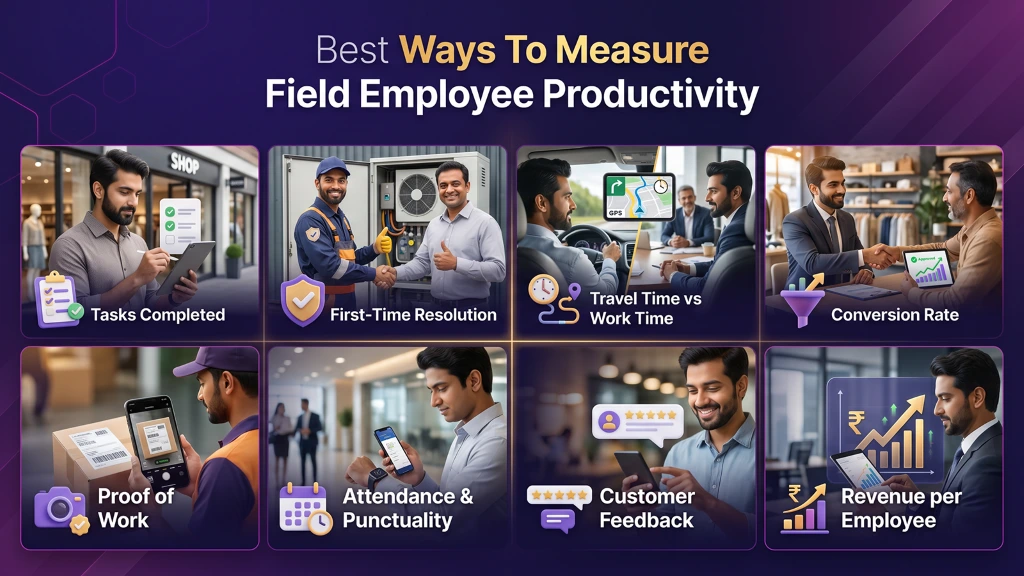
8 Effective Ways to Measure Field Employee Productivity
To measure field employee productivity, you need to track parameters like tasks, customer feedback, travel time, attendance, lead conversions, revenue per employee, and more. Take a look at all the effective ways to measure productivity below:
1. Task Tracking
One of the easiest ways to calculate and boost employee productivity is to keep track of the tasks or visits assigned to team members. The time it takes them to complete the task or the outcome of the visit are part of employee KPIs. Also, completed tasks/visits are better performance indicators than total tasks.
2. First-Time Resolution Rate
An employee who takes multiple visits to install a solar panel or convert a lead is not very productive. That’s why first-time resolution rate is a good way to measure field employee productivity. Higher rates indicate better efficiency.
3. Travel Time vs Working Time
Shows how much time is spent travelling compared to actual work. Lower travel time and more time spent with clients are a better indicator of productivity.
4. Conversion Rate
For sales teams, this measures how many visits result in successful sales conversions. Ask yourself: who is more productive, the employee who converts 1 out of 5 leads or 1 out of 30 leads?
5. Attendance & Punctuality
Tracks consistency and discipline in work hours. Employees who adhere to shift timings and reach task sites on time tend to be more productive.
6. Geo-Verified Proof of Work
Photos, timestamps, and location data help verify if work was actually done or only the task was marked complete. Ensure your employees upload proof of work like:
- Pictures
- Documents
- Expense receipts
- Voice notes
7. Customer Feedback
It’s important to check how customers rate your employees. The more satisfied the customers, the better your company’s reputation and faster the growth.
8. Revenue Per Employee
It measures the financial contribution of each employee to your business. The more productive your company is, the bigger the revenue per employee.
For example, assume you have 200 field employees, and your annual revenue is from field sales alone is ₹10 Lakh. Then, your revenue per employee would be 10,00,000/200 = ₹5000 per employee.
Best Ways To Measure Field Employee Productivity
How To Calculate Field Employee Productivity: Steps, Formula & Key Metrics
Calculating field employee productivity is easy. A widely used formula is as follows:
Productivity = Output ÷ Input
In the context of field operations:
- Output = Tasks completed, sales closed, or services delivered
- Input = Time spent, distance travelled, or resources used
Here is how you can calculate it step by step:
Step 1: Define Your Output
Decide what success looks like. For example, number of successful visits or solar panels installed.
Step 2: Measure Input
Track the time spent on field activities, including travel and task execution.
Step 3: Calculate Productivity Ratio
Divide output by input to get a productivity score.
For instance, let’s say it took 130 hours for an employee to travel 1300km in a month. In this case, the distance travelled productivity would be 1300/130 = 10km/hour.
Step 4: Compare Across Employees
Analyse differences to identify high and low performers, be it teams, managers or individual employees.
Step 5: Track Trends Over Time
Monitor improvements or declines in productivity. Common metrics used in calculations include:
- Tasks per day
- Revenue per visit
- Time per task
- Cost per visit
- Conversion rate
How Trackofield Helps You Track & Improve Field Employee Productivity
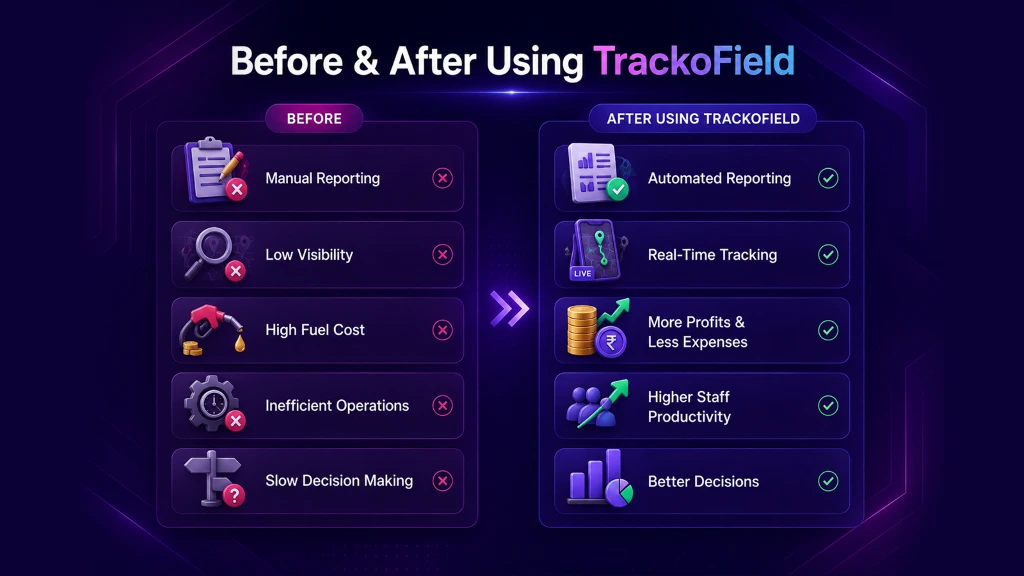
TrackoField’s field employee tracking software is ideal for companies that need a higher degree of accuracy. It combines multiple features into a single platform, making it easier for businesses to monitor, analyse, and optimise field operations.
Automating productivity measurement allows you to quantify the work done in a day. With the distance travelled reports, managers can accurately calculate the distance travelled for meeting clients. Also, track the time to complete a single or group of tasks. Apart from reports, you also get to:
- Track employees in real time.
- You can assign urgent location-based tasks in bulk to teams and track their progress.
- Simplify sales order-taking process for teams with order management module.
- Get instant performance insights with AI manager bot.
- Optimise routes to save employees’ time and fuel costs.
- Allow field agents to upload geo-verified proof of work.
- Analyse target v/s achievement reports.
If you are operating a field team, calculating their efficacy can be tough. However, TrackoField’s real-time tracking, geocoded attendance marking, task status calculation, and specific reports can get you out of the problem.
Field Staff Productivity Before & After Using TrackoField
Industry Use Cases: Who Benefits Most from Field Productivity Tracking?
Field productivity tracking is valuable across multiple industries, especially those that rely heavily on on-ground operations. Here are some key sectors that benefit the most:
1. NBFCs and MFIs: Loan officers and collection agents that visit JLG meetings, conduct KYCs and onboard borrowers.
2. Telecom: Field technicians who manage installations and maintenance tasks.
3. Healthcare and Pharma: Medical representatives that execute doctor visits, pharma sales or demos.
4. Solar and Energy Sector: Field teams that manage inspections, installations, and maintenance tasks smoothly.
5. Agri-Input: Agri field reps who pitch new farming products or conduct demos in group gatherings.
Conclusion
It’s 2026 and gone are the days of manual employee management. Field force automation software like TrackoField have completely transformed the industry. Managers can now easily check how their field teams are doing and be more proactive in decision-making.
Measuring field employee productivity has become much easier today than with traditional methods. Evaluating field employee productivity allows you to see their efficiency and the profits yielded by each one. This helps drive business growth and get ahead in a cutthroat market. To learn how to effortlessly track and monitor tasks, attendance, and productivity.
Frequently Asked Questions
-
What’s the best way to measure field employee productivity?
You’ll get the clearest picture of your staff productivity by looking at tasks completed, time spent, and results delivered. Check real-time info like visits, sales, and task status. Balance quantity and quality so you can see how each employee is really performing day-to-day.
-
What features should good field employee management software have?
You want GPS tracking, task assignments, attendance tracking, and solid reporting. It should still work offline and be simple for everyone to use. Added features like proof of work, route planning, and integration with other tools make a big difference.
-
What tools help improve field employee productivity?
Field force management software, GPS tracking apps, and solid task management tools all make a big impact. They give you live updates, cut down on manual work, and help with better planning. Your team can spend more time actually working and less time filling in reports.
-
Which is the best software to track field employee productivity?
Go for software that gives you real-time tracking, task management, and reporting all in one place. Something like TrackoField lets you track work, confirm visits, and boost your team’s performance using simple dashboards and easy-to-use mobile apps.
-
How do you calculate the productivity of a field sales team?
Productivity formula is simple. Divide total sales or successful visits by the time spent or the total number of employees. Keep an eye on conversions, visits per day, and revenue per agent. These numbers show exactly how much value each team member creates every day.
-
How does GPS tracking boost workforce efficiency?
GPS tracking shows exactly where employees are during the day and how they get around. It’s great for cutting travel time, confirming visits, and planning smarter routes. Managers can give better directions and make sure jobs get done on time.

Mudit is a seasoned content specialist working for TrackoField. He is an expert in crafting technical, high-impact content for Field force manage... Read More


Related Blog

Face Recognition: What It Is, How It Works & Benefits for Field Teams
Facial recognition is a way of identifying or confirming an individual’s identity using their facial features. Read this guide to…
Field Operations Manager: Roles, Challenges & How to Optimize Performance
Field operations managers handle on-ground activities with challenges like visibility, control, and coordination. This blog covers their roles, key challenges,…

What is Face Recognition Attendance Software & How Does It Work?
This blog explains the concept of face recognition attendance software. We will also explore how it enhances attendance monitoring for…
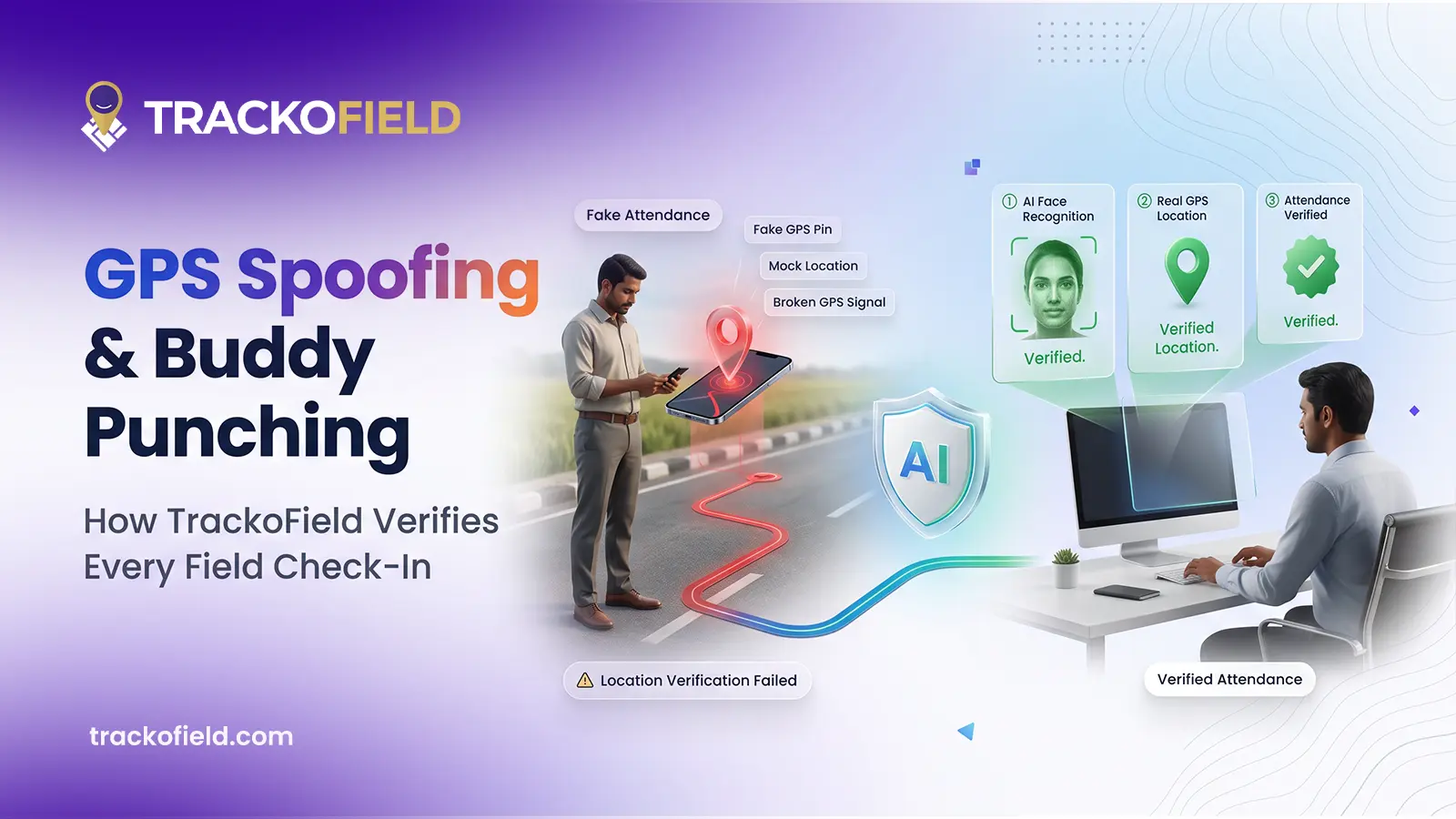
How TrackoField Stops GPS Spoofing and Buddy Punching in Field Teams
Your field team’s attendance data looks clean. The question worth asking is whether it’s real. Here’s how GPS spoofing actually…


Your inbox awaits a welcome email. Stay tuned for the latest blog updates & expert insights.
"While you're here, dive into some more reads or grab quick bites from our social platforms!"Stay Updated on tech, telematics and mobility. Don't miss out on the latest in the industry.