
Quick Summary

- Truck Fleet Management involves tracking vehicles, drivers, fuel, and maintenance using GPS and software, crucial for operational efficiency.
- It helps identify issues like route deviations, fuel wastage, and maintenance needs, enabling proactive management.
- Key benefits include better fuel control, vehicle utilization, fewer breakdowns, improved driver safety, and enhanced delivery visibility.
- Choosing the right software should focus on solving specific operational problems, ensuring compatibility with existing systems, and considering total costs.
Truck fleet management means tracking trucks, drivers, fuel, and maintenance through GPS and software. Fuel alone eats 20% to 35% of operating costs, and software runs USD 10 to 50 per truck a month.
If you’re running a truck fleet, you already know that keeping vehicles on the road is only half the job.
Then there’s the operational side. Where your vehicles are at any given moment. Whether drivers are sticking to the routes you’ve planned, or deviating without you knowing. Fuel consumption versus what the trip should actually cost. Which vehicles are due for maintenance before a breakdown takes them off the road. Whether deliveries are hitting their promised timelines.
With a handful of trucks, calls and spreadsheets can just about hold this together. But as the fleet scales, that same manual process starts breaking down. You’re no longer managing operations, you’re constantly playing catch-up.
This is where truck fleet management comes in.
It brings vehicle tracking, route planning, fuel, maintenance, driver behaviour and reporting into a more organised system. Just knowing where a truck is doesn’t tell you much on its own. You need to understand what’s actually happening with that vehicle, and act on it.
What Is Truck Fleet Management?
Fleet management sounds simple until you’re actually doing it. It’s not just trucks and drivers. It’s routes, fuel, maintenance schedules, safety, and about ten other things happening at once, all of which can go wrong quietly.
Say a delivery is supposed to take six hours and it takes eight. Fine, you know it’s late. But why? Bad route? Driver stopped somewhere he shouldn’t have? Truck sat idling for an hour at a signal that shouldn’t take ten minutes? Held up at the delivery point itself?
You won’t know unless someone’s tracking it. These are the questions fleet managers need to answer.
A good fleet management setup helps them look beyond the final outcome and understand what caused it. Instead of piecing together information from calls and spreadsheets, they can use actual vehicle and trip data.
This also explains the difference between GPS tracking and fleet management.
GPS tracking just tells you where the truck is. Fleet management tells you what’s actually going on with it, and where you need to step in.
For businesses evaluating the technology, explore Fleet Management Software.
How Does Truck Fleet Management Work?
It starts with collecting data, GPS location, fuel usage, engine hours, trip details, from every vehicle. That data needs to reach the people making decisions, not just sit in a system. And then it has to actually change something in how the fleet runs day to day, or it’s just numbers on a screen.
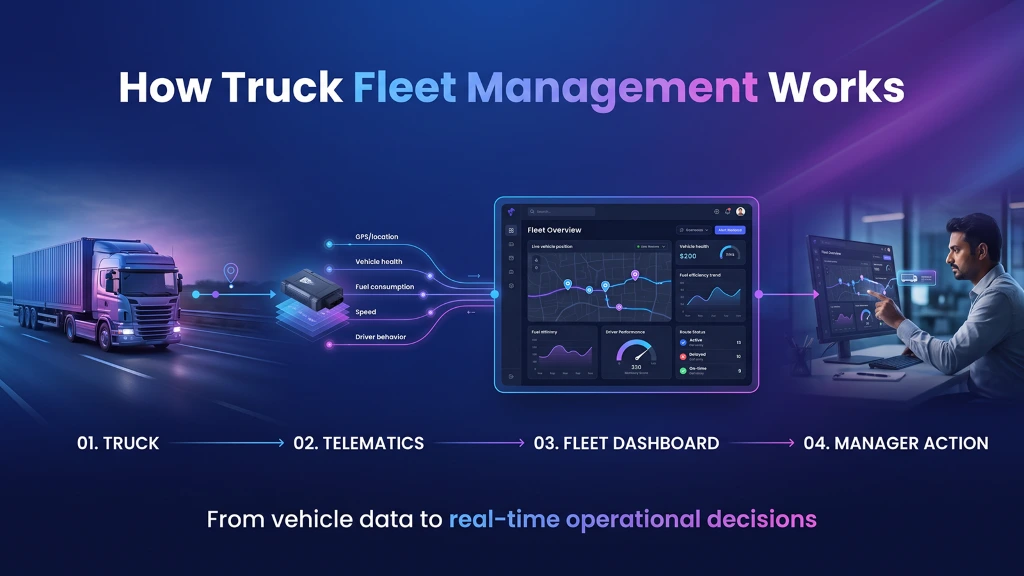
How fleet data becomes action
1. Collect vehicle and trip data
GPS units and telematics sensors sit on the truck and just keep sending data back. Location, speed, how far it’s gone, ignition on or off, what happened on that trip. All of it flows in constantly, whether anyone’s watching or not.
2. Monitor vehicles in real time
Instead of calling drivers for updates, managers can view vehicles from a central dashboard and follow trip progress.
3. Identify exceptions
The system can flag route deviations, excessive idling, speeding, unexpected stops and delays. This allows managers to focus on trips that need attention.
4. Take action
Depending on the issue, a manager may contact the driver, adjust the route, investigate unusual activity or schedule maintenance.
5. Learn from historical data
One late delivery doesn’t tell you much. But look back at a month of trips on the same route, and patterns start showing up that you’d never catch trip by trip. If that route is consistently running long, the problem probably isn’t the driver’s speed, it’s the route itself.
This creates a simple cycle:
Track → Understand → Act → Improve
What Does Truck Fleet Management Include?
Fleet management brings together several areas that directly affect cost, safety and service.
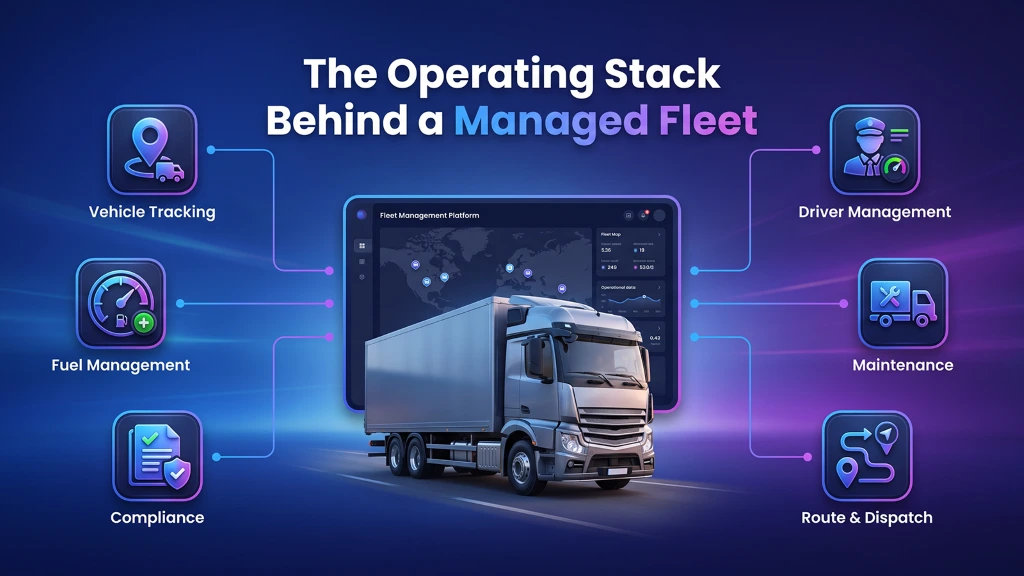
The core of fleet management
1. Vehicle Tracking and Visibility
You open the dashboard and see exactly where every truck is, right then. Not where it was an hour back. A vehicle stops somewhere it shouldn’t, drifts off the planned route, or just isn’t moving when it should be, and you catch it as it happens instead of finding out from an angry customer call later.
2. Route and Trip Management
Route planning helps teams determine how vehicles should travel between locations. Comparing planned and actual journeys can reveal unnecessary kilometres, deviations and recurring delays.
3. Driver Management
How a driver actually drives shows up everywhere else, in the fuel bill, in wear on the vehicle, in whether anyone gets hurt. Speeding, harsh braking, harsh acceleration, idling too long at stops, once you’re tracking this, coaching conversations stop being guesswork and start being backed by actual numbers.
4. Fuel Management
Fuel costs can add up quickly across a fleet, and a fuel card network helps track where that spend goes. Looking at consumption alongside distance, routes and driving behaviour can help explain why one vehicle or trip is using more fuel than expected.z
5. Vehicle Maintenance
A breakdown during an active trip can affect the vehicle, driver and delivery schedule. Preventive maintenance helps teams keep track of servicing requirements before a minor issue becomes a larger disruption.
6. Reporting and Analytics
Individual trips show what happened once. Reports help identify what is happening repeatedly. Which vehicles are underutilised? Which routes regularly take longer? Where is fuel consumption increasing?
These are the questions that make fleet data useful.
What Are the Biggest Challenges in Managing a Truck Fleet?
Most fleet problems build up through smaller inefficiencies across vehicles, drivers and trips.
-
Limited Visibility
A driver may say a truck is on the way, but that does not tell you whether it is following the planned route, has stopped somewhere or is still likely to arrive on time. Real-time visibility reduces this information gap.
-
Rising Fuel Costs
Fuel consumption is influenced by idling, unnecessary kilometres, route choices, driving behaviour and vehicle condition. Without the right data, it is difficult to know which factor is responsible for an increase.
-
Unplanned Downtime
A missed service can become a breakdown. When a truck becomes unavailable during an active trip, another vehicle may need to take over, affecting the wider schedule.
-
Driver Safety
Speeding, harsh braking and other risky behaviours can affect safety as well as fuel consumption and vehicle wear. Identifying recurring patterns gives managers something specific to address.
-
Inefficient Routes
A route that looks efficient during planning may perform differently on the road. Comparing planned and actual trips helps teams understand where the difference comes from.
-
Too Much Data, Not Enough Action
Modern fleet systems can generate a lot of information. More data does not automatically mean better decisions. Managers need clear alerts, relevant KPIs and reports that show what needs attention and why.
What Are the Benefits of Truck Fleet Management?
The value of fleet management becomes clearer when it is connected to everyday decisions.
1. Better Control Over Fuel Costs
Fuel consumption can be analysed alongside routes, mileage, idling and driver behaviour. This makes it easier to identify unusual patterns and investigate where fuel may be getting wasted.
2. Better Vehicle Utilisation
Fleet data can show which vehicles are regularly idle and which are carrying a heavier workload. This helps businesses make better use of the vehicles they already have.
3. Fewer Avoidable Breakdowns
Maintenance schedules and vehicle history allow teams to plan servicing instead of waiting for a vehicle problem to interrupt a trip.
4. Better Driver Safety
Driver behaviour data gives managers a concrete basis for coaching rather than relying only on general observations.
5. Faster Response to Operational Issues
When a truck takes an unexpected route or a trip starts falling behind schedule, managers can see the issue while it is happening and decide what action is needed.
6. Better Delivery Visibility
A clearer view of vehicle and trip status helps businesses provide customers with more accurate delivery updates.
The real benefit is not simply having more information. It is having enough visibility to act before a small issue becomes a larger one.
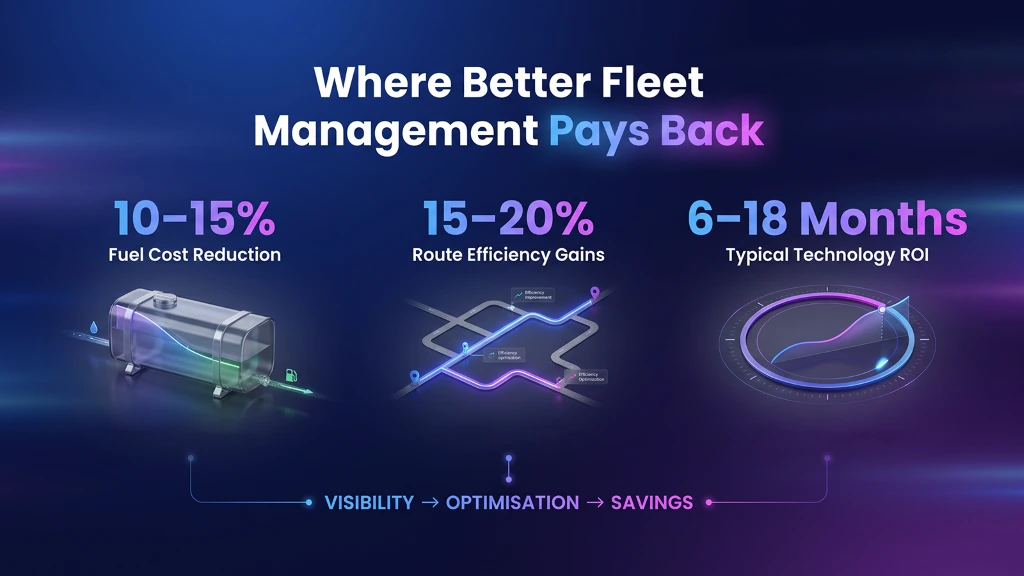
Where visibility delivers value
What Features Should Truck Fleet Management Software Have?
When comparing truck fleet management software, it is easy to get caught up in feature lists. Start instead with the problems your fleet needs to solve.
| Feature | What it helps manage |
| Real-time GPS tracking | Vehicle location and trip progress |
| Route planning | Planned and efficient journeys |
| Route deviation alerts | Unexpected vehicle movement |
| Driver behaviour monitoring | Speeding, braking and idling |
| Fuel monitoring | Consumption and efficiency |
| Maintenance alerts | Planned vehicle servicing |
| Trip management | Trip allocation and monitoring |
| Geofencing | Vehicle activity around defined locations |
| Reports and analytics | Fleet performance |
| ETA visibility | Delivery planning |
| Telematics integration | Vehicle and sensor data |
Check Hardware Compatibility
If GPS devices are already installed across the fleet, check whether the software supports them. Replacing existing hardware can add unnecessary implementation costs.
Look at Integrations
Depending on the business, the platform may need to connect with ERP, logistics, accounting, CRM or other systems.
Consider Usability
A system can have extensive functionality and still be difficult to use. Managers should be able to find important information, understand alerts and access reports without unnecessary complexity.
7 Ways to Improve Truck Fleet Efficiency
Technology gives you visibility. Your processes determine what you do with it.
1. Start With the KPIs That Matter
Focus on metrics connected to cost, service and productivity.
- Useful KPIs include:
- On-time delivery rate
- Fuel consumption
- Fuel cost per kilometre
- Vehicle utilisation
- Idle time
- Route deviation
- Maintenance frequency
- Vehicle downtime
- Driver safety events
For more detail, see our guide to Fleet Management KPIs.
2. Manage Exceptions Instead of Watching Everything
A fleet manager cannot spend the day watching vehicles move across a map. Set alerts for events that actually need attention, such as route deviations, unexpected stops, excessive idling or speeding.
3. Use Driver Data for Coaching
If the same behaviour keeps appearing, use the data to understand the pattern and have a specific conversation with the driver. Monitoring becomes more useful when it leads to improvement.
4. Make Maintenance Proactive
Create maintenance schedules and reminders based on vehicle requirements. A well-maintained truck is easier to plan around than one that breaks down during an active delivery.
5. Investigate Unusual Fuel Consumption
If two similar trucks travel similar distances but one consistently uses more fuel, look at idling, routes, driving behaviour and vehicle condition before deciding what needs to change.
6. Compare Planned and Actual Trips
If a route repeatedly takes longer than planned, investigate why. The issue could be route selection, recurring stops, delivery planning or another operational factor.
7. Plan for Fleet Growth
Consider whether the platform can support more vehicles, users, locations, integrations and reporting requirements as the business grows.
How Does GPS Tracking Help Truck Fleets?
GPS tracking provides the location visibility that many truck fleets depend on.
It can show:
- Current vehicle location
- Trip history
- Vehicle movement
- Speed
- Route adherence
- Geofence events
- Stops and halts
- Distance travelled
- Estimated arrival information
But location is only the starting point.
Imagine a truck is 40 kilometres away from its planned route. GPS tracking can show where it is. Fleet management helps you investigate why.
Was there a road closure? Did the driver take another route? Was there an unplanned stop? Was the original route not practical?
That is why GPS tracking software becomes more useful when combined with route management, driver monitoring, fuel information and reporting.
TrackoBit combines GPS tracking with broader fleet management capabilities to help businesses manage vehicle visibility and day-to-day fleet operations.
How Is AI Changing Truck Fleet Management?
AI is becoming useful in fleet management because fleets generate large amounts of operational data.
It can support:
- Predictive maintenance
- Route optimisation
- Driver behaviour analysis
- Exception detection
- Vehicle performance analysis
- Demand forecasting
- Decision support
For example, historical vehicle and sensor data can help identify patterns that may indicate an emerging maintenance issue. AI can also support route optimisation by considering multiple operational factors rather than distance alone.
The important point is to use AI where it solves a genuine fleet problem. It should make a manager’s job easier, not simply add another feature to the software.
How to Choose the Right Truck Fleet Management Software
Choosing a truck fleet management system should start with your operational problems, not a feature comparison sheet.
1. What Are You Trying to Improve?
Is the main problem fuel consumption, poor visibility, delayed deliveries, driver safety, maintenance or vehicle utilisation?
Your answer should determine which capabilities matter most.
2. Will It Work with Existing Hardware?
Check whether the platform supports your GPS devices and sensors. This can affect implementation costs and timelines.
3. Can It Connect with Existing Systems?
Check available integrations with ERP, CRM, logistics, accounting and other platforms already used by the business.
4. Will Managers Actually Use It?
Look for dashboards, alerts and reports that make information easy to understand and act on.
5. What Is the Total Cost?
The cost of truck fleet management software can depend on fleet size, modules, hardware, installation, integrations, implementation and support.
Consider the full cost:
Software + GPS hardware + installation + integrations + implementation + support + training
Then compare that investment with the problem you want to solve.
If reducing fuel costs is the priority, for example, the system should provide enough visibility into idling, routes, mileage and driver behaviour to identify where fuel is being lost.
Businesses evaluating their options can also explore Truck Management Software.
How Much Does Truck Fleet Management Software Cost?
There is no single price for truck fleet management software. Costs can vary based on the number of vehicles, GPS hardware, software modules, installation, integrations, users, implementation and support.
Comparing only the subscription price can therefore be misleading.
A better approach is to look at total cost of ownership and compare it with the value the system is expected to provide.
If it helps identify excessive fuel consumption, reduce avoidable downtime, improve vehicle utilisation or provide better delivery visibility, those outcomes should form part of the decision.
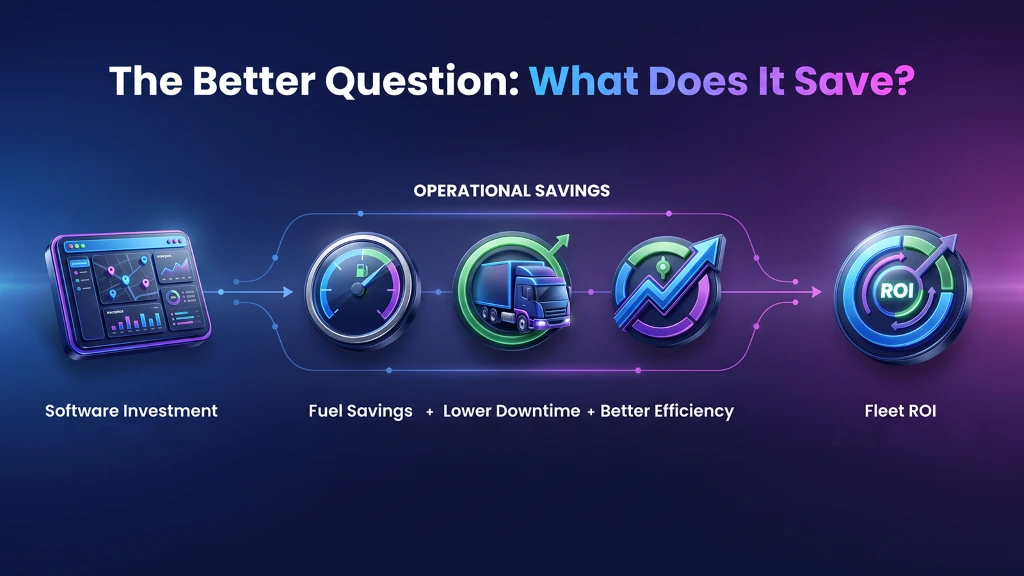
Turning software spend into savings
Conclusion
Managing a truck fleet becomes harder when information is spread across calls, spreadsheets, GPS platforms and separate operational processes.
Truck fleet management brings those moving parts together.
It gives managers visibility into where vehicles are, how trips are progressing, how drivers are performing, when vehicles need attention and where inefficiencies are developing.
GPS tracking provides the foundation, but the real value comes from connecting it with route management, fuel monitoring, driver behaviour monitoring, maintenance and reporting.
The objective is not to collect more data. It is to make better decisions with the data you already have.
For a growing fleet, that shift from tracking vehicles to managing performance is what makes fleet management a strategic part of the operation.

Frequently Asked Questions
-
What is truck fleet management?
Truck fleet management is the process of managing commercial trucks, drivers, routes, fuel, maintenance, safety and related operations. It helps businesses improve vehicle utilisation, control costs, reduce avoidable downtime and maintain reliable deliveries.
-
What software is used for truck fleet management?
Truck fleet management software generally combines GPS tracking with route planning, driver monitoring, fuel management, maintenance, trip management and reporting. The right solution depends on fleet size, vehicle types, operating requirements and integrations.
-
How can truck fleets reduce fuel costs?
Excessive idling, inefficient routes, unnecessary kilometres, driving behaviour and poor vehicle maintenance can increase fuel consumption. Monitoring these factors together helps identify where fuel is being used unnecessarily.
-
What role does AI play in truck fleet management?
AI can analyse fleet data, identify patterns, support predictive maintenance, optimise routes and highlight operational exceptions. Its practical role is to help managers make faster, better-informed decisions.
-
Is GPS tracking required for commercial truck fleets?
GPS tracking is important for fleets that need real-time vehicle visibility. It helps monitor locations, trips, route adherence and stops, but GPS tracking alone does not provide complete fleet management.
-
How does truck fleet management work?
It works by collecting vehicle and trip data, monitoring operations, identifying exceptions and using the information to take action. Historical data can then reveal recurring issues and help improve routes, maintenance and driver performance.
-
What are the key KPIs for truck fleet management?
Common KPIs include fuel consumption, fuel cost per kilometre, vehicle utilisation, idle time, on-time delivery rate, route deviation, maintenance frequency, downtime and driver safety events.
-
How does fleet management software improve driver safety?
It can identify behaviours such as speeding, harsh braking, harsh acceleration and excessive idling. Managers can use these insights to identify recurring patterns and provide targeted coaching.
-
What is the difference between GPS tracking and truck fleet management?
GPS tracking primarily tells you where a vehicle is and how it has moved. Truck fleet management goes further by connecting that information with route planning, driver management, fuel monitoring, maintenance, analytics and operational workflows.

Apoorva Raizada is the Content Marketing Manager at TrackoBit. With over a decade of experience across media, advertising, and B2B SaaS, she brings a sharp editorial mindset to technology-led business... Read More


Related Blog
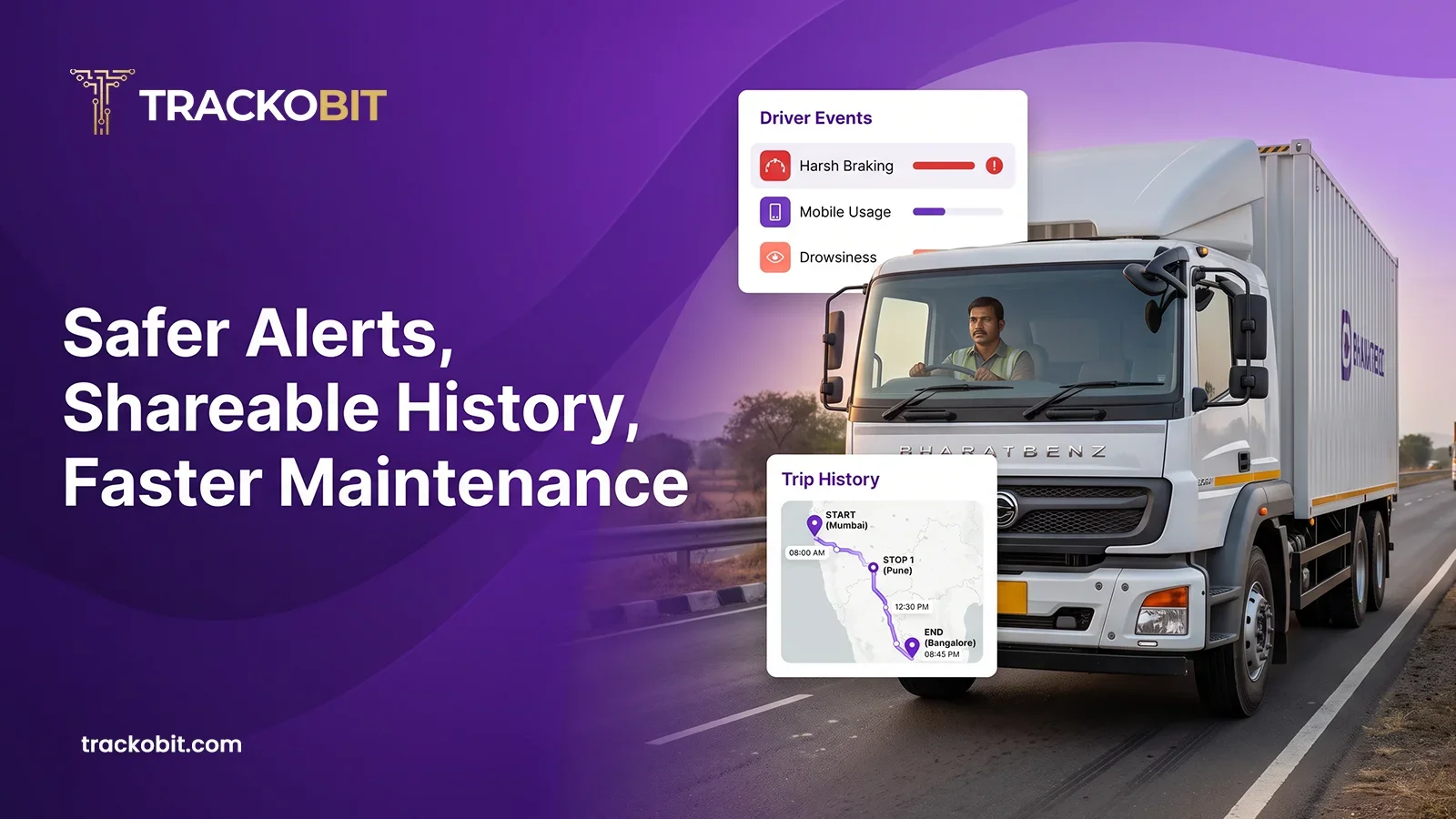
Safer Alerts, Shareable History, Faster Maintenance in TrackoBit
TrackoBit now adds an Evidence Model and authority-based access for ADAS and DMS alerts in video telematics, Vehicle History Sharing…
Fleet Management Requirements: The Complete Guide for 2026
Every wondered what exactly fleet management requirements are? Or, why do they matter? This guide helps you understand in detail.
7 Fleet Management Best Practices Every Fleet Manager Needs
Learn 7 fleet management best practices to improve safety, vehicle utilization, efficiency, and fleet performance in 2026.
What Are the Roles and Responsibilities of a Fleet Owner?
Behind every well-run fleet is a fleet owner juggling tasks like vehicle maintenance and driver management without letting anything fall…


Your inbox awaits a welcome email. Stay tuned for the latest blog updates & expert insights.
"While you're here, dive into some more reads or grab quick bites from our social platforms!"Stay Updated on tech, telematics and mobility. Don't miss out on the latest in the industry.