
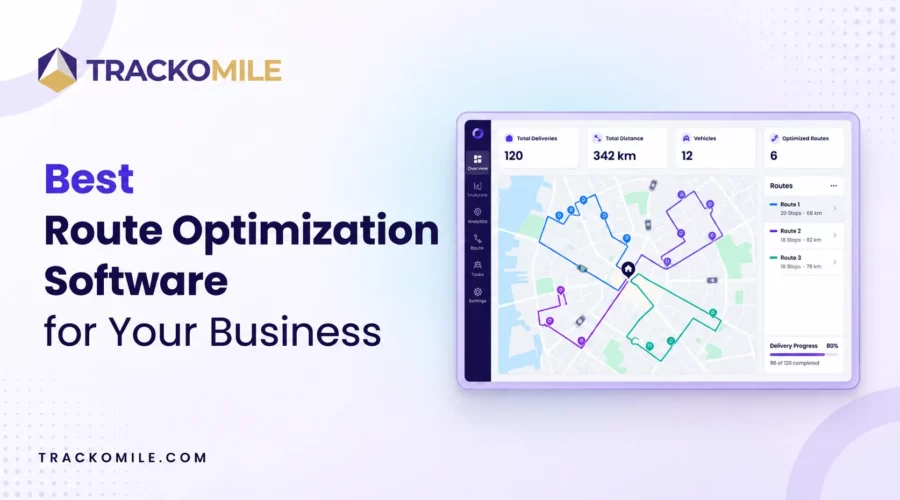
This guide compares 10 best route optimization software on features, pricing, ratings, and best-fit use case.
Despite technological advancements, many logistics businesses still manage their delivery operations manually. While a few vehicles and a small number of daily trips can be managed with spreadsheets or basic navigation tools, this model fails when order volume increases.
Routes become harder to plan. Ad-hoc orders aren’t accommodated smoothly. Traffic disruptions aren’t factored in. Riders end up backtracking. As a result, valuable time, effort and fuel are wasted. These problems are especially prevalent in last mile delivery operations. However, there’s a simple way to tackle these issues: route optimization software. The most competent one automates route planning and helps reduce resource usage. It ensures routes are planned as per order priority, live traffic and rider availability.
But not all route optimization platforms are built the same. It’s important to pick the one that meets the scale and type of your delivery operations. On that note, we bring you this list of 10 best route optimisation software in 2027.
What Is Last-Mile Route Optimization Software?
Route optimization software is a digital tool to efficiently plan, monitor, and continuously adjust the sequence of stops in a delivery trip. In last mile delivery operations, route optimization is essential to create the most efficient path from a distribution hub or fulfilment centre to the customer’s door. The software weighs in several factors like:
- Order priority
- Delivery window
- Traffic conditions
- Rider workload
- Customer availability
- Vehicle capacity
Route optimisation isn’t just about creating the fastest or shortest path for delivery riders. It also decides which route a rider should take to travel the minimum distance while completing the maximum possible deliveries.
Thus, the software helps businesses reduce operational costs significantly.
- Riders don’t deviate from the routes
- Travel distance is reduced, saving fuel & time
- Timely deliveries improve customer experience
- Riders don’t have to self-navigate
- Helps accommodate new & ad-hoc orders smoothly
A strong route optimisation system creates a route for riders before the day starts and helps teams adjust it as conditions change throughout the day.
Key Features to Look for in Route Optimization Software
Not all route optimization platforms are the same. Yet they must have essential features like rule-based optimization, dynamic routing, and live tracking. Here are all the features you should look for in the software.
1. Rule-Based Optimization
This is the foundation of any good route optimisation platform. There are many factors that need consideration while creating delivery routes. These include:
- Delivery windows
- Vehicle capacity
- Rider proximity & shifts
- Order priority
- Traffic & fuelling stops
The more number of rules or constraints the software weighs in before creating a route, the better. This also ensures workloads remain balanced. One rider shouldn’t be struggling to complete deliveries while another sits idle.
2. Multi-Stop Trip Sequencing
Multi-stop trip sequencing refers to arranging multiple stops in the best possible order to reduce both delivery time and travel distance. Time for parking, unloading, verification, customer interaction, and proof of delivery collection must be accounted for as well when setting aside time for delivery stops.
3. Dynamic Route Adjustment
Static routes aren’t feasible due to the increasing complexity of delivery operations. A route created at 7 AM may get inefficient by noon. New orders may come in. Traffic may increase. A driver may fall behind schedule. AI-powered dynamic routing helps teams respond to these changes without manually rebuilding every route.
4. Live Tracking & ETA Visibility
Route planning tells you what should happen. Tracking reveals what is actually happening on the ground. Real-time visibility helps managers compare planned routes with actual rider movement. This can reveal delays, route deviations, long stops, or unexpected idle time. Accurate ETAs also improve customer communication. Instead of giving vague delivery estimates, businesses can provide live tracking links to customers.
5. Rider Mobile App
An easy-to-use and intuitive app ensures riders can smoothly view routes and delivery instructions. Map-based routing and instant notifications ensure riders don’t have to manually navigate. It reduces support calls to dispatchers and makes status updation easier.
6. Analytics & Reporting
A route optimisation software should help businesses understand whether their routes are actually improving operations. Useful metrics include:
- Distance travelled
- Stops per vehicle
- On-time delivery rate
- Idle time
- Cost per delivery
Analysing these metrics and reports helps businesses:
- Compare planned performance with actual results
- Identify weak routes
- Improve future plans
Best Route Optimization Software in 2027
The top route optimization software in 2027 includes TrackoMile, Locus, Routific and Route4Me. Here is a complete list of 10 best tools to optimise routes along with their key features, use cases and pricing.
| Software | key Features | Price |
| TrackoMile |
|
Custom |
| Locus |
|
Custom |
| Route4Me |
|
Custom |
| OptimoRoute |
|
From $35.10/driver/month |
| Routific |
|
Free up to 100 orders/month; from $150/month |
| FarEye |
|
Custom |
| Dista |
|
Custom |
| Fleetroot |
|
From $79/month |
| Onfleet |
|
From $619/month |
| Upper |
|
From $40/user/month |
1. TrackoMile
TrackoMile
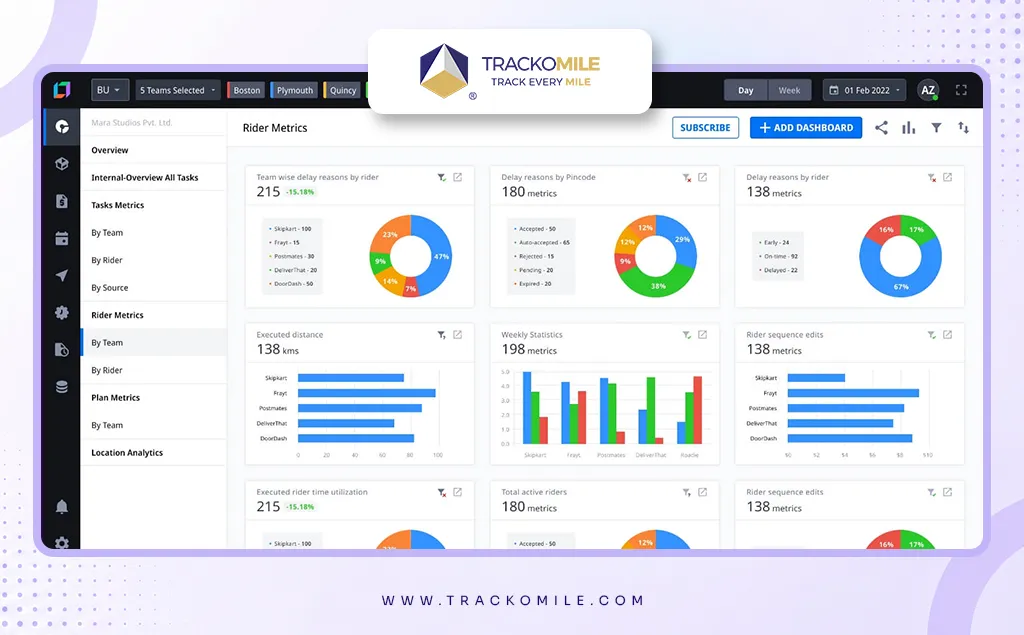
TrackoMile is a leading last-mile delivery management software in India. It offers dispatch management, route optimization, rider roster, and ePOD into a single system. Its rule-based engine weighs 120+ constraints (rider shifts, vehicle load, delivery windows) before assigning routes.
Key Features:
- Route optimization across 120+ rules (load, shift, traffic, time windows)
- Dynamic dispatch and rider allocation
- Multi-format proof of delivery (OTP, bar code, e-signature, photo)
- Rider roster & attendance management
- ERP, CRM, and warehouse-system integrations
- Detailed reports and live analytical dashboard
Best For:
Retail, e-commerce, and 3PL teams that want last-mile routing, dispatch, and delivery management in one platform.
Rating:
Overall positive reviews on Apple store, Google playstore, SoftwareSuggest and GetApp for dispatch efficiency.
2. Locus
locus
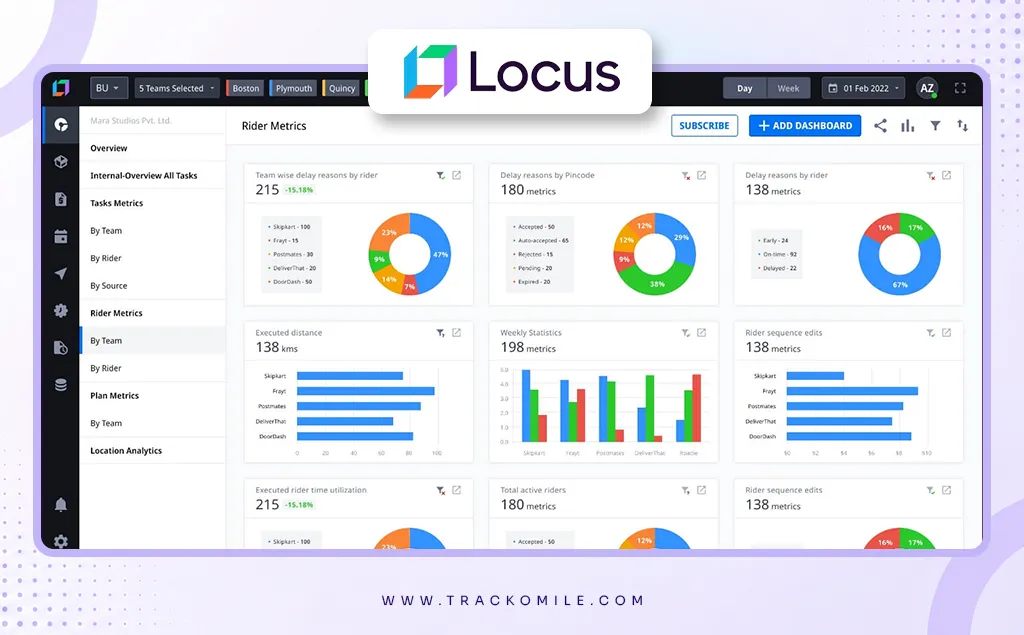
Locus is an agentic transportation management system built for enterprise last-mile logistics, running thousands of drivers across multiple depots and carriers. Instead of one route each morning, it continuously re-optimizes as orders and traffic change. It’s backed by the deepest constraint library on this list.
Key Features:
- Continuous, agentic re-optimization rather than a static morning plan
- Solves 250+ real-world constraints simultaneously
- Proprietary geocoding engine for messy addresses
- Multi-carrier, multi-depot network planning
Best For:
Large enterprises in retail, FMCG, and 3PL running complex, multi-region last-mile networks.
Rating:
4.8/5 on G2, ranked #1 in Route Planning in G2’s 2027 Best Software Awards.
3. Route4Me
Route4Me
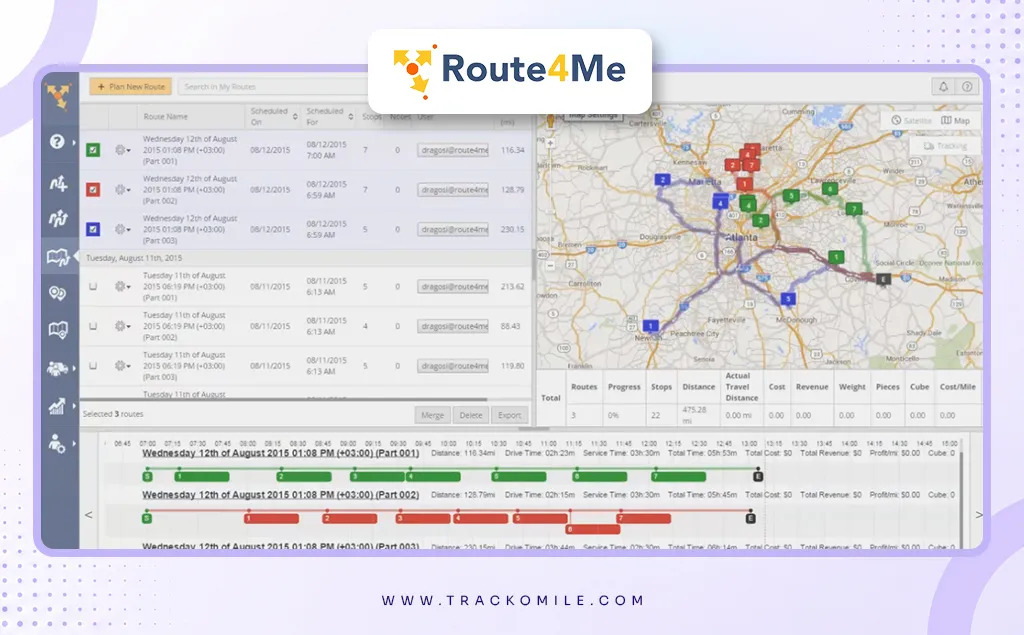
Route4Me is one of the longest-running names in route optimization, with 40,000+ customers and 3 billion-plus miles optimized since 2009. Much of that has been last-mile delivery and field service routing. It’s built around a large marketplace of add-on modules. Route4Me is highly configurable, but also expensive than its competitors.
Key Features:
- Multi-stop optimization with hours-of-service and weight constraints
- Native iOS, Android, Windows, and Mac apps
- Recurring route scheduling for repeating patterns
- Public routing API for custom integrations
Best For:
Last-mile operations with unusual constraints (weight limits, hours-of-service, multi-day routes) needing a highly configurable engine.
Rating:
4.6/5 average across G2 and Capterra (100+ combined reviews).
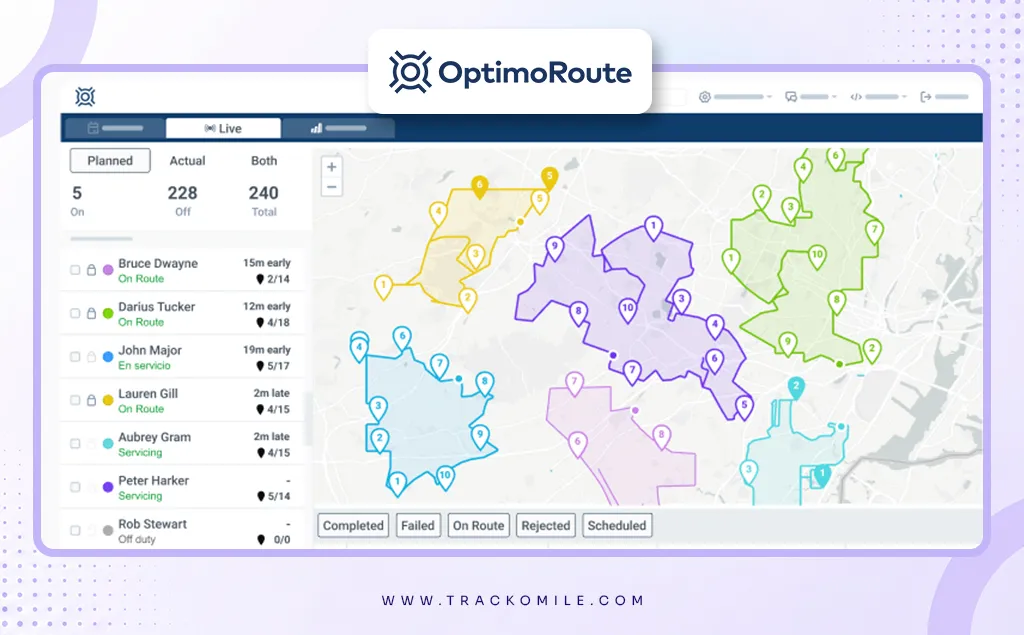
4. OptimoRoute
OptimoRoute
OptimoRoute is a cloud-based route planner for small and mid-market last-mile delivery and field service teams that want strong optimization without an enterprise sales process. It plans up to five weeks ahead. Reviewers note its routes need less manual cleanup than cheaper alternatives.
Key Features:
- Dynamic multi-stop, multi-vehicle route optimization
- Planning horizon up to five weeks in advance
- Live route editing with recalculated ETAs
- Return-to-depot and pickup-and-delivery routing
Best For:
Small-to-mid-size last-mile delivery or field service teams that prioritize routing quality over the lowest sticker price.
Rating:
4.8–4.9/5 on G2, among the highest-rated tools in this category.
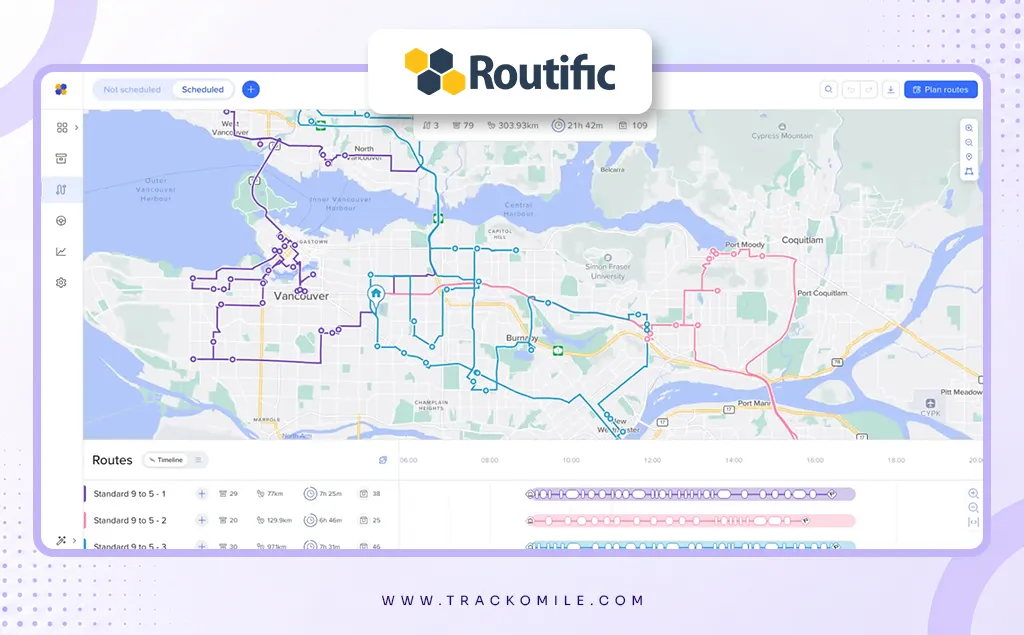
5. Routific
Routific
Routific is a last-mile delivery planning tool built for teams managing under 50 vehicles with stable, repeating routes. It’s known for a clean interface and fast setup; users report going live in hours.
Key Features:
- Intelligent multi-stop optimization with time windows
- Drag-and-drop route editing with instant impact preview
- Driver-friendly routes that minimize overlap and criss-crossing
- Proof of delivery with photo capture and barcode scanning
Best For:
Small-to-mid last-mile delivery teams that want transparent, self-serve pricing and low-friction setup.
Rating:
4.8/5 on G2, with some of the strongest ease-of-setup scores in the category.
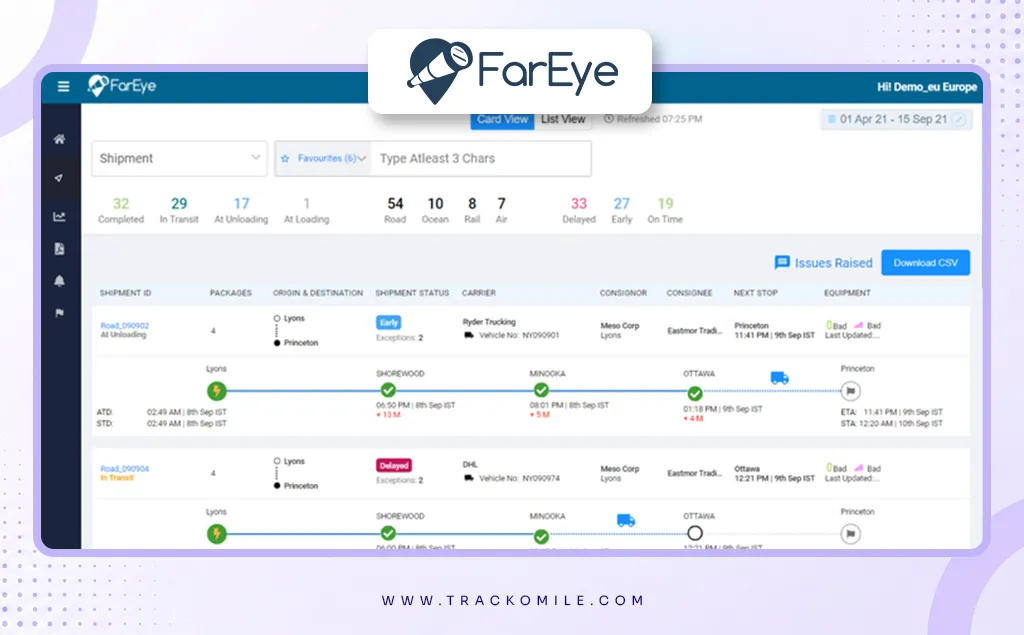
6. FarEye
FarEye
FarEye is an enterprise last-mile orchestration platform. It goes beyond routing into carrier allocation, invoice reconciliation, and customer-facing delivery experience. Its April 2027 “PILOT” release adds agentic AI dispatcher: autonomous agents that execute routing and dispatch decisions rather than just recommending them.
Key Features:
- AI-driven dynamic route optimization and scheduling
- Multi-carrier orchestration with 1,500+ carrier integrations
- Agentic dispatcher (PILOT) for autonomous decisions
- Sustainability and invoice-reconciliation dashboards
Best For:
Large enterprise retailers and 3PLs needing last-mile routing bundled with multi-carrier orchestration.
Rating:
4.8/5 on G2 (249+ verified reviews), ranked #1 in Last Mile Delivery in G2’s 2027 Best Software Awards.
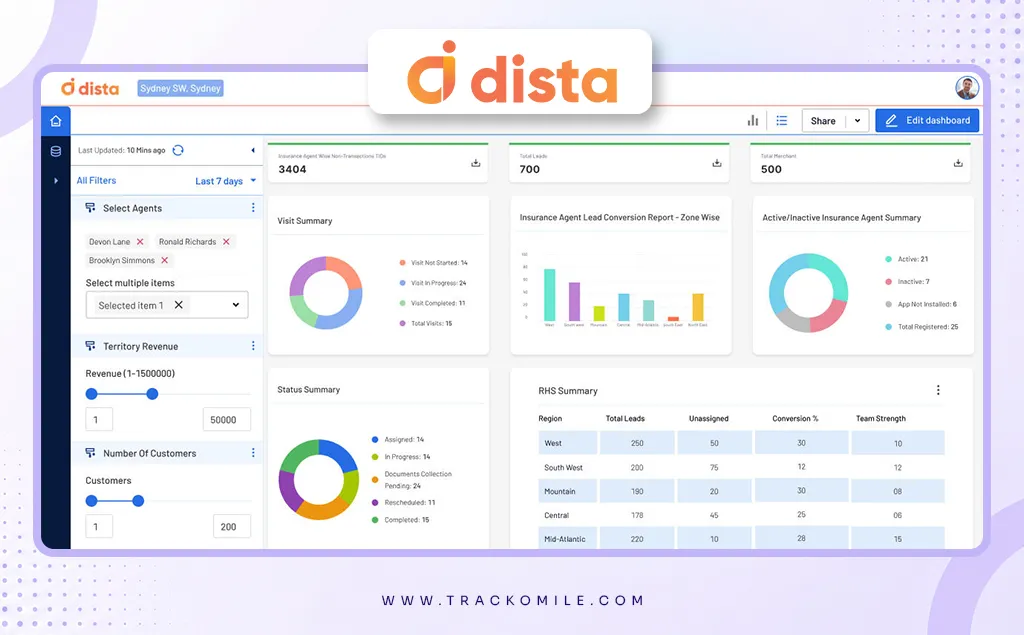
7. Dista
Dista
Dista is a location-intelligence platform used across last-mile delivery, field service, and field sales. Its engine leans heavily on geocoding accuracy, built to make sense of incomplete residential addresses. It can also weigh 150+ business constraints when building routes.
Key Features:
- AI/ML-based dynamic route optimization across 150+ constraints
- Patent-pending geocoding and address verification
- Territory optimization with auto-grid clustering
- Live tracking with predictive delay alerts
Best For:
Last-mile operations in regions with inconsistent address data that need routing tied to strong geocoding.
Rating:
Limited public review volume to date; case studies highlight routing accuracy and cloud scalability.
8. Fleetroot
Fleetroot
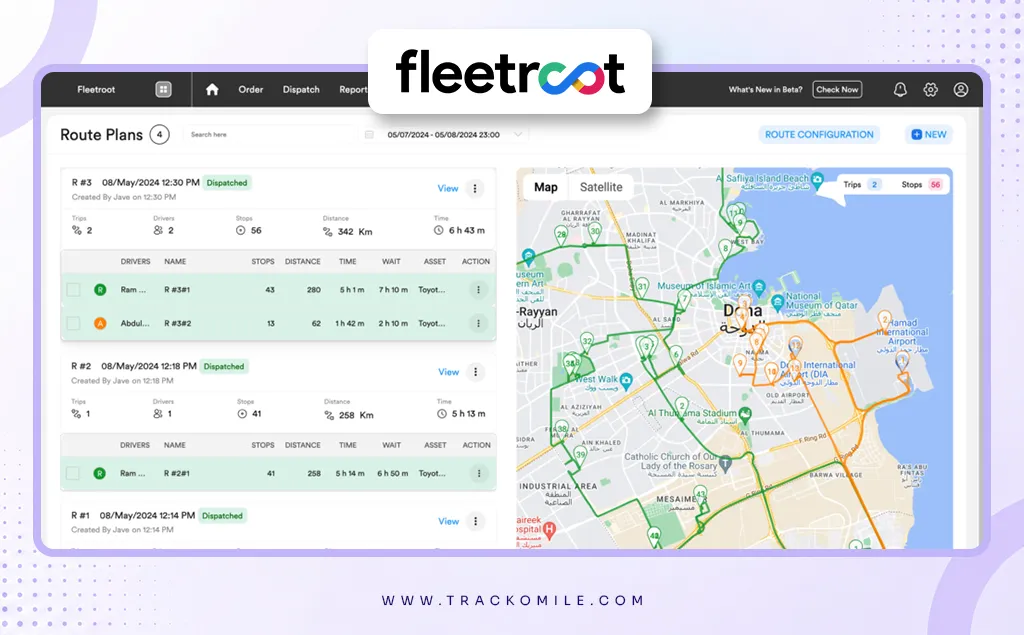
Fleetroot is a broader fleet management and IoT platform covering GPS tracking, fuel monitoring, and driver behaviour. Last-mile route planning is one module here, not its sole focus, which suits businesses that wish to integrate it into wider logistics operations.
Key Features:
- Route planning and fleet optimization
- Fuel management and consumption monitoring
- Driver behaviour scoring
- Trip and delivery communication workflows
Best For:
Mid-size to enterprise last-mile fleets that want routing bundled with telematics and fuel monitoring.
Rating:
Limited public review volume; available reviews highlight tracking accuracy.
9. Onfleet
Onfleet
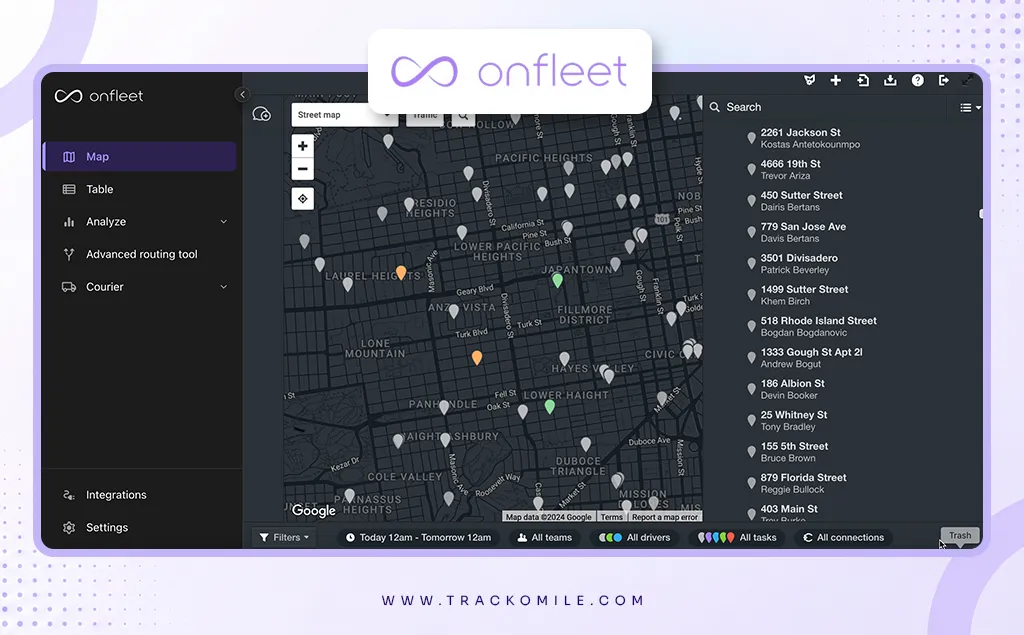
Onfleet is a last-mile delivery platform built around same-day and on-demand operations (grocery, pharmacy, courier) where routes change constantly through the day. It bills by completed delivery task rather than per driver, so cost tracks volume, not headcount.
Key Features:
- Auto-dispatch with real-time route optimization
- Task-based billing tied to delivery volume, not seats
- Automated customer SMS notifications and live tracking links
- RESTful API for order-system integrations
Best For:
Same-day and on-demand last-mile delivery businesses that want a polished driver and customer experience.
Rating:
4.6/5 on G2, 4.7/5 on Capterra.
10. Upper
Upper
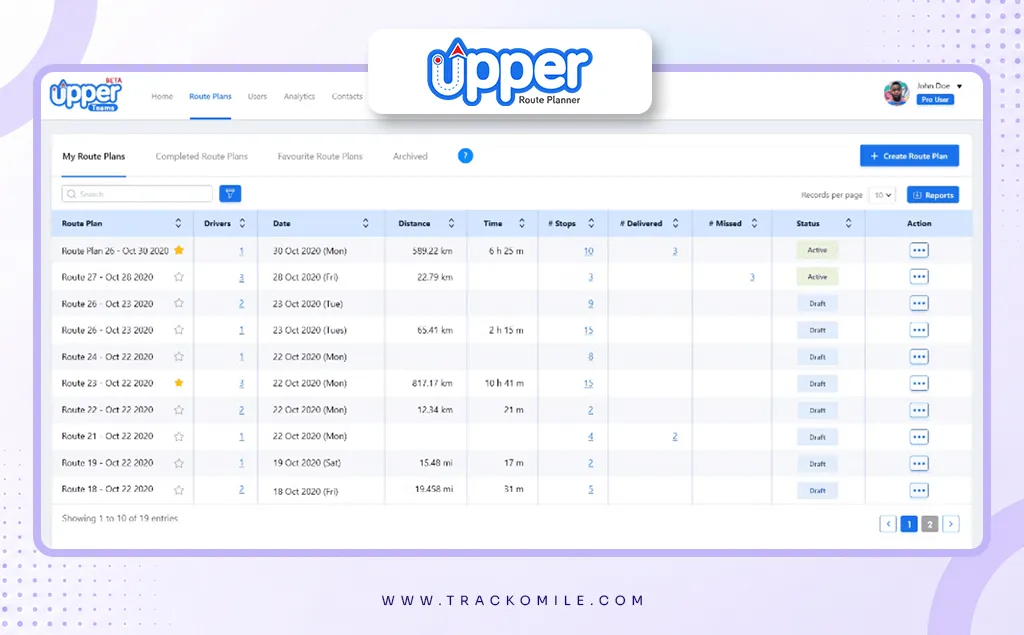
Upper is a straightforward route planner for small last-mile delivery and service businesses, like food, pharmacy, and HVAC. It’s built for fast spreadsheet import without a steep learning curve.
Key Features:
- Bulk import of up to 500 stops from Excel
- One-click route optimization and dispatch
- Driver app with turn-by-turn navigation
- Delivery time windows and stop prioritization
Best For:
Small last-mile teams that want an easy, spreadsheet-driven setup without enterprise-grade constraint handling.
Rating:
4.6–4.8/5 across G2 and Capterra, with reviewers praising ease of use and support.
How to Choose the Best Last-Mile Route Optimization Software?
To pick the best route optimization software, start by understanding your delivery model, test with real data, ensure integration capabilities and look for transparent pricing. The best route optimization software is not the one with the most features. It’s the one that makes the job of managers and riders easier.
1. Understand Your Delivery Model
Your delivery model should guide the buying decision. Don’t just look at the feature list or pricing. A business running scheduled routes has different needs from an on-demand delivery company. A field service company may care more about appointment windows and technician skills. A retail distribution business may need to consider vehicle capacity. Match the tool to that pattern first.
2. Evaluate Driver Adoption
Prioritise tools with quick onboarding, mobile-friendly interface and short learning curve. If the app is too complex for your delivery teams, they might make constant errors and resort to other navigation tools.
3. Test With Real Operational Data
A polished sales demo with fake sample data tells you little. Test the software with:
- Real orders
- Real delivery windows
- Actual rider availability
- Usual vehicle constraints
Add distant stops. Include urgent deliveries. Add multiple delivery windows. Test what happens when a rider becomes unavailable.
4. Look at Integration Capabilities
Route optimisation software should connect with the systems that generate delivery data. Depending on the business, this may include ERP, CRM, order management, or warehouse management tools. Strong integration reduces duplicate entry and manual data transfer.
5. Consider the Total Cost
Subscription fees are only one part of the cost. Many vendors have hidden charges to access advanced features, one-time onboarding fees, and minimum user requirement. Ensure complete transparency in pricing. Also factor in any additional costs for implementation, integration, or support. Read reviews to know what actual users or your competitors are saying about the software.
Final Thoughts
There’s no single best route optimization software. There’s a best fit for your delivery pattern, team size, and budget. Enterprises running complex, multi-region last-mile networks will get more value from delivery management software like TrackoMile, Locus or FarEye. A five-person courier service will find OptimoRoute, Routific, or Upper faster to deploy and more budget-friendly. For the best ROI and overall value for money, for both SMEs and enterprises, TrackoMile would be the right choice.
But be sure to analyse your delivery model and constraints. Shortlist two or three platforms that match, and test each using real data and difficult delivery scenarios. The right solution should make routes easier to plan, easier to execute, and easier to improve.
Frequently Asked Questions
-
How much does route optimization software cost in 2027?
The cost of route optimization software depends on factors like teams size and features needed. AI-powered solutions are expensive. Most software have fixed subscriptions along with per user charges. Enterprise platforms like Locus or FarEye use custom pricing instead.
-
What's the difference between route planning and route optimization software?
Route planning maps a fixed sequence of stops manually or with basic tools. Route optimization software uses algorithms to calculate the most efficient sequence automatically, factoring in traffic, time windows, and vehicle capacity. Planning is static. Route optimisation is dynamic as it involves adjusting routes through out the day.
-
Does route optimization software work for small businesses?
Yes. Tools like TrackoMile and OptimoRoute can be beneficial for small teams. They offer custom plans and per-use charges. Small businesses also experience faster ROI since automated routing make delivery operations smoother.
-
Which is the best route optimization software?
There’s no single best option. Every platform offers unique solutions. Some cater to both last mile and telematics. Some are AI-powered. The best route optimization software is the one that best fulfils your business requirements.
-
How much can businesses save with route optimization software?
Businesses typically cut routing costs by 10% to 25% through fewer miles driven and less idle time, according to McKinsey. Load consolidation can also raise vehicle fill rates from about 45% to 74%.

Mudit Chhikara writes for TrackoField and TrackoMile at InsightGeeks, covering field operations and last-mile logistics. His work spans routing, delivery operations and technical guides that turn comp... Read More


Related Blog
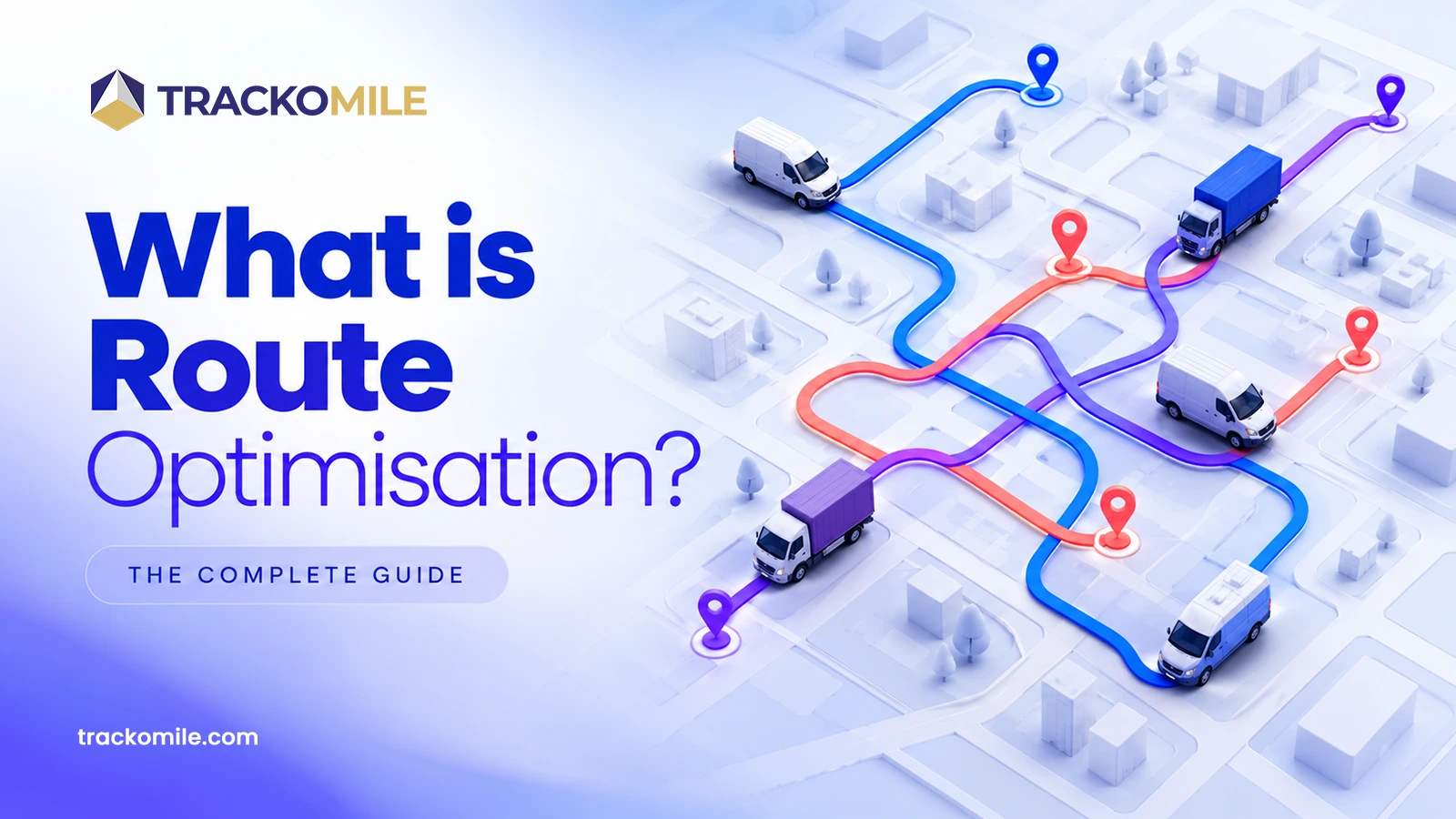
What is Route Optimization: The Complete 2027 Guide
Explore route optimization, how it works, why it is essential for last-mile delivery, and the best practices for choosing the…
10 Delivery Management Best Practices Every Logistics Team Should Follow
Following delivery management best practices can improve order allocation, real-time tracking, and KPIs. These tips reduce delays and last-mile delivery…
What Is Delivery Management? Process, Challenges & Best Tools
Delivery management streamlines order allocation, route optimisation, dispatch, and tracking to reduce costs, improve efficiency, and boost customer experience.
Building Resilient Delivery Operations with TrackoMile in 2026 and Beyond
Logistics businesses build resilient delivery networks with TrackoMile. But how exactly? With real-time route optimization, automated scheduling, and end-to-end fleet…


Your inbox awaits a welcome email. Stay tuned for the latest blog updates & expert insights.
"While you're here, dive into some more reads or grab quick bites from our social platforms!"Stay Updated on tech, telematics and mobility. Don't miss out on the latest in the industry.