
Quick Summary

- Global fuel crises are increasing operational costs for fleet operations, with diesel comprising 50-55% of truck expenses.
- Rising fuel prices are exacerbating existing inefficiencies, leading to higher operational pressures and reduced profitability.
- Logistics businesses must improve route planning and driver behavior to combat rising fuel prices and maintain customer satisfaction.
- Investing in fleet management software is essential for monitoring fuel consumption and enhancing operational efficiency during fuel crises.
Exploring how global fuel disruptions are changing fleet economics. Also, why operational efficiency has become critical for logistics businesses.
The fuel pricing across India rising by 3 Rupees Per Liter. Its pushing inflation and its effect is spreading beyond petrol pumps to businesses.
Former All India Motor Transport Congress president Bal Malkit Singh said diesel alone contributes nearly 50-55% of total truck operating costs. This makes the latest fuel hike particularly painful for the sector.
“With increases in fuel prices, tolls, insurance, tires, maintenance and compliance expenses, transporters are struggling for survival,” he said.
As the third largest oil importer, rising fuel prices is only part of the problem. The problem is that for long, logistics businesses were internally absorbing fuel losses. But now with prices skyrocketing, operational inefficiencies have started hitting hard. Activities like idling and poor route planning cannot be tolerated any longer.
For managers, the fuel crisis has turned from a financial to operational challenge. Delivery timelines, customer expectations and overall profitability are tied to fuel efficiency. Businesses that are lacking the visibility into fleet operations stand to suffer more.
The World’s Fuel Supply Just Got a Lot more Unstable
The current fuel crisis is not just a temporary fuel price fluctuation. It is a result of large-scale disruption. The global oil supply chain has taken the biggest hit. The transportation businesses worldwide are facing repercussions.
1. Strait of Hormuz Disruptions are Impacting Global Fuel Movement
The strait of Hormuz alone handles nearly 20% of global oil trade. Roughly 20 to 35 million barrels of crude oil pass through this narrow 21-mile channel every day.
Attacks on Iran and Gulf facilities effectively closed the Strait of Hormuz. Producers in Iraq, Kuwait, UAE, Saudi Arabia and Qatar shut their output. Even export-oriented refineries reduced and eventually cut their runs. The International Energy Agency calls this “the largest oil supply crisis in history”.
As tanker traffic stalled, Brent crude surged. By May 2026, Brent had climbed to $111.50 per barrel. Economists are assessing a scenario where Brent crude surges to $180 per barrel. This will happen if the strait of Hormuz remains constrained for an extended period.
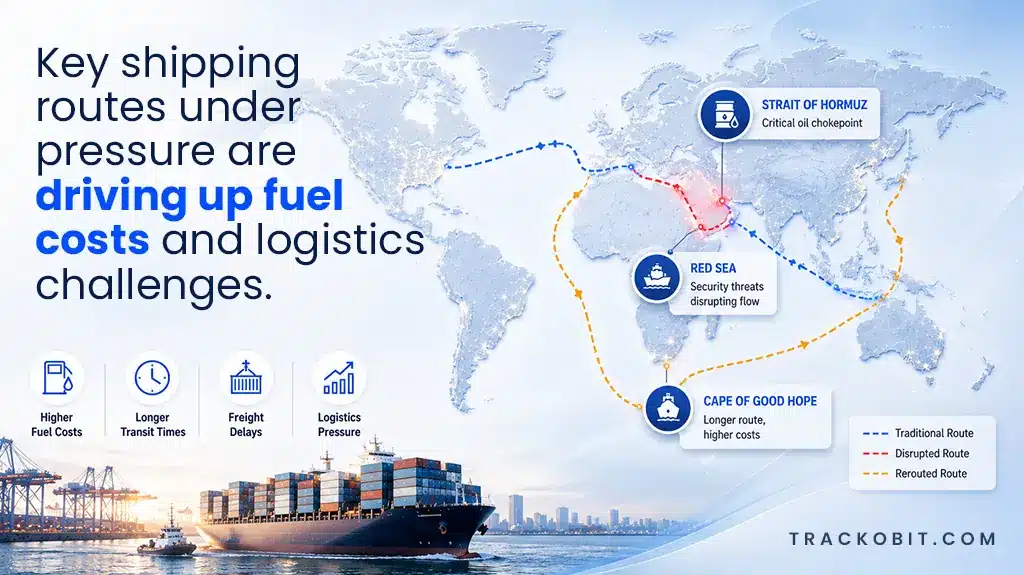
Factors disrupting fuel supply and logistics route
2. Red Sea Crisis Disrupting Global Fuel Supply Chain
Nearly 50% of diesel shipments are now avoiding the Red Sea route entirely. This has created delays and supply imbalances across multiple regions.
The ongoing red sea crisis adds concern to the international fuel supply and market. It is also disrupting logistics network. The red sea route connects Suez Canal to global trade corridors. It is a critical shipping lane for crude oil and refined petroleum products. The canal is also the route for container cargo between Asia, Europe, and the Middle East. But the ongoing attacks on vessels have forced shipping companies to avoid this route.
Due to this the vessels are now being rerouted around Africa’s Cape of Good Hope, adding 10-14 extra days. As a result, there is an increase in –
- Transit distance
- Voyage time
- Fuel consumption
- Shipping costs globally
- Maritime insurance premiums
3. Crude Oil Volatility Is Increasing Operational Pressure
As the supply tightened, crude prices responded immediately. Brent crude climbed up. Global inventories have also witnessed one of the fastest drawdowns in recent years. Nearly 246 million barrels depleted between March and April 2026. This sharp imbalance between supply and demand is creating uncertainty across fuel markets.
4. India’s Logistics Sector is Already Feeling the Brunt
Despite rising global costs, fuel demand across India remains high. In October 2025, India petroleum consumption crossed 20.17 million tonnes. Whereas Diesel consumption reached 7.62 million tonnes.
When fuel prices were stable, inefficient operations reduced margins slowly. This often went unnoticed. Today, those same inefficiencies create immediate financial pressure.
A delayed dispatch now costs more. A poorly optimized route now costs more. Underutilized vehicles and unnecessary mileage now impact profitability far more aggressively than before.
This is why many businesses are already feeling the operational pressure. Even before major fuel hikes fully reach retail markets. The crisis is amplifying existing inefficiencies rather than creating entirely new problems.
Rising Fuel Prices are Only Part of the Problem
Most discussion around the current fuel crisis focuses entirely on rising petrol prices. But for fleet dependent businesses, the real challenge runs much deeper.
1. Fuel Inefficiency Compounds Faster During Volatile Markets
When fuel prices were stable, inefficient operations reduced margins slowly and often went unnoticed. Today, those same inefficiencies create immediate financial pressure.
A delayed dispatch now costs more. A poorly optimized route now costs more. Underutilized vehicles, unnecessary mileage, and idle time now impact profitability far more aggressively than before.
This is why many fleet businesses feel operational pressure even before major fuel hikes fully reach retail markets. The crisis is amplifying existing inefficiencies rather than creating entirely new problems.
2. Logistics Businesses Are Losing Predictability
Predictability is the foundation of profitable fleet operations. To maintain profitability businesses, need –
- Stable delivery timelines
- Manageable operating costs
- Accurate route planning
3. Fuel volatility disrupts all three simultaneously
Dispatch teams are struggling to manage flatulating transportation costs. All the while maintaining customer expectations around delivery speed and quality. Meanwhile, route delays caused by congestion or inefficient scheduling create additional fuel burns. This further squeezes margins.
Rising fuel volatility is also affecting planning confidence inside operations teams. When transportation costs become unstable, businesses often become more reactive operationally. Thus, leading to rushed dispatch decisions, inconsistent route planning, and poor vehicle utilization. Ironically, this creates even more fuel wastage.
Surging fuel costs directly threaten the profitability of fleet operators. Cost-per-km is rising rapidly. If diesel jumps 15–20%, and fuel is 25–30% of a truck’s OPEX, then each kilometer driven costs substantially more.
With fuel prices changing frequently, managers need to know what a trip is likely to cost. A fuel cost calculator helps estimate the fuel expense for a planned trip.
For example,
A truck averaging 4 km per liter running 300 km per day burns 75 liters daily. At the current ₹3 per liter hike, that is ₹225 extra per truck per day. Across a fleet of 30 trucks running 25 days a month, that is ₹1.68 lakh extra every single month. From the price hike alone, a single internal inefficiency is counted.
4. Rising Inflation Is Increasing Operational Stress Across Fleets
India’s wholesale inflation touched 8.3% in April 2026. This is driven largely by rising energy costs. Meanwhile, petroleum related inflation surged by over 67% year on year.
For fleet businesses, this means fuel is not the only expense increasing. Maintenance costs and freight movement costs are rising steadily. Even spare part pricing and overall transportation expenses are rising.
This creates a compounding pressure cycle. Operational inefficiencies become increasingly difficult to absorb over time.
Businesses can no longer afford to treat fuel optimization as a secondary priority.
The Hidden Fuel Losses Most Fleet Still Ignore
With fuel volatility pressure closing in, businesses face internal pressure as well. They are facing internal fuel loss that has remained largely invisible.
1. Excessive Idling Quietly Drains Profitability
A vehicle idling for 10 minutes uses as much fuel as it takes to travel 5 miles and uses more than 27 gallons of fuel a year. Now imagine a large fleet. This translates into thousands of rupees lost monthly through fuel waste alone.
What makes idling particularly dangerous is that businesses rarely notice it in isolation. The losses get absorbed into overall fuel expenses. Thus, making rising monthly fuel bills appear normal over time.
One important operational insight here is that idling often increases during operational chaos. Delayed loading and poor dispatch coordination increases idling. Even and route confusion indirectly increase idle hours across fleets.
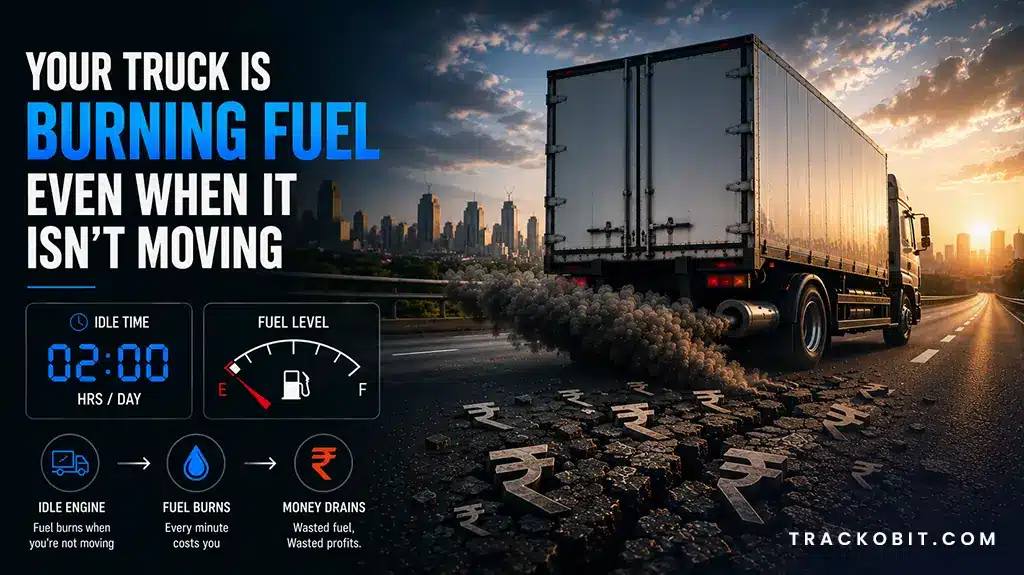
Idle trucks burn fuel, increase costs, and quietly reduce fleet profitability
2. Route Deviations Are Quietly Increasing Cost Per Trip
Route deviations have become significantly more expensive during the current fuel crisis. Even small detours now create measurable increases in operating costs. The problem worsens when multiplied across hundreds of trips.
Poor planning can force drivers to take longer routes. Inconsistent dispatch coordination adds to the issue. Traffic avoidance also increases travel distance. Unauthorized vehicle usage can silently raise monthly fuel consumption across the fleet.
For long or short haul logistics, route inefficiencies is more than planning issue. They are directly impacting route profitability.
In Andhra Pradesh, transport unions have already signaled a freight rate hike. This is to offset surging diesel. Indian Express estimates businesses may face ₹5,000–₹10,000 extra per month in operating costs.
3. Aggressive Driving Behavior Is Increasing Fuel Burn
Driving behavior is one of the most overlooked contributors to fuel inefficiency.
Lack of driver behavior monitoring causes overspeeding, harsh acceleration, and sudden braking. Aggressive throttle usage can increase fuel consumption.
Aggressive driving also accelerates –
- Tire wear and tear
- Increases maintenance frequency
- Reduces vehicle lifespan
- Raises accident risks
During fuel volatility, these secondary operational costs become even harder to absorb.
4. Fuel Theft Remains an Invisible Operational Leakage
Fuel theft remains one of the most underreported operational losses across Indian fleets.
Without fuel level sensors or fuel monitoring systems, small siphoning incidents go unnoticed. Businesses only recognize the problem later. That too through abnormal fuel consumption trends or unexplained mileage discrepancies.
Why Fleet Management Software Matters More During Fuel Crises
In such volatile situations fleet management software is unavoidable. It becomes an operational intelligence system helping reduce fuel wastage. This is where TrackoBit becomes increasingly important.
1. Fuel Monitoring Helps Businesses Move from Reactive to Preventive Control
With the help of fuel management software, visibility becomes an advantage. Fleet managers are monitoring fuel consumption in real time instead of month end. They are getting alerts regarding any anomaly in consumption pattern.
With real time fuel monitoring, businesses can –
- Detect sudden fuel drops
- Identify possible theft incidents
- Compare route wise fuel efficiency
- Analyze driver wise fuel consumption
- Identify unusual fuel burn patterns early
With it, businesses can make the shift from reacting to prevent fuel loss. Even before the matter escalates.
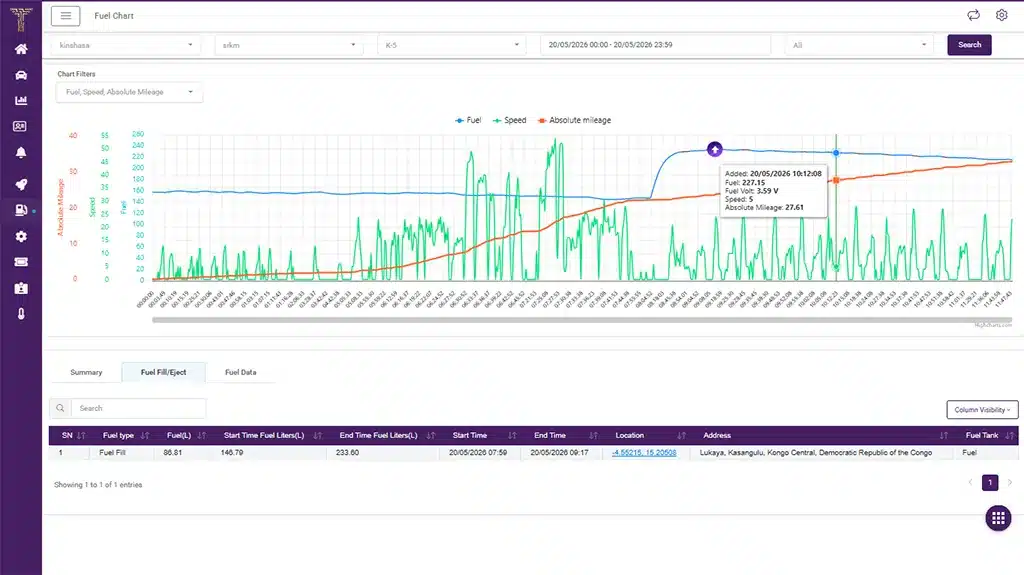
TrackoBit’s fuel monitoring software track usage, anomalies and expense
2. Real Time Fleet Visibility Improves Operational Efficiency
Real time visibility helps businesses optimize movement continuously rather than retrospectively.
Dispatch teams can monitor:
- Live vehicle movement
- Route adherence
- Turnaround delays
- Unauthorized trips
- Idle time
- Trip completion efficiency
This helps reduce avoidable mileage and improves operational coordination across the fleet.
3. Route Planning Software Reduces Operational Uncertainty
Route planning software is not for just finding shorter routes. During the fuel crisis, its use is to reduce operational uncertainty.
With real time route visibility, dispatch teams can:
- Avoid congestion and high fuel consumption zones
- Reduce unnecessary detours and empty runs
- Improve trip allocation and turnaround planning
- Monitor route adherence through geofencing
- Receive instant alerts for route deviations
- Improve ETA accuracy and delivery planning
The software lowers fuel wastage. It improves vehicle utilization and overall operational efficiency. Research shows that companies using route planning software can save up to 30% on fuel costs. Reduce overall transportation expenses by approximately 15%.
4. Driver Behavior Monitoring Improves Fuel Efficiency at Scale
Driver behavior directly affects the fuel economy. Driver behavior software flags events that increase fuel use. Events like –
- Overspeeding
- Harsh braking
- Aggressive acceleration
- Excessive idling
Over time, these insights help operations teams coach drivers using measurable behavioral data. And not assumptions. Even moderate improvements in driving discipline can create substantial fuel savings.
5. Preventive Maintenance Supports Better Fuel Economy
Poorly maintained vehicles typically consume more fuel and experience higher operational downtime.
But it preventive maintenance businesses can maintain vehicle efficiency consistently through –
- Timely servicing
- Engine health monitoring
- Maintenance scheduling
For example – Tires influence how much energy your vehicle uses to move. Under-inflated or misaligned tires cause more rolling resistance. This makes the engine work harder. This extra effort consumes more fuel.
Conclusion
Fleet businesses that survive the fuel crisis will not be the ones with the largest budget. Neither will be the ones with the biggest operations. Rather, they will be the ones that improve operational visibility. Even before inefficiencies become uncontrollable.
Fuel crisis may be external and largely beyond a business’s micro control. But internal inefficiencies and leakages can be managed. Every idling engine, route deviation, and untracked fuel attacks OPEX profitability more aggressively.
Investing in fuel monitoring and operational intelligence will have a longer-term effect. These solutions are positioned to control cost and improve resilience. TrackoBit’s fuel monitoring software helps businesses gain control over fuel usage. It will help build a much more resilient operation during uncertain fuel conditions.
Frequently Asked Questions
-
Why are fleet businesses heavily affected during fuel crises?
Fleet businesses depend heavily on diesel for transportation and delivery operations. Rising fuel prices increase cost per kilometer, reduce profit margins, disrupt route planning, and make operational inefficiencies like idling and route deviations significantly more expensive.
-
Why is fleet management software important during fuel crises?
Fleet management software provides real time visibility into fuel consumption, driver behavior, route efficiency, and vehicle movement. It helps businesses reduce operational inefficiencies, improve dispatch decisions, control fuel wastage, and manage rising transportation costs effectively
-
What are the hidden fuel losses most fleet businesses ignore?
Hidden fleet fuel losses include excessive idling, unauthorized trips, aggressive driving, route deviations, poor dispatch planning, fuel theft, and underutilized vehicles. These inefficiencies silently increase fuel consumption and operational costs over time.

Tithi Agarwal is an established content marketing specialist with years of experience in Telematics and the SaaS domain. With a strong background in literature and industrial expertise in technical wr... Read More


Related Blog
Fleet Monitoring: The Ultimate Guide (2026)
Fleet monitoring means using GPS, telematics, and software to track vehicles. This guide helps managers dive deeper into this ecosystem…
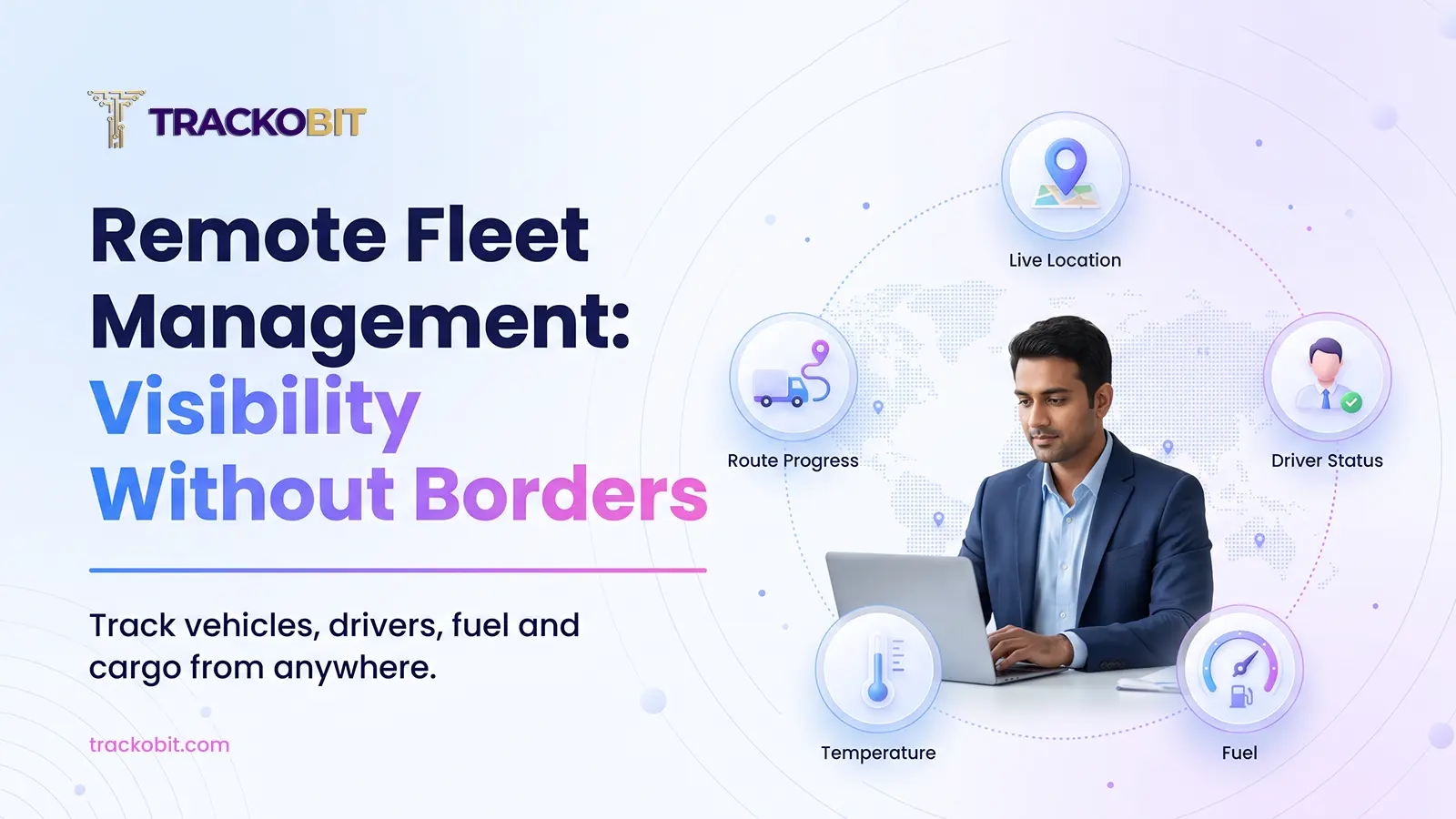
Remote Fleet Management: Track Vehicles from Anywhere
Remote fleet management lets fleet managers track vehicle location, driver behaviour, fuel use, and cargo temperature from anywhere, using GPS…
Truck Fleet Management: A Complete Guide to Efficient Fleet Operations
Truck fleet management means tracking trucks, drivers, fuel, and maintenance through GPS and software. Fuel alone eats 20% to 35%…
Fleet Management Market: Size, Growth & Forecast
The global fleet management market is worth USD 27 to 38 billion in 2026 and is growing 13% to 19%…


Your inbox awaits a welcome email. Stay tuned for the latest blog updates & expert insights.
"While you're here, dive into some more reads or grab quick bites from our social platforms!"Stay Updated on tech, telematics and mobility. Don't miss out on the latest in the industry.