

Quick Summary

- Field Force Management for loan origination enhances lending by streamlining borrower verification and digitalizing field activities.
- Despite adopting Loan Origination Software, NBFCs and MFIs face challenges due to workflow disconnects and the need for physical interactions.
- Field force management software optimizes customer onboarding, routing, and real-time tracking, reducing turnaround time and improving accuracy.
- Implementing structured field operations ensures compliance, boosts agent productivity, and ultimately leads to faster, more efficient loan origination.
Field force management for loan origination transforms the lending process by improving borrower verification and digitalising field activities.
Loan origination is a core part of the lending process, be it in NBFCs (Non-Banking Financial Companies) or MFIs (Microfinance Institutions). It takes 7-15 days for lenders to arrive at a decision. Field agents visit potential borrowers, verify their documents, and gather details to ensure repayment capacity.
This is typically quite time-intensive and NBFCs rely on dedicated LOS (Loan Origination Software). However, LOS can only simplify the initial lifecycle of a loan (application, underwriting, and approval).
Lending organisations still require field force management for loan origination to enhance the lending process. It helps delays, and reduces rejections, improper borrower verification and high operational costs.
Read on to know more about critical role of field force management in the loan origination process.
Why Loan Origination Still Struggles Despite Digital LOS
90% NBFCs and MFIs have adopted LOS and LMS. These help digitalise applications, automate underwriting, streamline approvals and simplify collection activities.
However, loan origination continues to remain challenging despite LOS integration. The reason? Workflow disconnects and lack of understanding of field lending activities.
- Field agents have to visit remote and extreme backward areas sometimes
- Potential borrowers lack typical banking history or credit scores
- Alternative means have to be adopted for risk assessment
- Collections, verifications and lending happens during physical meets
- MFIs have to monitor joint liability groups (JLGs)
All these operations take place in remote villages in low or no network areas and involve small businesses. They involve document verification and alternate credit scoring. Any lapse in monitoring these operations can lead to delays and risky loans. That’s why it is important to digitalise lending operations with field force management (FFM).
Let’s better understand the exact role of LOS and FFA in field operations in the following section.
The Role of Field Operations in Loan Origination
Loan origination depends heavily on field activities. While customers may fill forms digitally, verification and validation often require physical interaction. Here are the key field-dependent stages in loan origination.
1. Customer Onboarding
Field agents educate customers about loan products, collect applications, and assist with documentation, especially in rural or semi-urban markets.
2. KYC & Document Pickup
Agents collect identity proof, address proof, income documents, and photographs. Any error or missing document can delay the process.
3. Physical Address Verification
Many lenders require agents to physically visit the customer’s residence or business location to verify authenticity.
4. Asset & Employment Checks
For secured or business loans, officers may inspect assets or confirm employment/business operations.
These steps directly impact approval timelines. If visits are delayed, incorrectly recorded, or poorly verified, the entire loan cycle slows down. This is where structured field force management for loan origination becomes critical.
Major Field Challenges That Slow Down Loan Origination
Often, lenders blame customers for delays. But inefficiencies in field operations are the major cause. Here’s why:
1. Missed or Delayed Visits
Without proper tracking, loan officers may postpone visits or cluster them inefficiently, increasing turnaround time (TAT).
2. Manual Status Reporting
Many agents still report updates through calls, WhatsApp, or end-of-day spreadsheets. This leads to reporting delays and inaccurate information.
3. Fake or Rushed Verifications
In the absence of geotagged and time-stamped proofs, verifications may be incomplete or even fabricated. This increases compliance risk later on and leads to lending to financially volatile borrowers.
4. No Real-Time Visibility
Managers sitting in branches or regional offices have limited visibility into:
- Where agents are
- If visits happened
- Verification timeline
- Visit outcomes
5. High Agent Idle Time
Poor BEAT planning and lack of optimised task allocation result in low field staff productivity, high idle time and slow field operations.
6. Poor Visit Coverage
Some areas get over-serviced. And others get ignored due to lack of monitoring, poor route planning or inefficient territory management.
7. Compliance Gaps in Centre Meetings
In microfinance models, centre meetings are crucial. Without digital face attendance tracking of JLG members and proof of collections, compliance gaps can occur.
How Field Force Management Software Improves Loan Origination
Now that you know what problems are plaguing lending operations, especially in loan origination, let’s move on to how to solve them. Field force management software for loan origination helps structure and optimise the lending process.
1. Faster Customer Onboarding & Reduced TAT
Turnaround Time (TAT) is one of the most critical metrics in lending. The faster the verification, the quicker the loan approval. Field Force Management for loan origination reduces delays at multiple levels:
As soon as a loan application is logged into the system, field verification tasks can be automatically created and assigned to the nearest or most suitable loan officer.
This eliminates manual coordination between branch staff and field agents, missed follow-ups, and confusion over task ownership.
Every task has:
- A deadline
- A defined checklist
- A clear status (Pending, In Progress, Completed)
This structured workflow ensures nothing falls through the cracks.
2. Optimised Routing or BEAT Plans
Field agents often waste time traveling inefficiently. They visit far-off locations without route planning. Smart route optimisation helps:
- Plan visits based on geography
- Reduce travel time
- Increase the number of daily verifications
- Lower fuel and travel costs
Instead of completing 4 visits a day, an agent can complete 6–8 with better planning.
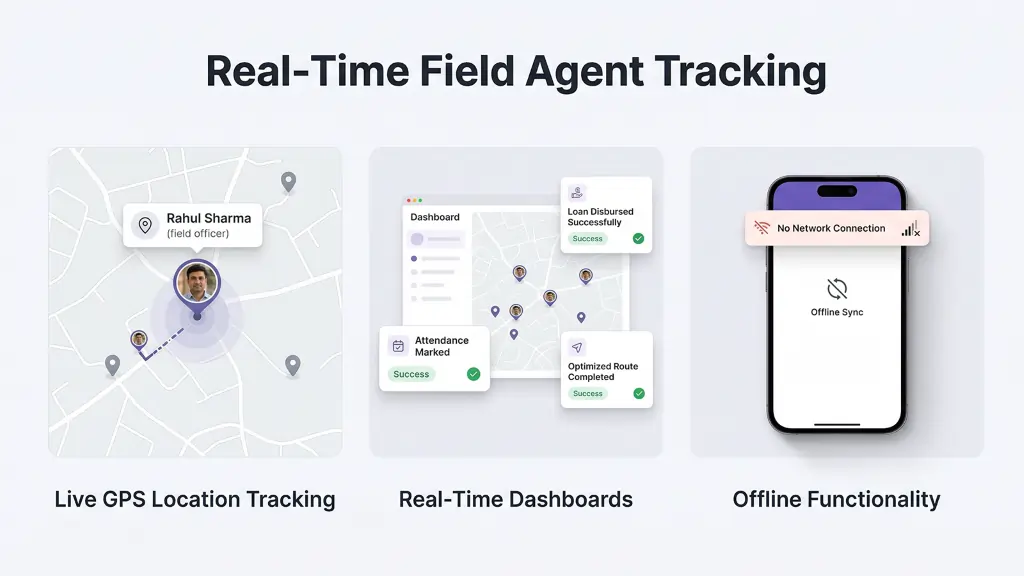
3. Real-Time Agent Tracking & Visit Updates
With live agent tracking, managers can view agent locations during working hours. This helps to ensure planned visits are executed, reduces unauthorized idle time and improves accountability.
Plus, with mobile-based updates, agents can mark visits complete instantly after finishing them. Managers no longer have to:
- Wait for end-of-day reports
- Call agents for status updates
- Depend on manual spreadsheets
4. Accurate & Compliant Field Verifications
Verification accuracy directly impacts loan rejection rates and audit risks. Poor or fake verifications can lead to financial losses and regulatory penalties. Field force management for loan origination ensures verification is both accurate and compliant.
5. Geo-Tagged Visits & Time Stamped Proofs
Each field visit is tagged with GPS location data. This ensures the right agent actually visited the borrower’s address and maintains a verifiable audit trail for compliance.
Plus, every activity is recorded with date and time stamps, preventing:
- Backdated entries
- Rushed or fabricated reports
- Manipulated verification logs
Supervisors can clearly see how long each verification took.
6. Digital Media Uploads
With FFM for loan origination like TrackoField, agents can upload:
- Customer photographs
- Property images
- Business site proof
- KYC documents
All documentation is instantly stored digitally, reducing paper dependency and loss of records.

Geoverified & Timestamped Field Activity
7. Complete Visibility Into Field Operations
One of the biggest problems in traditional loan origination is lack of visibility. Managers often don’t know where agents are or whether visits are completed.
Field Force Management solves this through real-time monitoring and centralised dashboards. It displays:
- Live agent locations
- Number of pending verifications
- Completed visits
- Overdue tasks
- Branch-wise performance
- Route history of agents
Managers can monitor performance across regions without waiting for manual reports.
Real Time Visibility of Field Agents
8. Bottleneck Identification
If approvals are delayed, managers can quickly identify:
- Specific agents with backlogs
- Regions with higher rejection rates
- Branches with low productivity
Instead of reacting late, corrective action can be taken immediately.
9. Higher Agent Productivity at Lower Cost
Scaling loan operations doesn’t always require hiring more agents. Sometimes, it simply requires better management, so more loans are processed per agent and operational costs are lowered. Field force management improves productivity by:
Reducing Idle Time: With structured task allocation and tracking, agents spend more time on productive activities rather than waiting for instructions.
Smarter Beat Planning: Visit frequency and coverage can be monitored. This ensures no area is over-serviced and no high-potential zone is ignored
Performance-Based Optimization: Managers can evaluate:
- Visits completed per day
- Conversion rate
- Average verification time
- Rejection percentage
High performers can be rewarded. Low performers can be trained or reassigned. Over time, this creates a performance-driven field culture.
Conclusion
Loan origination cannot be fully optimised through LOS alone. Since a major portion of the process happens in the field, lenders must strengthen field operations to reduce delays, improve verification accuracy, and control costs. This is only possible using field force management software. It bridges the gap between digital systems and on-ground execution.
For NBFCs and MFIs aiming to scale responsibly while maintaining compliance, adopting field force management for loan origination has become essential. Only with transparent and data-driven field operations can loan origination be made faster, risk-free and profitable.

Frequently Asked Questions
-
How does field force management impact loan origination?
Using field force management for loan origination makes the lending process faster and more transparent. Field agents collect borrower details, documents, and location proof in real time. Managers can see updates instantly. This reduces errors, avoids delays, and helps credit teams approve loans with better confidence.
-
Can TrackoField integrate with loan origination systems?
Yes. TrackoField can integrate with Loan Origination Systems using APIs. Loan data flows to field agents. Field updates sync back to the system. This keeps office and field work connected.
-
Is field force management secure for BFSI operations?
Yes. Modern systems use data encryption and secure cloud storage. Access is role-based. Every action is time-stamped and recorded. This protects borrower data and supports compliance in BFSI operations.
-
Is field force management software useful for NBFCs and banks?
Yes. It helps NBFCs and banks track field visits, verify borrowers, and capture digital documents. Managers get live visibility of field work. This improves productivity, reduces fraud, and supports better loan approval and collection processes.
-
How does real-time tracking reduce loan approval time?
Real-time tracking shows when agents visit borrowers and upload documents. Managers do not need to wait for reports. They can review data instantly. Faster verification means quicker credit checks and faster loan approvals.
-
What is the difference between LOS and LMS?
LOS handles loans before disbursal. It manages application, checks, and approval. LMS handles loans after disbursal. It tracks repayments, dues, and collections. LOS creates the loan. LMS manages the loan.

Mudit is a seasoned content specialist working for TrackoField. He is an expert in crafting technical, high-impact content for Field force manage... Read More



Related Blog

Face Recognition: What It Is, How It Works & Benefits for Field Teams
Facial recognition is a way of identifying or confirming an individual’s identity using their facial features. Read this guide to…

Field Operations Manager: Roles, Challenges & How to Optimize Performance
Field operations managers handle on-ground activities with challenges like visibility, control, and coordination. This blog covers their roles, key challenges,…

What is Face Recognition Attendance Software & How Does It Work?
This blog explains the concept of face recognition attendance software. We will also explore how it enhances attendance monitoring for…

How TrackoField Stops GPS Spoofing and Buddy Punching in Field Teams
Your field team’s attendance data looks clean. The question worth asking is whether it’s real. Here’s how GPS spoofing actually…


Your inbox awaits a welcome email. Stay tuned for the latest blog updates & expert insights.
"While you're here, dive into some more reads or grab quick bites from our social platforms!"Stay Updated on tech, telematics and mobility. Don't miss out on the latest in the industry.