
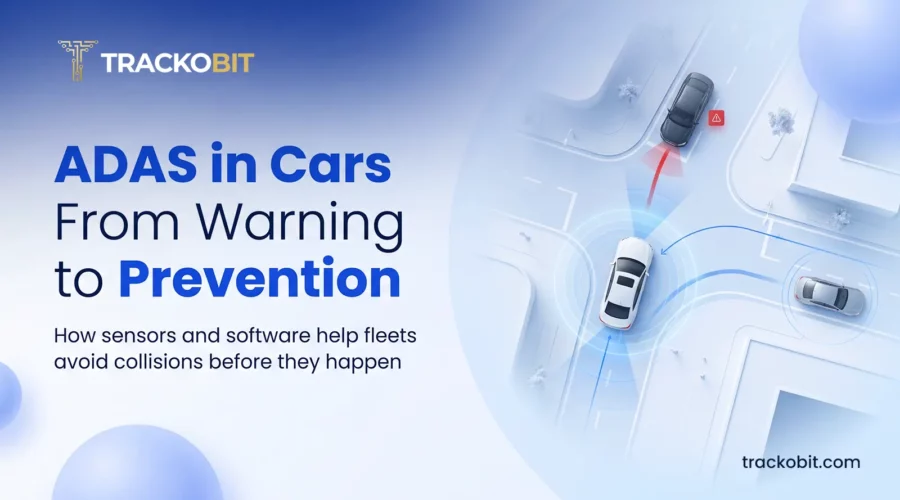
ADAS road safety system is a technology that uses sensors and software to detect danger and alerts the driver to prevent accidents.
Imagine a fleet of 40 vehicles undertaking an overnight delivery route on a city’s peripheral highway. The driver takes his eyes off the road for a second. The distance between the vehicles narrows. The ADAS system in cars identifies a closing distance. A warning sound comes up. The driver slows the vehicles for safety.
This explains why fleet managers now see ADAS as a must-have rather than an option. It offers less road damage and lower insurance premiums. You also get reduced vehicle downtime when vehicles are grounded. This blog explores how ADAS functions and what it offers. You also get to know about its levels and limitations.
What Is an ADAS System in a Car?
An ADAS system in cars is a combination of sensors, cameras, and software. It is designed to monitor the road and perform specific functions. The system helps to assist the driver to ensure safety.
- Active ADAS: Active ADAS intervenes directly with the driver by deciding to brake and steer on their own. An example of this would be an automatic emergency system.
- Passive ADAS: ADAS alerts the driver only and does not take any control of the car. As an example, the lane departure warning.
Fleets may require both types. Active systems instantly prevent risk. Passive alarms cultivate safe driving practices over a period of time.
ADAS vs Autonomous Driving
ADAS in cars assists a driver who has full control of his vehicle. For vehicle automation levels, a full self-driving vehicle assumes the role of a driver. Fleets should view ADAS as an ancillary service. It is no replacement for an experienced driver.
Why ADAS in Cars Matters for Fleet Operators
If you use an ordinary GPS tracking, you will not be able to monitor the driver’s actions. He might be distracted, sleepy, and so on.
How ADAS Helps – ADAS helps by combining ordinary GPS with video telematics. It enables fleet operators to provide earlier alerts and tangible proofs for proactive decisions.
How Does ADAS Work in a Car?
ADAS works in a car by using cameras, radar, and sensors to scan the road, then an onboard computer analyses the data. It alerts the driver to danger and, if the driver doesn’t respond, brakes or steers automatically. This four-step loop repeats continuously while the vehicle is moving.
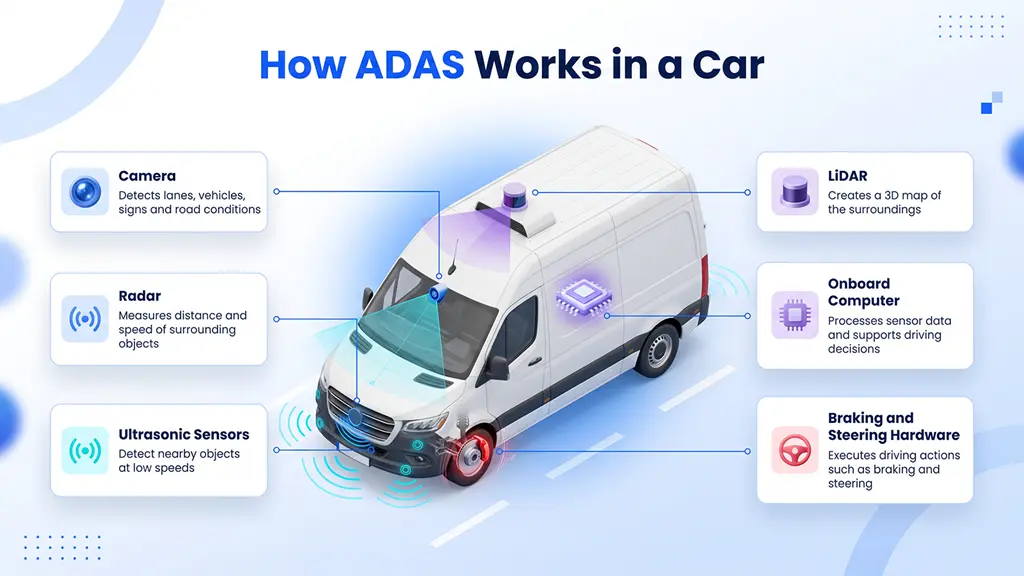
How the ADAS Detection Loop Works
Step 1: Watching the Environment
Cameras, radars, and sensors scan everything near the car. Some sense distances and velocities. Others create a 3D picture of surrounding objects using laser pulses. All work together to detect motion in crucial conditions.
Step 2: Interpretation of Data
The onboard computer compares this data to safe parameters of speed and distance. It also assesses the driver’s behavior. The system records all this information in real time.
Step 3: Informing the Driver
The vehicle alerts the driver through a beep, a light on the dashboard, or by vibrating the steering wheel. This is the operation of passive ADAS.
Step 4: Taking Action
If the driver doesn’t respond, the vehicle automatically takes control via brakes and steering. That is active ADAS working.
ADAS Components at a Glance
The table below shows a quick glance at the components of ADAS.
| Component | What it Detects | Used For | Weakness |
| Camera | Pedestrian signs and lane markings | Recognition of signs and lane keeping | Faces issues in rain, fog, and glare |
| Radar | Speed and distance of vehicles | Collision alerts and cruise control | Cannot identify small or stationary objects |
| Ultrasonic sensor | Objects that are close | Assistance in parking and braking while in low speed | Works only on short range |
| Laser-based sensor (LiDAR) | Designs a 3D road map | Detects precise objects | Costly at fleet scale |
| Onboard computer | Combined sensor data | All ADAS decisions | Only as good as its inputs |
| Braking and steering hardware | Not applicable | Braking, steering, and throttle response | Depends on timely signals from the system |
The car combines data from all sensors. It gives a single clear picture of the road. It is like how the brain senses.
AI dash cams improve this loop. They track forward driving tasks and lane departures. Every footage aligns with speed and position records. AI dash cams sends alerts that enable video telematics audits.
Key ADAS Features in Cars
The functions of ADAS in cars can be grouped into two categories. Active features need to be taken into control. Passive functions can only give warnings.
Active ADAS Features
- Adaptive Cruise Control (ACC)- ACC holds a set speed. It maintains a safe distance from the vehicle in front. ACC works well on a long highway drive.
- Automatic Emergency Braking (AEB) – AEB applies the brakes strongly when a crash seems imminent. It will activate if the driver does not respond. The U.S. is mandating vehicles to have it from September 2029.
- Lane Keeping Assist (LKA) – LKA gently encourages the car to stay in a lane. Clear lane markings are required for LKA to operate effectively. Rural roads with faded lines can confuse them.
- Electronic Stability Control (ESC) – ESC notices a loss of grip. It applies the brakes to individual wheels to keep the car steady. It is most useful on sharp corners or rough roads.
- Parking Assist and 360 cameras – The cameras guide drivers through smaller spaces. They can also take over steering in some cases. This reduces damage to bumpers/mirrors in crowded depots.
Passive ADAS Features
- FCW (Forward Collision Warning) – FCW will warn of a rapid closing distance ahead. FCW is integrated with AEB. If the FCW is ignored by the driver, then AEB will follow.
- Lane departure warning (LDW) – LDW signals a driver who strays into another lane without signaling. It also signals when the vehicle is set to parking in the wrong bay. Though, if lane markings are poor then LDW will have poor assessment. Check your route first.
- Blind Spot Detection (BSD) – If something sits in the blind spot, BSD flashes the mirror. They are great for narrow city roads. Two-wheelers can be here.
- Traffic Sign Recognition – This reads the speed limits from the road. It displays them on the dash pod. It is designed to help drivers not to break rules unknowingly.
- Driver Monitoring System (DMS) – DMS is a driver monitoring system used in in-car cameras. It monitors sleepiness or distraction. It is combined with driver behavior monitoring to identify repeat offenders.
Night Vision – Night vision operates using heat sensing cameras. It detects pedestrians and animals that headlights may overlook. Consider it for your highway fleets that run at night. This can include intra-city deliveries or emergency services.
Levels of ADAS: From Warnings to Partial Automation
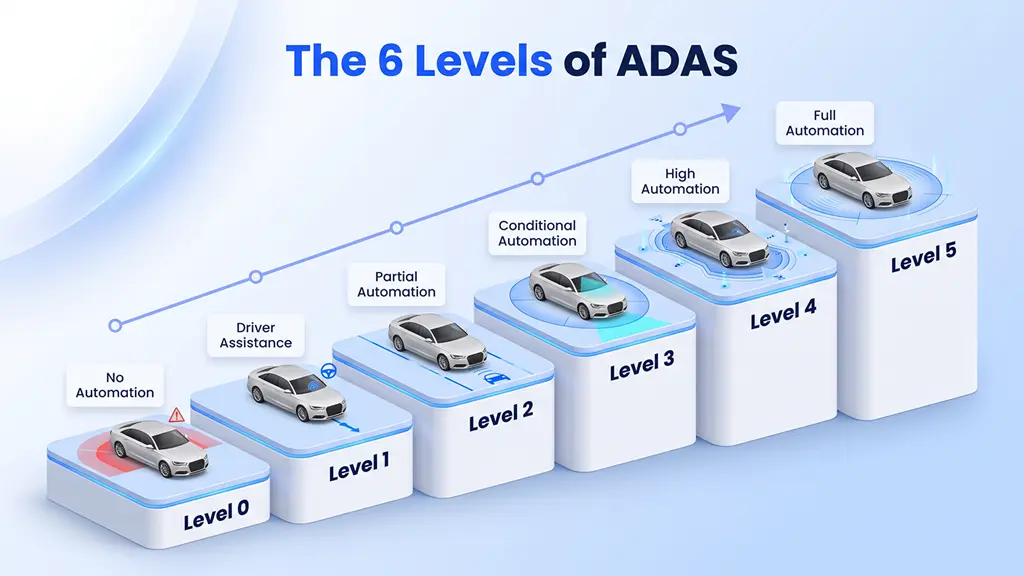
The 6 Levels of ADAS Automation
A range of the car’s assisted behavior is shown, with 0 meaning no assisted behavior, and 5 meaning full automatic driving. Modern cars today are most likely to be either Level 1 or 2.
| Level | What it Means | Example |
| Level 0 | Sends alerts only, no control | Warning for collisions in the front |
| Level 1 | Helps in one function | Adaptive cruise control or lane keeping |
| Level 2 | Controls the steering as well as speed | Driving assistance on highways |
| Level 3 | Drives in specific conditions, driver takes up the request | Mercedes-Benz DRIVE PILOT (selected regions, low speeds) |
| Level 4 | Drives without a human in specific zones | Robotaxi services in certain cities |
| Level 5 | Fully autonomous in every condition | Not yet commercially available |
Benefits of ADAS for Everyday Driving
ADAS system in cars assists in most situations like car crash possibilities, boosting cost control, and more. That is never-ending city traffic and long stretches of lonely roadway. It also works on conditions where darkness is ever-present.
1. Less Crashing
Research by NHTSA and all the big automakers have revealed one thing quite clearly. AEB reduces rear-end crashes by 49%. Pedestrian AEB is a more specific version of the feature. It can reduce cyclist crashes by 49%. Make sure to compare your own crash figures before implementation.
2. Better Cost Control
Fewer crashes means less damage and repairing expenses. It makes sure fewer down time and repair costs for vehicles sitting idle. Keep track of this and compare plots for before and after implementation.
3. Stronger Driver Accountability
All ADAS alerts are added to a driver’s scorecard after customization from the fleet owners. This allows fleet managers to see how drivers compare. It allows behavior problems to be identified and addressed early. Managers must consider reviewing driver behavior reports weekly.
4. Lower Insurance Costs
Insurance companies tend to favor vehicles with ADAS. Find out more about how ADAS affects insurance premiums. Use this information to win a better rate at your next renewal.
Use Case:
Last-Mile Delivery Fleets – Imagine 150 vans doing city delivery runs every day. A 49% crash reduction, even at a small percentage, becomes a lot significant. Less repairs means less idle vans. (Hypothetical, not a customer success story.)
| Driving Situation | How ADAS Helps | India Example |
| City | Flags sudden stops in slow moving traffic | AEB reacting to a two-wheeler cutting across in Bengaluru |
| Highway | Holds a safe following distance | ACC easing fatigue on the Delhi-Mumbai Expressway |
| Night | Improves hazard detection in low light | Collision warning on an unlit state highway |
Limitations of ADAS
Some of the limitations of ADAS are weather constraints, and road marking confusions. See the full list below for an informed choice.
- Weather: Weather like heavy rain, fog, and glare can cause visibility problems for sensors.
- Driver control: System Level 1 and 2 still require a driver to be alert.
- Road markings: When the lane paint is worn down, the cameras are unable to identify the lanes.
- Range of detection: Only a limited extent can be reached by radar and ultrasonic sensors.
- Too much dependence: The control of the vehicle by systems can cause the drivers to trust them too much.
Cost is still a factor for many fleets, and so are uneven standards and reliability concerns. Ask them for transparent terms on data management as well.
Future Trends in ADAS Technology
The future trends in ADAS technology include AI and machine learning, improved sensor fusion, and V2X communication. The convergence of these trends is enabling ADAS systems in cars to be more accurate, more connected, and more cost effective for fleet operators.
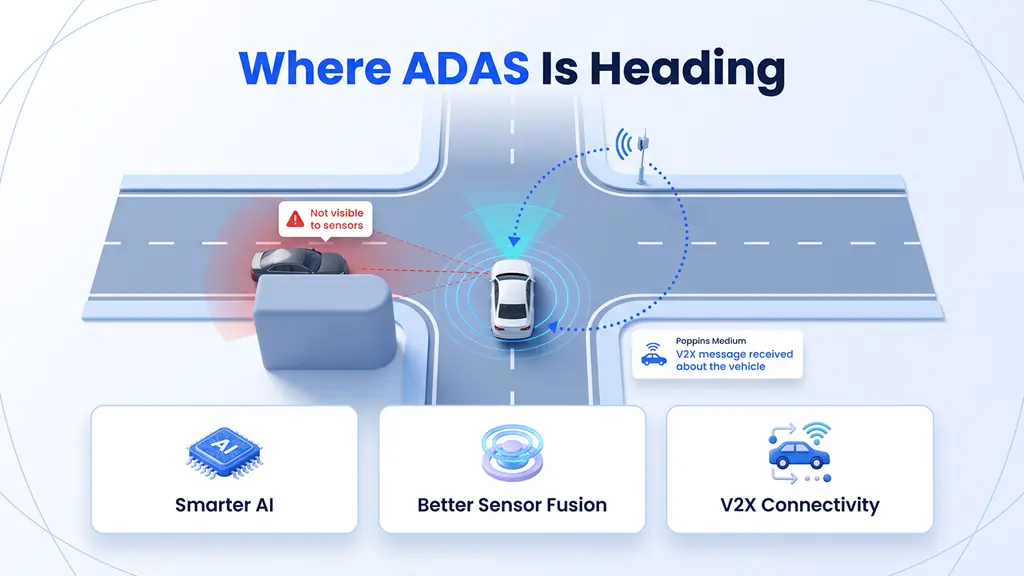
How V2X Sees Around Blind Corners
- AI and machine learning are getting better: Hybrid models can add more than one data feed. These models lower false positives and drive greater accuracy. This matters because a series of false alerts have misguided drivers and lowered their confidence. AI dashcams already do this to warn of dangerous driving as it happens.
- Better sensor fusion: As vehicles optimise software and centralise computing, sensor fusion is advancing. Camera sensors are less capable in adverse weather conditions and unfavorable lighting conditions. Radar and LiDAR will be instrumental here. They can provide accurate data in conditions like hazy and foggy vision, rain, etc.
- V2X brings the bigger picture: V2X allows communication between vehicles and other vehicles. It helps the drivers share updates about road closure conditions, traffic updates and other purposes. V2V messages are capable of reaching up to 300 meters. This provides alerts on threats in blind corners where cameras and radars do not have range.
Conclusion
ADAS system in cars has become an essential fleet infrastructure in most cars. Begin by reviewing your crash data. Next, pilot the ADAS on your risky routes.
Eager to test ADAS on your fleet? Schedule a TrackoBit demo and experience the alerts on your vehicles.

Frequently Asked Questions
-
What is ADAS in a car?
The term ADAS, “Advanced Driver Assistance System” means the use of cameras, radar, and sensors to monitor the environment around the vehicle. Using the cameras, radar, and sensors, the ADAS aims to alert the driver of a danger. It can also automatically prevent/lessen an accident.
-
Is the ADAS the same as a self-driving car?
No, it’s not the same. Given ADAS, the driver remains fully in control of the car. The driver-less car currently eliminates completely the driver. Nowadays, only a few cars currently provide limited automation.
-
Is it possible to put ADAS into an older car?
Factory fitted ADAS are difficult to retrofit to an older car as they require extensive integration with the vehicle systems. Because of this, AI dashcam may provide a camera based ADAS, providing warning to the driver rather than actual intervention.
-
How does ADAS operate in a car?
ADAS has a menu, which loops inside the car. The sensors interact with the road around the car. The onboard computer evaluates the risk and warns the driver or takes over control if needed. The full loop starts again about 10 times a second.
-
How many ADAS levels do most cars have?
Many current cars, including the fleet vehicles introduced into India, are only partial guidance systems. They assist with steering, acceleration, and deceleration but still require a vigilant driver at the controls.
-
Is the ADAS impacted by a change of the windshield?
Yes, it can. A lot of manufacturers place a lot of their ADAS cameras on the windscreen in the first place because it’s an easier place to put them. So, when you change the windscreen, the setup might change. They must make sure that the cameras are set up correctly and re calibrate afterwards.

We're not just a team but a collective force that makes this space come alive. Here, you'll find insights and inspiration from a variety of voices – our passionate staff members, expert guest contri... Read More



Related Blog
Safer Alerts, Shareable History, Faster Maintenance in TrackoBit
TrackoBit now adds an Evidence Model and authority-based access for ADAS and DMS alerts in video telematics, Vehicle History Sharing…
Fleet Management Requirements: The Complete Guide for 2026
Every wondered what exactly fleet management requirements are? Or, why do they matter? This guide helps you understand in detail.
7 Fleet Management Best Practices Every Fleet Manager Needs
Learn 7 fleet management best practices to improve safety, vehicle utilization, efficiency, and fleet performance in 2026.
What Are the Roles and Responsibilities of a Fleet Owner?
Behind every well-run fleet is a fleet owner juggling tasks like vehicle maintenance and driver management without letting anything fall…


Your inbox awaits a welcome email. Stay tuned for the latest blog updates & expert insights.
"While you're here, dive into some more reads or grab quick bites from our social platforms!"Stay Updated on tech, telematics and mobility. Don't miss out on the latest in the industry.