
Quick Summary

- The Fleet Management Market is projected to grow from USD 27 billion to USD 38 billion by 2026, with an annual growth rate of 13% to 19%.
- Key growth drivers include the rise in commercial vehicles, increased telematics adoption, and regulatory compliance requirements.
- North America currently leads the market, while Asia-Pacific, especially India, shows the fastest growth due to e-commerce and AIS 140 regulations.
- AI and predictive analytics are transforming fleet management, enhancing operational efficiency and enabling proactive maintenance strategies.
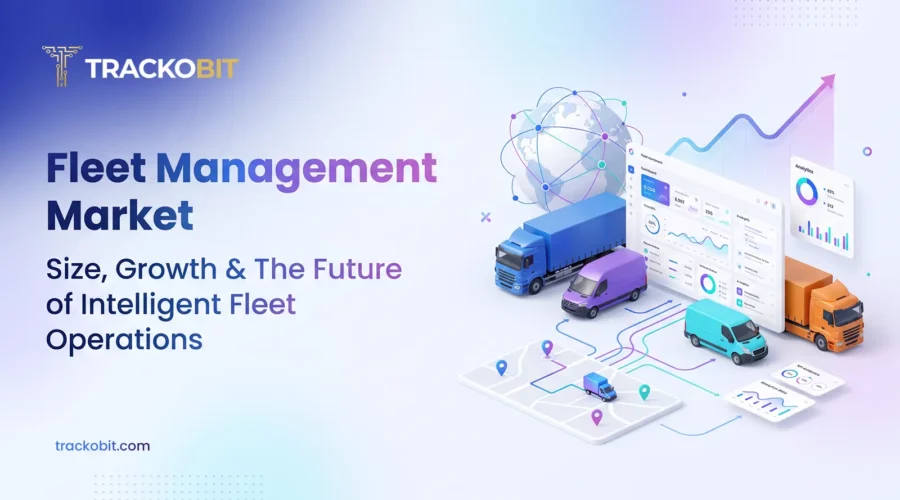
The global fleet management market is worth USD 27 to 38 billion in 2026 and is growing 13% to 19% a year. It could pass USD 120 billion by 2035, with Asia-Pacific, led by India, growing the fastest.
Fleet operations used to mean one thing: keep the trucks running. That has changed. Today, fleets also have to manage data, compliance, and fast-changing technology. This is why the fleet management market has grown so quickly. It has moved from a small telematics niche to one of the biggest segments in enterprise software.
This report covers the market in five parts. It looks at current size, how fast the market is growing, and what is driving that growth. It also covers how the market differs by region, and the technology changing how fleets are run.
Fleet Management Market Overview
What is Fleet Management?
Fleet management means using software and systems to oversee a company’s vehicles, drivers, and related assets. It covers GPS tracking, route planning, fuel monitoring, maintenance scheduling, driver behaviour tracking, and compliance. The goal is simple: cut cost and keep vehicles running longer. For a deeper look at how these pieces fit together, see what fleet management actually involves.
The fleet management system market and the fleet management software market mean roughly the same thing in most industry reports. Both describe the technology layer that ties these functions into one view.
Market Definition & Scope
The market covers three things: hardware (tracking devices, sensors, dashcams), software (dashboards and analytics platforms), and services (installation, support, consulting). The fleet management software market and the broader fleet management solutions market are often tracked as separate figures. Software-only estimates run lower than full-ecosystem numbers. This market touches many industries, logistics, construction, government, retail, and healthcare, wherever vehicles or field assets need tracking.
Evolution of Fleet Management Systems
Fleet management started with basic GPS tracking, just location data. It grew into telematics, adding fuel and engine diagnostics. Now AI sits on top of that data. Fleets have moved from tracking what already happened to predicting what happens next.
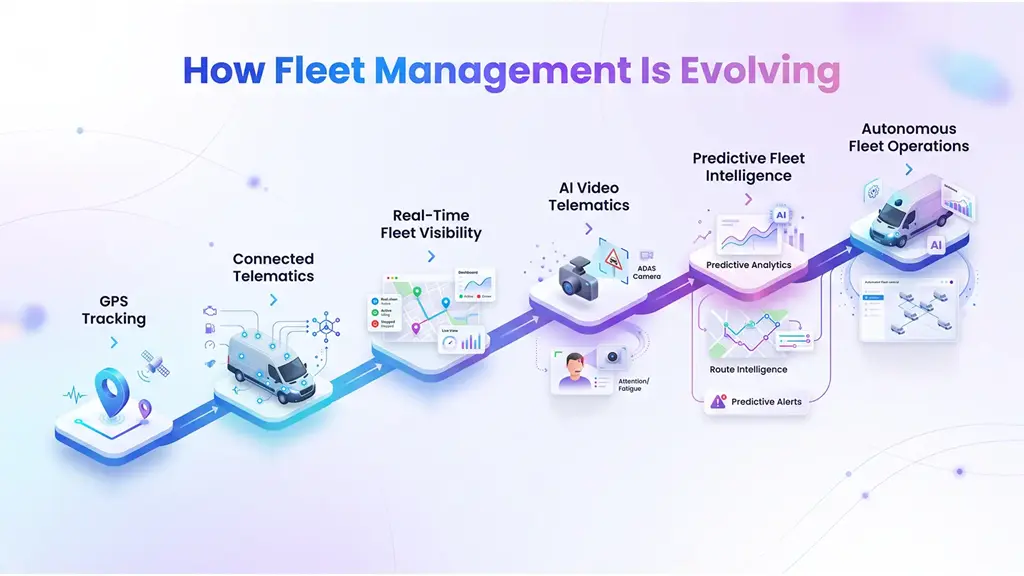
From GPS Tracking to Autonomous Fleet Intelligence
How Fleet Management Software Works
Fleet management software pulls data from GPS units and onboard sensors. It sends that data to a cloud platform. The platform turns it into something useful: live location, fuel use, driver scores, and maintenance alerts. Newer platforms use AI to flag problems before they happen, not just report them afterwards.
Fleet Management Market Size & Forecast
Market size estimates vary by research firm. But the growth story is the same everywhere: strong, double-digit growth through the next decade.
- Global Market Insights values the market at USD 27 billion in 2025. It sees this growing to USD 30.1 billion in 2026 and USD 122.3 billion by 2035, a CAGR of 16.9%.
- MarketsandMarkets puts 2025 value at USD 37.71 billion, growing to USD 70.26 billion by 2030, a CAGR of 13.3%.
- Fortune Business Insights tracks the software segment specifically, the more relevant figure for SaaS buyers. It puts this at USD 38.28 billion in 2026, growing to USD 152.89 billion by 2034, a CAGR of 18.9%.
These numbers differ because each firm scopes the market differently: hardware-only, software-only, or the full ecosystem. But every major research house agrees on the direction. The fleet management market is growing 13% to 19% a year, a rare pace for software tied to physical infrastructure.
North America and Europe together hold the largest share of global revenue today. This is based on the regional breakdowns in the GMI and MarketsandMarkets reports linked above. That share is expected to narrow gradually as Asia-Pacific grows faster than both regions over the next decade.
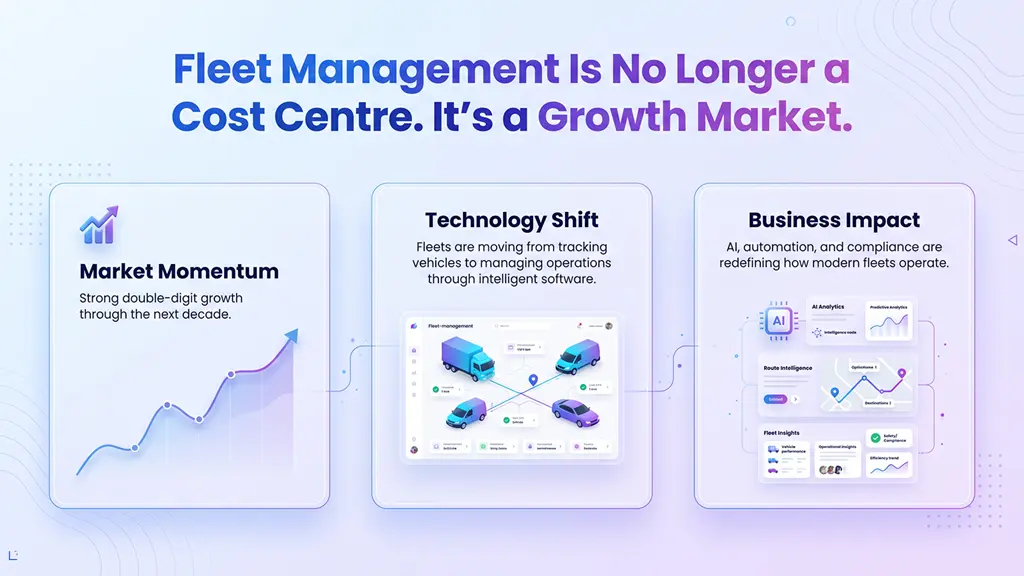
What’s Driving Fleet Management Market Growth?
Revenue Forecast and Growth Opportunity
The clearest trend is a shift from hardware to software. Tracking devices and sensors once drove most revenue. Now software and subscription-based platforms make up close to half the market value in several estimates. Global Market Insights’ breakdown shows this shift clearly. Services, installation, support, and consulting are the fastest-growing category, as fleets need more help integrating these systems.
Fleet Management Market Dynamics
Fleet Management Market Drivers
- Rising commercial vehicle fleets –More commercial vehicles are on the road as logistics, e-commerce, and industrial freight grow. This expands the total market fleet management vendors can sell into.
- Operational efficiency pressure –Fuel, driver wages, and maintenance are the biggest costs for most fleets. Even small efficiency gains save real money.
- Fleets that adopt telematics – including route optimisation, typically cut fuel use by 10% to 25%. This is according to Fleetistics’ telematics ROI analysis.
- Telematics adoption – Real-time GPS tracking has moved from a competitive advantage to a baseline expectation across commercial fleets.
- Regulatory mandates – Governments are tightening vehicle safety and emissions reporting rules, pushing fleets towards compliant tracking systems.
- E-commerce and last-mile delivery growth – Same-day and next-day delivery expectations are forcing fleets to adopt smarter dispatch and routing tools.
Fleet Management Market Challenges
- High initial implementation cost- Hardware, integration, and training costs remain a barrier for smaller fleet operators.
- Data privacy and cybersecurity concerns – As fleets collect more granular data, they also take on more exposure. Data breaches and compliance risk both grow with it.
- Legacy system integration -Many large fleets still run on ageing systems that resist clean integration with modern telematics platforms.
- Connectivity limitations – Rural and remote operating regions still face gaps in network coverage that limit real-time data transmission.
Fleet Management Market Opportunities
- Electric fleet management – EV-specific fleet tools cover charging schedules, range planning, and battery health. This is an emerging sub-category with limited mature competition.
- AI-powered fleet operations – Predictive maintenance and AI-based route optimisation are the next wave of differentiation among platforms.
- Fleet-as-a-Service models – Subscription-based, outcome-driven fleet management is gaining ground over traditional software licensing.
Fleet Management Market Trends & Insights
Fleet management market trends are worth tracking closely right now. Vendor roadmaps and buyer expectations are shifting at the same time.
- AI-powered fleet intelligence is moving from a nice-to-have to a baseline feature, particularly for predictive maintenance and anomaly detection.
- Video telematics adoption is growing as fleets pair GPS data with dashcam footage for safety and dispute resolution.
- Fleet electrification is forcing platforms to build EV-specific monitoring, since fuel-based metrics do not translate to electric fleets.
- Usage-based insurance is creating a new data-sharing relationship between fleet platforms and insurers.
- IoT-enabled monitoring, often marketed as the IoT fleet management market, is expanding beyond vehicles to trailers, containers, and other fleet-adjacent assets.
- Sustainability and ESG reporting rules are pushing fleets to track and report emissions data, not just operational metrics.
- Smart fleet management platforms combine AI, IoT, and video telematics into one system. They are increasingly replacing point solutions bought separately. For a closer look at how these shifts play out in practice, see what’s currently changing across the fleet management industry.
Practical tip: when evaluating vendors, ask which of these features a platform already supports in production. Roadmap promises are not the same thing. Several vendors market AI capabilities that are still in pilot phase.
AI & Technology Impact on the Fleet Management Market
AI is the single biggest structural shift in this market right now. It shows up in four practical ways.
- Predictive maintenance – AI models flag likely part failures before they cause a breakdown, reducing unplanned downtime.
- Driver behaviour monitoring – Machine learning spots risky driving patterns: harsh braking, speeding, distraction. This enables targeted coaching instead of blanket policy enforcement.
- Intelligent route optimisation – AI-driven routing accounts for live traffic, weather, and delivery windows at the same time. Static route planning cannot do this.
- Computer vision and dashcams – AI-enabled cameras now detect fatigue, distraction, and near-miss events in real time. They no longer just record footage for later review.
- Autonomous fleet management is still early-stage – But the same AI infrastructure built for predictive maintenance and routing today will support autonomous operations tomorrow.
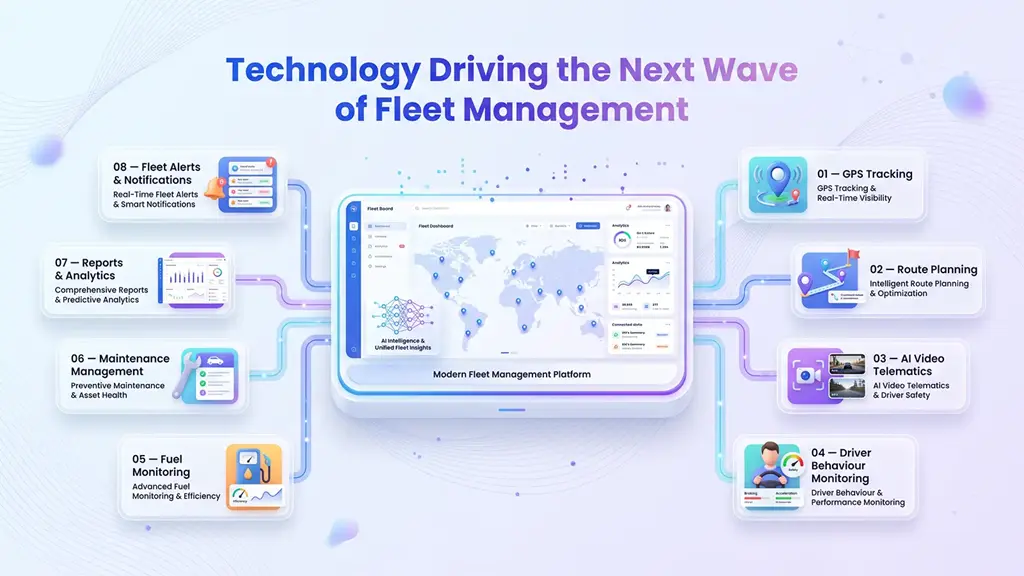
Technologies Powering Modern Fleet Operations
Fleet Management Market Segmentation
- By Component: Software leads in most estimates. It makes up close to half the market value as the shift to subscription-based models continues. Hardware still matters, but it now looks similar across most vendors.
- By Deployment: Cloud-based deployment is the fastest-growing model. It is easier to access remotely and update across multi-location fleets. On-premises still holds meaningful share where data control is a priority.
- By Vehicle Type: Commercial vehicles, trucks, vans, and heavy-duty fleets make up the majority of the market by vehicle type. This reflects how central logistics and freight are to this industry. The exact share varies widely between research firms, since each one defines the commercial vehicle category differently. We have not repeated a single precise percentage here, see the editorial note at the end of this document.
- By Solution: Real-time location monitoring is consistently the largest functional segment. Route optimisation, maintenance management, and driver behaviour monitoring follow.
- By Industry Vertical: Transportation and logistics leads adoption. Construction, government, and oil and gas follow, with retail and healthcare fleets growing steadily too.
Fleet Management Industry Adoption Analysis
- Logistics and transportation remain the largest adopters, given the direct link between fleet visibility and delivery reliability. This connection is explored in more depth in why fleet management matters specifically for logistics operations.
- Construction fleets use tracking mainly for equipment utilisation and theft prevention across scattered job sites.
- Mining and utilities rely on fleet systems for asset-heavy, safety-critical operations where downtime carries a high cost.
- Public transportation adoption is driven largely by regulatory mandates around passenger safety and route compliance.
- Oil and gas fleets use tracking for compliance and driver safety across long-haul, often remote, routes.
- Healthcare fleets are a smaller but fast-growing segment, driven by time-sensitive delivery of medical supplies and patient transport.
Fleet Management Market: Regional Insights
- North America is the largest regional market by revenue today. Both the GMI and MarketsandMarkets reports cited above point to mature telematics adoption as the main reason. Regulatory reporting requirements add to that. Within this, the US fleet management market accounts for the majority of regional revenue. Established telematics infrastructure and long-standing commercial fleet compliance rules support this.
- Europe follows closely. Adoption is driven heavily by emissions regulations and sustainability reporting mandates, under frameworks like the European Green Deal.
- Asia-Pacific is consistently flagged as the fastest-growing region. Future Market Insights projects India to grow at 17.8% CAGR and China at 16.4% CAGR through 2036. E-commerce logistics expansion and digital freight infrastructure are driving both.
- Latin America and the Middle East & Africa currently hold smaller shares of the global market. Both are showing rising adoption as logistics networks formalise and government fleet digitisation programmes expand.
India Fleet Management Market
India presents one of the more fragmented but fast-moving pictures in this space. Unlike the global figures above, most India-specific estimates sit close enough together to state with real confidence.
- Mordor Intelligence values the India fleet management software market at USD 1.91 billion in 2026, up from USD 1.69 billion in 2025. It projects USD 3.51 billion by 2031, a CAGR of 12.96%.
- IMARC Group puts the broader India market at USD 1.30 billion in 2025, growing to USD 3.04 billion by 2034, a CAGR of 9.87%.
- Marketsandata projects the fastest growth, from USD 1.54 billion in FY2024 to USD 4.79 billion by FY2032, a CAGR of 15.25%.
Taken together, these three reports support a working range. The market sits at USD 1.3 billion to USD 1.9 billion in 2025-2026. It should grow to roughly USD 3 billion to USD 4.8 billion by the early 2030s. CAGRs generally sit between 10% and 18%.
Three factors explain this growth. First, AIS 140 standards require GPS tracking and emergency alert systems in commercial and public transport vehicles. This makes fleet tracking compulsory infrastructure rather than an optional upgrade. Second, booming e-commerce and quick-commerce logistics are driving demand for hyperlocal routing and two-wheeler fleet management. Mordor Intelligence’s data reflects this too, with two-wheeler telematics as the fastest-growing vehicle category. Third, cloud-based deployment already commands a majority share of the India market. This shows how quickly Indian fleets have skipped past on-premises systems entirely.
The India market also stands out for how quickly mid-sized fleet operators, not just large enterprises, have adopted tracking systems. This is largely because AIS 140 compliance applies broadly across commercial vehicle categories. That has pulled smaller operators into digital fleet management earlier than in most other markets.
Fleet Management vs Traditional Fleet Operations
Traditional fleet operations rely on manual logs, periodic check-ins, and reactive maintenance. Modern fleet management replaces this with continuous, real-time visibility and predictive decision-making. The difference is not small. It is the gap between finding out about a problem after it happens and preventing it from happening at all.
Benefits of Fleet Management Software
The most commonly cited, measurable benefit is fuel savings. Fleets adopting telematics typically cut fuel use by 10% to 25%, per the same Fleetistics ROI analysis referenced earlier. Route optimisation is usually the single biggest driver of that saving. Beyond fuel, fleets gain compliance assurance, safer driving, and better asset use. These benefits compound over time rather than paying off once.
ROI timelines vary widely by fleet size and how mature the rollout is. We have avoided quoting one precise payback period here for that reason. Most fleets see a return within the first year. Treat any more specific number you see elsewhere with some caution unless it names its source. These gains are typically tracked against a standard set of fleet management KPIs that most operators review monthly.
Fleet Management Market: Competitive Landscape
The global market includes established players such as Geotab, Verizon Connect, Samsara, and Teletrac Navman. Trimble, MiX Telematics, Fleet Complete, Omnitracs, Azuga, and Motive round out the field. Most compete on platform depth and integration breadth rather than tracking hardware alone.
In India specifically, the landscape includes global entrants like Trimble and Geotab. It also includes strong domestic and regional players such as Tata Motors, Mahindra Telematics, LocoNav, WheelsEye, and Fleetx Technologies. This reflects a market still young enough for local players to compete meaningfully against global scale.
Fleet Management Market: Future Outlook
The next decade of fleet management will be shaped less by whether fleets adopt tracking technology. Most already have. It will be shaped more by how well that data gets used. Electrification will force a rebuild of core metrics away from fuel-based logic. AI will shift platforms from passive dashboards to active recommendation engines. Regulatory pressure, especially around emissions and safety reporting, will keep pushing adoption even in cost-sensitive segments.
Fleets that adopt these capabilities early gain a growing edge on cost and uptime. Fleets that delay face a widening gap against competitors already running on real-time data.

Frequently Asked Questions
-
What is the current size of the global fleet management market?
Estimates place the market between USD 27 billion and USD 38 billion for 2026. This range depends on scope and how each firm counts the market, but every major research firm projects steady double-digit annual growth.
-
How is AI transforming fleet management solutions?
AI powers predictive maintenance, driver behaviour analysis, and intelligent route optimisation. It also drives computer vision-based safety monitoring, shifting platforms from passive tracking to active decision support.
-
What are the key benefits of fleet management systems?
Typical benefits include 10% to 25% fuel savings after adopting telematics and faster regulatory compliance. Most fleets also see a return on investment within the first year.
-
What factors are driving the growth of the fleet management market?
Several forces are pushing growth at once. These include more commercial vehicles on the road, rising fuel and operational costs, and tighter compliance rules. E-commerce-led delivery demand and wider telematics adoption add to the pressure.
-
Which industries are adopting fleet management software the fastest?
Transportation and logistics leads adoption. Construction, government, and oil and gas follow, with a growing share also coming from retail, FMCG, and healthcare fleets.
-
What is the future outlook for the fleet management market?
The market should keep growing 13% to 19% a year through the early 2030s. AI adoption, fleet electrification, and expanding rules are driving that pace.

Apoorva Raizada is the Content Marketing Manager at TrackoBit. With over a decade of experience across media, advertising, and B2B SaaS, she brings a sharp editorial mindset to technology-led business... Read More


Related Blog
ADAS System in Cars: How It Works and Why It Matters
ADAS road safety system is a technology that uses sensors and software to detect danger and alerts the driver to…
Safer Alerts, Shareable History, Faster Maintenance in TrackoBit
TrackoBit now adds an Evidence Model and authority-based access for ADAS and DMS alerts in video telematics, Vehicle History Sharing…
Fleet Management Requirements: The Complete Guide for 2026
Every wondered what exactly fleet management requirements are? Or, why do they matter? This guide helps you understand in detail.
7 Fleet Management Best Practices Every Fleet Manager Needs
Learn 7 fleet management best practices to improve safety, vehicle utilization, efficiency, and fleet performance in 2026.


Your inbox awaits a welcome email. Stay tuned for the latest blog updates & expert insights.
"While you're here, dive into some more reads or grab quick bites from our social platforms!"Stay Updated on tech, telematics and mobility. Don't miss out on the latest in the industry.