

A territory sales manager plans and manages sales territories, field teams, customer relationships, and targets.
Field sales don’t grow on their own. They depend on how effectively a business manages its operations. This is where a territory sales manager (TSM) plays a crucial role. TSMs are responsible for managing sales activities within defined zones. They monitor field sales reps, assign territories, manage customer accounts, and ensure sales quotas are being met.
But territory sales managers face various challenges, especially with the constantly evolving nature of field sales. Expansion into new markets, customer demands, limited visibility and manual territory management can affect the work of TSMs. The best way to overcome these issues is to use field force automation software. It combines strategic planning with data-driven decision-making to maximise territory performance.
What is a Territory Sales Manager (TSM)?
A territory sales manager or TSM is responsible for managing sales operations within a defined geographical area. TSMs act as the bridge between field sales representatives and senior management, ensuring sales goals align with business objectives. TSMs help manage field sales, and their main goal is to increase revenue by:
- Increasing customer acquisition
- Improving existing client relationships
- Ensuring sales reps achieve their targets
They are also accountable for the entire territory’s growth and performance, not just individual sales reps. When a region hits or misses its targets, well… that accountability rests with the TSM.
Core Responsibilities of a Territory Sales Manager
A territory sales manager performs a combination of sales, management, planning and reporting activities. Their daily responsibilities vary depending on the industry they work in. But the core roles and responsibilities are common which are listed below.
1. Territory Planning
A territory manager divides sales regions fairly to ensure the workload is equally divided between employees. Proper territory planning also improves market coverage, prevents overlapping visits and ensures high-potential areas receive adequate resource allocation.
2. Managing Field Sales Teams
TSMs supervise field sales reps working across different locations. Their day to day on the ground includes:
- Assigning tasks
- Monitoring daily activities
- Reviewing leave
- Verifying expense claims
- Tracking attendance
- Analyse staff productivity
3. Achieving Sales Targets
One of the biggest responsibilities of TSMs is meeting sales targets. They set achievable targets for reps and track their performance regularly. TSMs implement corrective measures whenever targets are missed.
4. Customer Relationship Management
Strong customer relationships improve retention and repeat business. TSMs regularly connect with distributors, retailers, dealers, and enterprise clients to understand their requirements and resolve issues. They help build new relationships and grow existing ones.
5. Market Analysis
Understanding local market trends helps businesses stay competitive. For this TSMs analyse the following factors before creating sales strategies:
- Competitor activities
- Customer preferences
- Pricing strategies
- Market demand
6. Reporting to Senior Management
TSMs have ownership of their territories. As such, they answer to senior management with reports on territory growth, targets, customer feedback and challenges.
Essential Skills Every Territory Sales Manager Should Have

Key Skills of a Good Territory Sales Manager
A strong territory sales manager needs a diverse skill set, from leadership and communication to tech proficiency. After all, managing field sales reps is not an easy task.
1. Leadership
A TSM must be able to motivate, guide, and support field sales teams to achieve business goals.
2. Communication
Good communication skills are essential to interact well with customers, senior execs, and internal teams effectively.
3. Analytical Thinking
A territory sales manager should be able to analyse field data to:
- Generate detailed reports
- Identify market trends
- Spot gaps in field operations
- Make data-driven decisions
- Rebalance territories
4. Negotiation
Sometimes, TSMs have to personally deal with high-value clients. This involves multiple rounds of negotiation, so TSMs should be excellent at closing deals and building solid long-term client relationships.
5. Problem Solving
Field sales operations often involve unexpected challenges such as:
- Missed visits
- Customer complaints
- Territory conflicts
- Task & attendance disputes
A TSM should be able to resolve these issues quickly without succumbing to pressure.
6. Time Management
Managing multiple territories, meetings, reports, and customer interactions requires top-notch time management skills.
7. Technology Proficiency
Modern territory managers rely on various digital tools to manage operations. They should know how to use CRM software, field force management software, and territory mapping tools easily.
Challenges in the Role of Territory Sales Managers
Sales territory management can be a tough job. It involves multiple challenges like fragmented data, frequent miscommunication, and poor visibility.
1. Territory Imbalance
Not all territories are equal. A TSM in a crowded region often works more and struggles with workload compared to a TSM in an area with few but high-value clients. Yet both are often judged against similar quota targets.
2. Data Fragmentation
Handling data is one of the primary jobs of TSMs. They juggle CRM data, FFA data, various reports, customer feedback, and employee feedback. This data can have mistakes due to manual data entry. It prevents managers from getting a clear picture of what’s happening on the ground.
3. Low Budget
Expanding to new territories and using automated tools to manage sales staff can be expensive. However, TSMs often have to work with limited budgets, which makes their job difficult. They have to cut corners and work inefficiently to optimise costs.
4. Visibility Gaps
Field sales happen on the ground, at the client’s place, villages or remote areas. This can affect visibility of operations and increase the chances of fraud or inaccurate field reporting. Poor field visibility leads to gaps in field data. It further affects decision-making and performance analysis.
Success Metrics & KPIs for Territory Sales Managers
Sales, rep productivity, and zone-wise performance are the main metrics that territory sales managers have to measure. These metrics help businesses evaluate how effectively territories are managed and whether sales targets are being achieved. Some of the major KPIs for TSMs include:
- Sales Target Achievement
- Revenue Growth
- New Customers Onboarded
- Customer Retention Rate
- Territory Coverage
- Sales per Rep
- Cost per conversion
Tracking these KPIs helps TSMs identify performance gaps, optimise territory allocation, improve field productivity, and make better sales decisions.
One of the most effective ways to measure sales performance is through analytical dashboards, such as the ones provided by TrackoField. Know more about them in the following section.
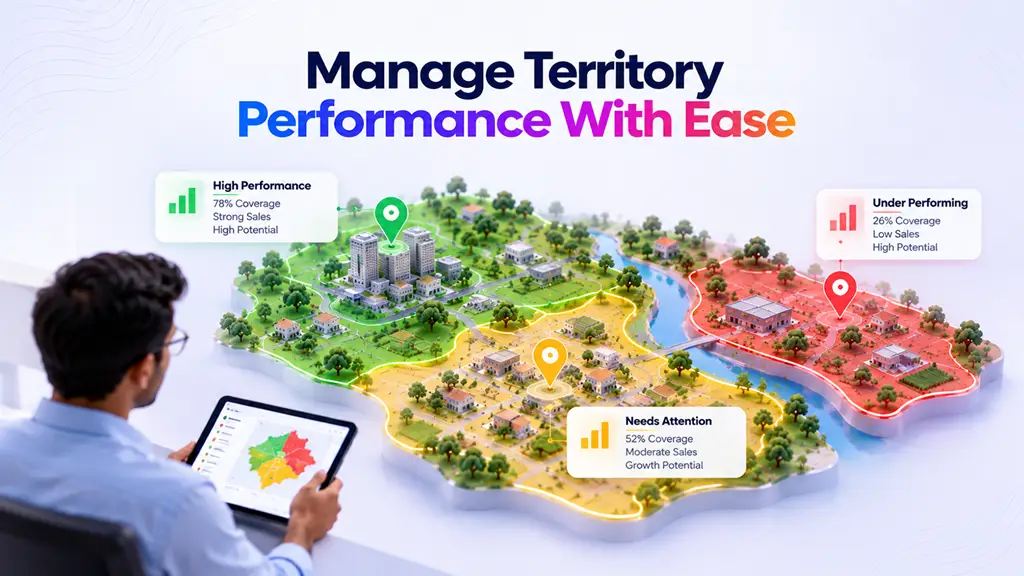
Manage Territory Performance With Reliable Field Data
How TrackoField Simplifies The Job of a Territory Sales Manager?
Automated field force management software like TrackoField allows territory sales managers to focus on revenue-generating activities instead of wasting time on admin work. It provides real-time visibility and advanced AI-powered solutions to simplify their work. TrackoField helps TSMs to:
- Track field sales reps in real time.
- Plan territories and beat routes efficiently.
- Assign and monitor tasks.
- Get AI-Powered insights with manager bot.
- Manage center operations in MFIs.
- Verify customer visits using GPS and geofencing.
- Monitor attendance and working hours.
- Analyse sales performance through dashboards.
No more scattered data. No more chasing reps for updates. Managers get all the information on a centralised dashboard.
Conclusion
Territory sales managers juggle strategy, relationship-building, and data analysis, all at once. They’re the ones driving field sales success.
TSMs handle everything from mapping territories and monitoring field sales reps to analysing their performance and building solid customer relationships. That’s how they help businesses keep growing, year after year. For this, they need to possess essential skills like leadership, communication, time management and tech proficiency. But managing several territories isn’t easy, especially remotely. Trying to do it all manually only makes it more difficult.
Field force automation software like TrackoField is the best option to tackle poor visibility, uneven workload, and slow decision-making. It offers features like territory management, real-time GPS tracking, and AI analytics. These features help TSMs gain better control of their teams, boost sales, and optimise territory coverage without inflating operational costs.

Frequently Asked Questions
-
What does a territory sales manager do daily?
On a day-to-day basis, a territory sales manager monitors sales reps, tracks orders, verifies customer data before onboarding and evaluates field data. TSMs also plan beat routes for reps, chase high-value leads, rebalance territories and identify new markets to expand into.
-
What's the difference between a TSM and an account executive?
A TSM has the ownership of a whole region across many accounts. An account executive usually manages a smaller set of named accounts or clients often without the geographical constraints that a TSM carries.
-
What tools help in territory mapping and management?
GPS tracking and geofencing are the main tools that help in mapping territories. These solutions are mostly part of a field force automation platform. They allow managers to define zones, allocate work, assign reps to territories and monitor their performance in real time.
-
What is the difference between territory manager and area sales manager?
A territory manager usually owns a smaller, single region. An area sales manager often oversees multiple territories, along with the territory managers running each one.
-
How are sales territories usually defined?
Sales territories are defined based on multiple factors. These can be geography, customer density, industry type, revenue potential or a combination of these. The goal is to properly balance the workload of sales reps and make management easier.

Mudit is a seasoned content specialist working for TrackoField. He is an expert in crafting technical, high-impact content for Field force management software With years of experience rooted in the me... Read More



Related Blog

Top Problems Faced in Smart Attendance Software & How to Solve Them
Smart attendance software helps businesses streamline attendance marking and prevent fraud using AI-powered face recognition and GPS verification.

Field Worker Safety: Complete Guide to Protect Field Staff
Wondering how to ensure field worker safety? You are in the right place. This blog explores the key risks in…

Sales Territory Management: 6 Best Practices for High-Performing Teams
Poor sales territory management can quietly stifle sales growth. Understand how companies can create high-performing territories.

TrackoField’s Manager Bot: Bringing the Future of Field Force Intelligence to You Today
TrackoField’s AI Manager Bot transforms field force management into field force intelligence by turning operational data into instant AI-powered insights.


Your inbox awaits a welcome email. Stay tuned for the latest blog updates & expert insights.
"While you're here, dive into some more reads or grab quick bites from our social platforms!"Stay Updated on tech, telematics and mobility. Don't miss out on the latest in the industry.