

Quick Summary

- Field staff training enhances productivity by equipping employees with the skills to perform tasks efficiently and accurately.
- Effective training improves the use of digital tools, allowing field staff to leverage technology for better reporting and task management.
- Training fosters accountability and data accuracy, enabling managers to track performance and make informed decisions in real-time.
- Investing in field staff training leads to faster onboarding, better customer interactions, and ultimately contributes to overall business growth.
The right field staff training approach boosts workforce productivity, cuts errors, and leads to quick digital tool adoption.
Field staff are the backbone of industries like NBFC, MFI, agri-input, BTL advertising, telecom and banking. These employees work on the ground, away from the office, and often in distributed locations. They handle sales, service, inspection, customer onboarding, and loan collections.
Since field staff mostly work without direct in-person supervision and represent the company in the field, it’s critical for them to be well-trained.
Whether it is handing customer interactions, navigating locations, conducting digital checks or KYCs, and using mobile tools for reporting, proper field staff training is essential. Employees have to be quick on the feet and be able to make decisions on the spot. Without proper training, mistakes increase and staff productivity drops.
In this blog, we’ll learn in detail about the benefits of field staff training, its challenges, and how managers should conduct them.
What is Field Staff Training?
Field staff training is the process of teaching employees how to perform their tasks correctly while working outside the office. This is critical since field staff are customer-facing, frontline workers who often represent a company.
Training typically includes operational knowledge, proper technology usage, and practical skills needed for real-world situations.
Employees learn how to use mobile apps, track tasks, update reports, and follow workflows. It’s important employees understand how to stay connected with managers while working remotely.
Why Field Staff Training is Important?
Imagine you hire a field employee for your NBFC (Non-Banking Financial Company). He has to perform tasks like borrower onboarding, document collection, payment collection, etc. Can you send him out to work on day 1 itself? No, right? The employee should first learn how to use digital tools like field force automation software.
Field work is unpredictable too. Customer requirements are ever changing. Apps may lag or glitch. Employees are required to visit remote locations with no internet. Routes get blocked frequently.
Field staff must be able to handle these situations with ease. That is only possible if they were well-trained. It helps field agents complete tasks faster with high efficiency and make fewer mistakes.
Training prepares employees for these situations. It ensures they follow the right process and use tools correctly. It also improves visibility for managers. When employees update tasks and data properly, managers can track performance in real time and take better decisions.
7 Key Benefits of Field Staff Training
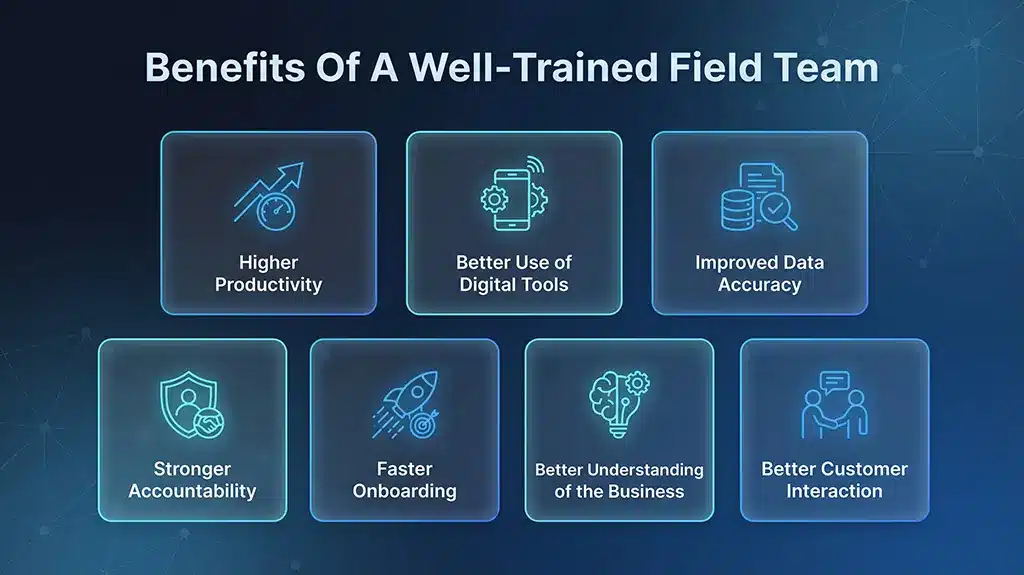
The main benefits of field staff training are higher employee productivity, better use of digital tools, stronger accountability and better customer interactions.
Benefits Of A Well-Trained Field Team
1. Higher Productivity
A trained employee is a productive employee! When employees know what to do and how to do it, they work faster with more confidence and make fewer errors. Training removes confusion and reduces time spent on planning or rework. This helps field teams complete more tasks in a day and improve overall business output.
2. Better Use of Digital Tools
Field staff use digital tools like FFA apps for tracking, reporting, and updates. Training ensures they use these tools to their full potential. This saves employees’ efforts and helps managers get real-time insights into field operations. Employees can use FFA software to easily upload documents, mark attendance, check routes, execute tasks and more.
3. Improved Data Accuracy
Accurate data is important for decision-making in any business. Training teaches employees how to capture correct information, fill forms properly, and upload updates on time. This reduces manual data errors and reduces dependence on paperwork.
4. Stronger Accountability
When employees follow structured processes and update tasks regularly, it becomes easier to track their work. Training ensures that all activities are recorded properly. This boosts accountability and reduces false reporting.
5. Faster Onboarding
Business with field workforce often face high attrition. That’s why it is important that new employees can get to work as soon as possible. A structured field staff training regimen ensures they understand tools, processes, and expectations early. It reduces dependency on managers and speeds up productivity.
6. Better Understanding of the Business
Proper knowledge transfer sessions help employees better understand how the company works, who its customers are and what its goals are. So, employees can fully focus on fulfilling business expectations instead of unrelated work.
7. Better Customer Interaction
Field staff often interact directly with customers. Training helps them better understand the types of customers they will face and what expectations they keep from the company. This allows staff to handle issues calmly and provide better service. Over time, it improves customer experience and builds trust.
9 Best Field Staff Training Programs To Boost Employee Development
The key programs and techniques managers can employ to better train their field staff include onboarding training, teaching soft skills, mobile-based learning and scenario-based training.
1. Onboarding Training
This is the first step where new employees learn about company processes, tools, and expectations. It helps them understand how field operations work and what is expected from them daily.
2. Technical Training
Employees are trained to use mobile apps, GPS tracking, task management tools, and reporting systems. This is important for businesses using field force automation platforms.
3. Safety and Compliance Training
Employees in solar industry, MFIs or NBFCs have to follow various regulations. Solar technicians install precise setups, tick off compliance guidelines and carry out safety checks. Thus, it’s important that all employees are trained to perform their tasks safely and ensuring they are compliant with local or national laws.
4. Data and Reporting Training
This focuses on standard workflows such as task execution, reporting steps, and escalation processes. It ensures consistency across teams and reduces errors in operations. The process is entirely data-driven.
Employees also learn how to capture and submit accurate data using digital tools. This includes filling forms, uploading proof of work, and maintaining proper records.
5. Soft Skills Training
Dealing with customers requires good soft skills. Not every field agent may be proficient in soft skills. Thus, ensure your learning modules include lessons on communication, problem-solving, and customer handling skills.
6. On-the-Job Practical Training
Employees learn better while performing real-world tasks. It is one of the most effective ways to improve learning. Practical learning lets staff apply their theoretical knowledge in real life. This is especially useful for solar technicians and BTL hoarding installers.
7. Mobile-Based Learning
Training modules delivered through mobile apps allow employees to learn anytime and anywhere. This is useful for distributed teams who cannot attend in-office sessions.
8. Tool-Based Training
Hands-on training on different digital tools ensures employees understand how to use features such as tracking, task updates, and reporting. This improves quick adoption of technology.
9. Peer Learning
New employees can learn from experienced team members by observing how they work. This helps them understand best practices and improves learning speed.
Plus, managers should provide regular feedback based on performance data. This helps employees improve consistently and stay aligned with business goals.
In addition to these programs, employees should also undergo mandatory refresher courses. Whether it’s to make them aware of new updates in FFA software, or changing company goals, a refresher course helps employees stay updated.
How To Train Field Staff for Better Field Management – Checklist
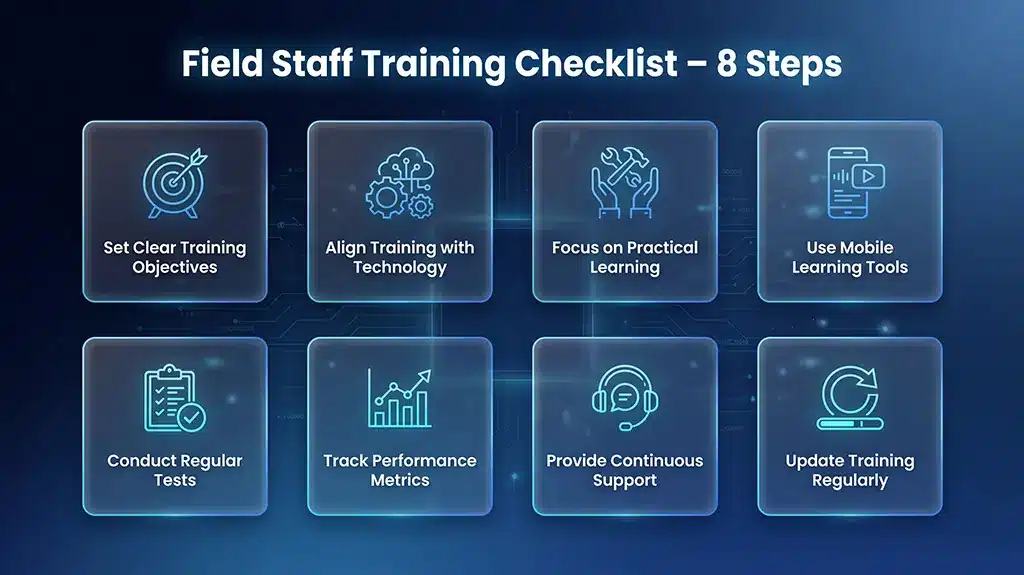
Here is a checklist managers should follow to better train their field staff and design foolproof training programmes.
Field Staff Training Checklist
1. Set Clear Objectives
Define what you want to improve in your field teams. It could be productivity, data accuracy, or task completion rates. Clear goals help design better training programmes.
2. Align Training with Technology
Ensure employees know how to use the digital tools. This includes mobile FFA apps, LMS, CRM, or ERP tools.
3. Focus on Practical Learning
Theoretical explanations even with video aren’t enough to train employees. They work mostly in the field and that’s where their training should be. Practical teaching helps employees learn to deal with different scenarios they might face during work.
4. Use Mobile Learning Tools
Provide instructions through mobile apps so employees can learn anytime. This improves accessibility and engagement.
5. Take Regular Tests
Employees should be evaluated via tests to know how quickly they are learning. Regular tests also help employees train with discipline and avoid laxity.
6. Track Performance Metrics
Measure training effectiveness using data such as task completion, error rates, and productivity. This helps identify areas for improvement early on.
7. Provide Continuous Support
Managers should guide employees regularly and provide feedback. This boosts employees’ morale and improves their performance.
8. Update Training Regularly
Companies evolve. New technologies emerge. Thus, training modules should also be updated regularly. This ensures employees stay aligned with business goals, process changes and new tools.
Conclusion
Field staff training is essential for managing modern field operations. It helps employees perform better, reduces errors, and improves efficiency.
To understand field force automation tools like TrackoField, training becomes even more important. Employees must know how to use technology along with following processes.
Businesses that invest in training build stronger field teams. They improve productivity, gain better visibility, and make faster decisions. In the long run, this leads to better performance and business growth.

Frequently Asked Questions
-
What are the real challenges of training field staff?
Training field staff is challenging because teams are spread across locations. They cannot all assemble at the same location at the same time to attend sessions. Plus, employees face changing conditions and need to learn different tools. Low digital familiarity, lack of real-time support, and no self-learning modules also make it harder to train field agents.
-
How to train a field employee with no experience?
Training field employees with no experience can be difficult but not impossible. Start with simple onboarding and explain basic tasks clearly. Use step-by-step training, mobile learning, and real use cases. Let them learn on the job with guidance from experienced staff. Provide regular feedback and support so they gain confidence and improve performance quickly.
-
How to effectively support your field employees so they work more productively?
You can support your field employees by giving them clear tasks, proper training, and easy-to-use mobile tools. Also, provide real-time support, review performance, and share feedback regularly. Ensure workload is distributed equally and resolve issues quickly.
-
What are the types of field staff training in field force management?
There are 5 main types of field staff training. These are onboarding training, technical training, compliance training, soft skills training and mobile-based learning.

Mudit is a seasoned content specialist working for TrackoField. He is an expert in crafting technical, high-impact content for Field force manage... Read More


Related Blog
Field Operations Manager: Roles, Challenges & How to Optimize Performance
Field operations managers handle on-ground activities with challenges like visibility, control, and coordination. This blog covers their roles, key challenges,…
What is Face Recognition Attendance Software & How Does It Work?
This blog explains the concept of face recognition attendance software. We will also explore how it enhances attendance monitoring for…
How TrackoField Stops GPS Spoofing and Buddy Punching in Field Teams
Your field team’s attendance data looks clean. The question worth asking is whether it’s real. Here’s how GPS spoofing actually…

Field Worker Challenges in 2026: Problems, Impact & Smart Solutions
This blog explores the major field worker challenges in 2026. Also, learn how businesses can solve these with better control…


Your inbox awaits a welcome email. Stay tuned for the latest blog updates & expert insights.
"While you're here, dive into some more reads or grab quick bites from our social platforms!"Stay Updated on tech, telematics and mobility. Don't miss out on the latest in the industry.